 For one of my classes last semester (Greek Exegetical Method), outside of translating the book of Philippians, all I did was study the original text of Philippians 1:27-30. It was a rather laborious process and task, but at the same time the study was extremely beneficial, both in helping me develop my exegetical skills and in understanding God’s word more. At the end of the semester I wrote a lengthy, and I warn you, very technical and academically minded commentary on these four verses. I certainly trust it will not only answer questions you may have concerning the text but also tell you more than you wanted to know. For those of you who know Koine Greek, you will find this more helpful than those who don’t. However, most of the technical discussion takes place in the footnotes, so even if you don’t know Greek you will still benefit from the body of this commentary (and possibly the footnotes too).
Author: Kirk E. Miller
A Mark Dever Quotation on Decisive Atonement
 On January 28th I posted a youtube video of an excerpt of a sermon by John Piper in which he described the real difference between the Arminian view of atonement (unlimited or universal) and the Calvinistic view of atonement (historically called limited atonement). (Click here to see that post). Yesterday I was reading a book by Mark Dever entitled The Gospel and Personal Evangelism. At one point in the book, Dever makes a statement in passing regarding the the decisiveness of Christ’s atonement which really hits at the crux of this “extent of the atonement” debate. Again, instead of being a debate over universal v. limited extent, the centerpiece of the issue is whether Christ’s death was a potential or effectual atonement.
The apostles clearly learned from Jesus how they were to understand his death on the cross; and to teach Christians about this, the Holy Spirit has inspired various images in the New Testament that convey the reality to us: Jesus as a sacrifice, a redemption, a reconciliation, a legal justification, a military victory, and a propitiation.
Marks of the Messenger by J. Mack Stiles
 I just finished this book yesterday. This is certainly not some high academic, grit-your-teeth-through-it book. It is written at the average person’s level, very easy to read (I read it in three days without much dedication), and very enjoyable.
The book is about evangelism, but more so, as Mark Dever says in the book’s foreward, “Mack puts the evangel [the Gospel] back in evangelism.” In other words, the main thrust of the book is not directly the idea of sharing the Gospel but understanding the Gospel and then seeing how a precise understanding of the Gospel affects the way you share it. It is an excellent book and the truths within it are surely something, as Christians, we all need to hear and be reminded of constantly. If we think we know the Gospel, we don’t know ourselves. We are inclined to forget the Gospel, neglect the Gospel, de-emphasize the Gospel, add to the Gospel (which in reality subtracts from the Gospel), distort the Gospel, tone down the Gospel, etc. We need reminders such as this.
Here is an excerpt from the last chapter of the book. I believe this portion summarize the main themes rather well.
The Paradox Isaiah 6:9-10
 This is a paper I wrote as a requirement for a class on Isaiah I took my senior year (Fall semester) at Maranatha Baptist Bible College. The introduction to the paper is as follows:
“Seminaries should train their students to preach sermons that will cause their listeners to become spiritually numb.” If one was to make such a claim, he would most assuredly be ridiculed, disregarded, and considered as absolutely ridiculous. However, a similar concept seems to exist in the words of Isaiah 6:9-10. In this passage God commands Isaiah to preach a message in order that the recipients of the message might be hardened. Should this be taken literally? Is something missing that would clarify these verses? How can one explain this? Some attempt to handle these verses by discarding or explaining away their paradoxical nature all together. However, in light of various sound explanations that will be presented, the apparent paradox in Isaiah 6:9-10 should be taken seriously.
The American Standard Version (You’ve Probably Never Heard of It)
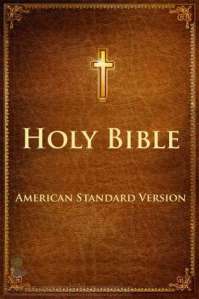 If you were to survey a wide variety of Christians as two which Bible translation they used or which translation they preferred, I am convinced the high majority of the answers you would get would be limited to the King James Version (KJV; also known as the Authorized Version, AV), the New King James Version (NKJV), the NIV (New International Version), the ESV (English Standard Version), the NASB (New American Standard Bible), the New Living Translation (NLT), or even possible the Revised Standard Bible (RSV) or the Holman Christian Standard Bible (HCSB). But one translation that has seemed to slip through the cracks is the American Standard Version (ASV). Interestingly enough, the ASV is actually the basis of three rather well known translations–the RSV (1971), Amplified Bible (1965), and the NASB (1995).
Allow me to introduce you to this version.
Continue reading
 Kirk E. Miller