 Today I was reading in The Supremacy of God in Preaching by John Piper and I ran across the paragraph below. This paragraph really seems to be just a side thought in Piper’s argument, but nonetheless, it caught my attention. Read it for yourself:
It horribly skews the meaning of the cross when contemporary prophets of self-esteem say that the cross is a witness to my infinite worth, since God was willing to pay such a high price to get me. The biblical perspective is that the cross is a witness to the infinite worth of God’s glory, and a witness to the immensity of the sin of my pride. What should shock us is that we have brought such contempt upon the worth of God that the very death of his Son is required to vindicate that worth. The cross stands in witness to the infinite worth of God and the infinite outrage of sin.
 I heard a great sermon out of Philippians 2:1-11 by Brian Trainer yesterday in chapel (2.28.2012). Here are my sermon notes:
 Every semester I have this habit of overachieving on certain projects, not for the sake of spending tons of time on them or to assure that I get a good grade, but because I like to push myself in my study of God’s word. This last semester (Fall, 2011), one of the projects in which I overachieved was a paper I wrote on church discipline for a class on pastoral counseling. This was also the semester I got married, and so things were a bit busy to say the least. But I was still able to put together a pretty substantial work. My goal was to try and set forth a rather exhaustive “system” of church discipline that takes into account all of the relevant passages and answers every practical question of which I could possibly think.
  J. Gresham Machen, at this point in my life, is probably my favorite author. Last year around this time I read his book Christianity and Liberalism. It was great. The purpose of his book was to identify liberalism (Liberal Christianity) and Christianity (Christianity that holds to the historic Christian doctrines) as two distinct religions. At one point in the book he states,
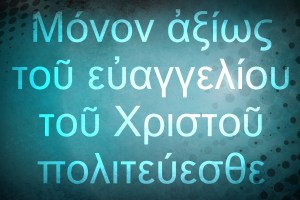 Having just posted
  Kirk E. Miller