Structure of 1 John 4:7-5:5
Explanation
1 John 4:7-5:5 is the most difficult portion of 1 John to outline. The structure, section breaks, and outline of the rest of the book are relatively much easier to discern; and there is much more agreement among scholars and preachers. However, no such consensus exists for 1 John 4:7-5:5. Commentaries, for instance, vary widely.
As I preached through this section, though, I noticed what I believe is a discernible structure with clear structural markers that I find convincing. However, I did not find this structure reflected in any of the literature (e.g., commentaries) that I read. So I wanted to document and offer it here in case it may serve valuable or convincing to others.
My three sermons on this section can be found here:
- Love is From God (1 John 4:7-11)
- Love’s Assurance (1 John 4:12-20)
- Faith Conquers for Love (1 John 4:21-5:5)
1 John 4:7-11
Claim: As we have come to know God’s love for us in the gospel, we must love one another. Those who know the God of love will necessarily be known by their love for each other.

1 John 4:12-20
Claim: As those characterized by love, we have confidence before God’s judgment that we abide in him.

1 John 4:21-5:5
Claim: As those who have conquered by trusting in Jesus, we must keep God’s commandment of love. John seeks to mobilize and encourage this command to love our fellow Christians (the church) by casting it in terms of the empowerment we’ve received in our salvation through Christ. Love is not merely a command; it is a product of our salvation.
[What follows is my own translation:]
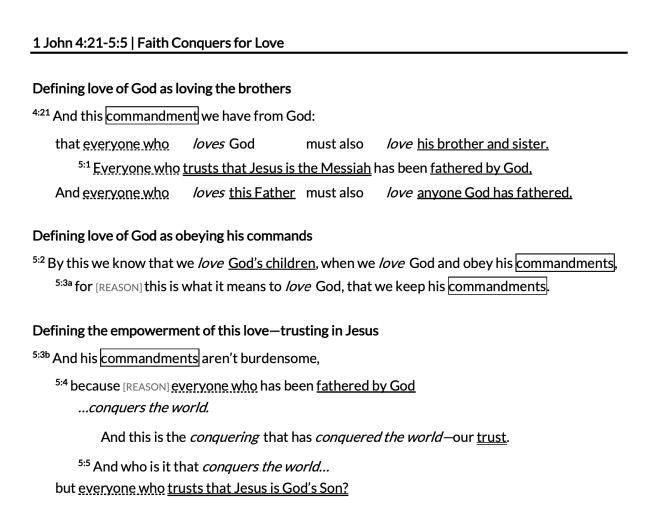
Faith Conquers for Love (1 John 4:21-5:5)

Faith Conquers for Love (1 John 4:21-5:5)
CrossWay Community Church
November 1st, 2020
Sermon follow-up:
Structure + my translation:
Should I Upgrade to Logos 9? (A Review of Logos 9)

Click here for my exclusive partner discount that includes free 5 books.
Timestamps:
- Intro (0:00).
- Dark mode (1:43).
- Factbook (3:43).
- Commentaries in Passage Guide (5:55).
- Sermon Building & Manager (7:36).
- Counseling Guide (13:51).
- Miscellaneous improvements / Reading plans (15:04).
- Charts (15:52).
- Bible Books Explorer (16:54).
- Should I upgrade? (17:58).
- Conclusion (24:31).
Reformation Day & Political Desperation
Happy Reformation Day!
On this day in 1517, Martin Luther sparked a gospel-protest (“protest-ant”), posting 95 theological assertions for debate (his “95 theses”) to the church door in Wittenberg. His goal was to reform the church. Thus, this movement would later become known as the Protestant Reformation (the protestors’ reform).
Today, known as “Reformation Day,” we remember this movement of recovering clarity on the Biblical gospel. And we praise God that the preservation and advancement of that gospel will never–can never–be thwarted.
This very point then is also a fitting reminder and lesson for us today amidst our political season, believe it or not. If ever there was a time when it felt like the true, Biblical gospel could be muffled and lost, it was probably the time of the Reformation. The Roman religious institution was dominant, not only religiously but politically; and the Biblical witness was outlawed. Could the true church survive? Would the Biblical gospel be preserved amidst such powerful opposition and persecution? Many feel similarly today, with the perceived threat of potential political outcomes.
But don’t doubt God. As Jesus said in Mt 16:18, “I will build my church, and the gates of hell will not prevail against her.” Against all human odds, the gospel prevailed and advanced during the Reformation. So today and forever, the church will survive throughout all ages, and God will always maintain a faithful witness to his gospel.
Today in our sensationalized political climate, many are be tempted to speak (argue) as if the church’s very existence hangs in the balance and hinges on certain political outcomes. If this is so, we become desperate to do whatever it takes politically to gain certain wins. But, frankly, God doesn’t need our compromised politics in order for his church to survive, and we would do well to remember that. An unfortunate irony today would be that the same folks who celebrate this truth in the Reformation might immediately turn and forget it in our politics.
Whatever comes November 3, may “the eyes of our hearts” be locked squarely on the sovereignty of God. Christ is king. And nothing can change that.
“Some trust in chariots and some in horses, but we trust in the name of the Lord our God.” – Psalm 20
 Kirk E. Miller