 In order for Fundamentalism to survive as true historic Fundamentalism, the belief in and defense of fundamental doctrines that are essential to the Christian faith, we have noted so far that Fundamentalism must embrace criticism, recognize it is in a fight for survival against internal problems, and become willing to positively critique itself for the purpose of improvement. With that said, my second “must do” for Fundamentalism is really just a branch off of that first criticism.
Fundamentalism has grown accustom to what I like to call “Fundamentalism’s great red herring”–Evangelicalism.[1] Oh, it doesn’t take too much time in many Fundamentalist camps before you hear the call against Evangelicalism. But let me say one note of caution, for the most part, Fundamentalists critique evangelicalism fairly accurately. The accuracy of their critique is, therefore, not my critique. Further, the existence of their critique is not my critique (for we ought to identify problems). My critique is that evangelicalism has become many Fundamentalists’ red herring.
Continue reading
 Dr. R.C. Sproul is founder and president of Ligonier ministries, founder and president of the Ligonier Academy of Biblical and Theological Studies, and the teaching pastor at Saint Andrew’s Chapel in Sanford, Florida. Sproul is a well equipped theologian, philosopher, and apologist. Each podcast is 26 minutes and 25 seconds, making it not excessively long or too short, and typically covers areas of theology and philosophy from an apologetic perspective. Sproul gets somewhat deep in his discussions yet still communicates in such a way that is understandable by most.
 Hell for many is an uncomfortable topic. We typically focus on attributes of God such as His love and mercy, but less and less on His holiness, justice, and yes, I’ll say it, wrath. The issue I would like to discuss here is God’s relationship to hell.
 Christians have faith in a large variety of things. We are very trusting people. For example, when we go out to eat we have faith that there is nothing wrong with the food we are eating. Or, if we fly in an large commercial airplane, we have faith in the pilot whom we most likely have never met and know no very little about. When we take extended trips we trust that the gas stations we will need to continue our journey will actually have gas despite the fact we never called a head of time to check if this is so (in fact, we don’t even check to make sure there are gas stations where we are heading; we assume and trust). The list goes on. There are countless other regular things that we never doubt or have second thoughts about.
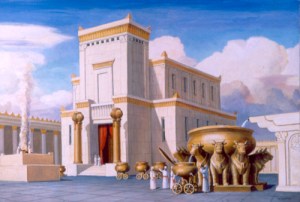 In verses 1 Corinthians 3:16-17, 6:19, and 2 Corinthians 6:16 Paul uses the Old Testament temple as a metaphor for believers. What this metaphor conveys is the comparison of our New Testament worship to that of the Old Testament. The Levitical law required sacrifices. However, now our worship demands a living sacrifice (Romans 12:1), a sacrifice of our lives. The Old Testament worship was centered on locality and the temple building. However, now worship is in spirit and in truth and no longer based on such externals such as location and buildings (John 4:20-24). And finally, just as the Shekinah glory dwelt within the temple, now the same presence of God, the Holy Spirit, dwells within us (1 Corinthians 6:19). And just as the Shekinah glory was the visible presence of God at the temple or tabernacle, so the presence of God should be visible in our lives (i.e., “the fruit of the Spirit,” Gal 5:22-23).
 Kirk E. Miller