Question: Should Christians Pledge Allegiance to a Flag?

Recent events have rekindled an old question:

Should Christians — whose ultimate and only unqualified allegiance is to Christ — pledge their allegiance to a national flag, or similarly (but maybe a little different) participate in a national anthem? This in light of the fact that a nation’s interests and activities may — and quite expectantly will — in ways conflict with one’s Christian convictions? But also this in balance with Biblical imperatives to submit to our government and give honor and respect to whom it is do (e.g., Rom 13)? (But even this — at least the imperative to submit — is not unqualified [see, for example, Acts 5:29]).

And, to nuance this properly, if Christians were to abstain from such activities, would they do so as an absolute principle (e.g., never pledging due to its inherent inappropriateness, like many anabaptists hold) or only in particular cases and for particular reasons? And if the latter, in what incidences should we abstain (e.g., one could think of a nation’s legalization of the killing of the unborn as a potential legitimization)? What criteria should we use to determine these sorts of incidences?

It would seem that most Christians would draw the line somewhere. (For example, I can’t imagine that many of us would be comfortable giving our allegiance to Nazi Germany.) As such, I’m not sure we can blankety reject the idea out of hand. We can debate the when and where; but I’m not sure we should debate if or whether.

In other words, if our response is an unthoughtful, gut reaction of “[Bleep] no, ’cause… well, ‘Merica! I’m a patriot, gosh darnit!” I’m not sure that’s the best ethical system. These are definitely things to be thought through. And — personal confession — I’ll admit, I’ve grown increasingly uncomfortable with these things (i.e., pledge of allegiance, national anthem) out of principle.

War is Atrocious

Christian, war is stupid and atrocious. And yet many arenas and features of our culture (I’m particularly looking at entertainment and nationalism here) glorify it.

Christian, don’t contribute to or take part in this glorification of war. It’s a reprehensible thing.

At best war is using lethal force to stop evil, an evil we should wish didn’t exist and need to be met with such force in the first place. At worse it’s a feud that gets taken to a sinful level where we are actually willing to kill because of it (think about that; it’s crazy!) In either case, it is the taking of precious life and is, without exception, outside of God’s original design for this world, i.e., not the way things should be, and, thus, not something we should find in any way attractive or be mesmerized by.

War, in at least certain circumstances, is a definite ethical quandary or dilemma. And I’m not trying to simplify or ignore that reality. In fact, if anything, I’m trying to do the opposite here.

So please, before anyone bombards me with any vicious comments or notifications of their offense, this post isn’t intended to discredit or dishonor servicemen and -women or necessarily to throw out any idea of just war theory or any potential cases of so-called just war (I will leave the pacism v. just war debate to another time and place).

I will just say this: the fact that we as Christians historically have felt the need to engage in such serious reflection about what–if anything–constitutes a just war speaks volumes in and of itself about the nature of war. As I like to say to my more firm just war theory friends, If you’re not at least sympathetic to pacifism, you’re probably not even a just war theorist.

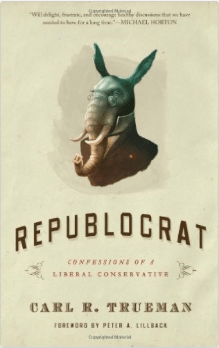
The Danger of Abortion as a Wedge Issue (Carl Trueman)

The use of abortion as a wedge issue and as a clear dividing line between Republican and Democratic parties has the potential to kill intelligent discussion on a host of other political topics.  After all, if Republican and Democrat are the only two credible electoral options in most places, then, according to many, the Christian way of voting is obvious, and it is pointless to discuss any other policies or issues.

Such an attitude is in my experience very common in Christian circles, and it is problematic for two reasons.  First, it fails to address the difference between Republican rhetoric on abortion and action on the same, which is often dramatic and serves to weaken the rather stark polarities that are often drawn between Republicans and Democrats.  Second, it preempts discussion on a host of other issues – poverty, the environment, foreign policy, etc. – and thereby runs the risk of provoking a reaction among younger evangelicals that relativizes the issue of abortion and thus achieves the opposite of what it intends.

Carl Trueman, Republocrat: Confessions of a Liberal Conservative, xx.

This is one of those cases where we have to make sure we are good and fair readers (I’m afraid we often fail in that respect…)

Notice: Trueman is not saying abortion isn’t horrendous. He’s not saying it isn’t an important political issue. Nor is he saying we shouldn’t oppose it with all of our political fiber. He’s not even necessarily saying here (he may say this elsewhere–I’m not sure; but he’s not saying it here at least) that one shouldn’t or can’t be what’s called “a single-issue voter,” if by that we mean that stances on certain issues necessarily disqualify a candidate from one’s vote (see someone like Denny Burk), not that only one issue should concern our vote (Trueman is obviously opposing that).

What he is saying, however, is that there is a danger (it’s just a danger, not an entailment) in using abortion as a litmus test for candidates. And that danger is shutting down the conversation on other important issues like foreign policy, the environment (think climate change), poverty and economic inequality, criminal justice, the racialized nature of our society, immigration, the refugee crisis, etc.

And, if I’m going to be honest, I’m afraid that’s what’s happened in much white American evangelical engagement in politics (note the recent fiasco criticizing Thabiti Anyabwile; see this Twitter thread for a good example). It would appear that abortion-as-wedge-issue has resulted in us becoming painfully partisan, in a way that results in us merely becoming pawns for a particular political party.

Lunatic, Lord, or Liar (C.S. Lewis)

The following two quotations, from Lewis’ Mere Christianity, constitute Lewis’ well known lunatic, lord, or liar argument, sometimes called Lewis’ “trilemma” or “mad, bad, or God.”

I am trying here to prevent anyone saying the really foolish thing that people often say about Him: “I’m ready to accept Jesus as a great moral teacher, but I don’t accept His claim to be God.” That is the one thing we must not say. A man who was merely a man and said the sort of things Jesus said would not be a great moral teacher. He would either be a lunatic-on a level with the man who says he is a poached egg-or else he would be the Devil of Hell. You must make your choice. Either this man was, and is, the Son of God: or else a madman or something worse. You can shut Him up for a fool, you can spit at Him and kill Him as a demon; or you can fall at His feet and call Him Lord and God. But let us not come with any patronising nonsense about His being a great human teacher. He has not left that open to us. He did not intend to.

We are faced, then, with a frightening alternative. This man we are talking about either was (and is) just what He said or else a lunatic, or something worse.

C.S. Lewis, Mere Christianity, book 2, chapter 3, paragraph 13; chapter 4, paragraph 1.

In short, Lewis argues the only two alternatives besides accepting that Jesus is God is to view him as either an immoral liar or an insane person who did not realize he was lying. Most non-Christians don’t exactly like those two alternatives to this Jesus figure who often seems to them seems like a pretty solid dude–just not God. But Lewis will have none of this riding the fence garbage. A good moral teacher would not claim to be God without actually being so. To falsely claim such, he must needs be either a lunatic or a liar. Thus, as Lewis argues, this common tact of taking Jesus as non-God, non-lord, great-moral-teacher is off the table.