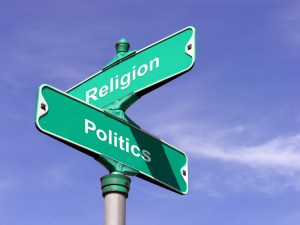
America’s Foundation, Political Science, and the Christian Worldview

AmericasFoundation

There are several areas of theology about which I find myself thinking on a consistent basis. One of those topics is the integration and relationship between the Christian worldview and political-economic science. (This probably isn’t terribly surprising given the fact that I entered college as a social studies major.) Lately, I have found myself thinking about these issues again… and on a frequent basis as well. This has much to do with some recent studying I’ve been doing on Dietrich Bonhoeffer. His views on government and the Christian’s relationship to government has sparked this internal conversation ablaze within me once again. …Well, some of these thoughts will now be spilling out in this post.

Continue reading

Metzger Critiques Evangelical-Fundamentalist View on Capitalism

I would like to recommend to you a lecture I was privileged to hear at Trinity Evangelical Divinity School via the Carl F.H. Henry Center. The lecture was presented by Dr. Paul Metzger and was entitled Downward Mobility and Trickle-Up Economics: A Trinitarian Reflection on Money and Power. In this lecture Metzger presented a critique and examination of the typical American evangelical-fundamentalist view of economics, namely capitalism, and calls for a “capitalism of a higher order.” For example, he states, “While evangelicals are engaging increasingly [in] enterprises towards the poor, they’re not advocating for political policies that would fight against the structures that make and keep people poor.” And he points out what he sees as an inconsistency between the Fundamentalist-Evangelical rejection of evolution and its survival of the fittest but acceptance of capitalism and its survival of the economic fittest.”But would it not be difficult to challenge genetic determinism and natural selection if the [evangelical-fundamentalist] movement is conflicted, promoting an equally deterministic and naturalistic [economic] system.” “Evangelicals as a movement could not be an outspoken opponent because it often assumes the free and unregulated market economic narratives as gospel truth and embraces it with blind faith. . . . Evangelicals don’t simply assume the the market’s gospel-truthfulness, they champion it.”

Continue reading

The Christian’s Proper Response to the Homosexuality Movement–Part 4

Vote Against “Gay Marriage”

In America, we have the amazing privilege of actually being a small portion of our government. But with this privilege comes the question of what we will do with the political movement that seeks to make homosexual marriage legal. Most conservative Christians would probably impulsively respond to this question by voting against laws to pass “gay marriage.” But let’s think through this, considering it is no light matter.

If homosexuality isn’t primarily a political issue but a spiritual one (see next point below), why should we be concerned with homosexuality on a political level at all? Isn’t it irrelevant whether homosexual marriage passes? If homosexuals already have the political right to practice homosexuality and live together with their homosexual partner, why should we disallow them from being seen as married in the government’s eyes? Are the said “government’s eyes” that important to us? There are several Christian moral standards that are not regulated by law for which Christians are not trying to push legislation (i.e., sex outside of marriage, lust, greed, using the Lord’s name as a curse word, homosexual practice, etc.) Is it the Christian’s duty to try to impose Christian ethics on others through the political realm? And if so, how do we determine which of our views we should seek to put into law as legal requirements? All of these questions are extremely good reasons not to immediately assume that we should vote against “gay marriage.”

Continue reading

The American Christian and Politics

Is Americanism Christian?

Was America founded on Christian principles? This is a question of much debate today, and in Christian circles we often run to our answer “yes” as if it will work as some sort of trump card, winning all moral issues in politics.

When the Articles of Confederation were tossed aside and the Constitution was being formed, our founding fathers established for us a Democratic Republic. In addition, America has tended to be very capitalistic. Our founding fathers also established for our nation various rights such as the right to bear arms and religious freedom.

Are any of these things inherently Christian? No. They are not. They are political ideologies. Our founding fathers may have been influence by Christianity, may have been Christians, and/or may have had Christian values, but that doesn’t make the political system Christian any more than Tony Dungy’s (a Christian NFL coach) football playbook a “Christian” playbook. Capitalism is no more Christian than Marxism, or vice versa; republic is no more Christian than a dictatorship, etc. So, when we say that out nation was founded on Christian principles, we cannot be speaking anything of government or political ideologies, for God does not describe any type of Christian government. He only describes one type of government—the God-given type (Rom 13:1).
Continue reading