What Does a Church Consumed for the Gospel Look Like? (Philippians 4:1-3)

The following is a sermon delivered at Lake Drive Baptist Church on Sunday morning June 14th, 2015. You will find both the audio and sermon notes below.

Podcast link.


Introduction/broader context:

Series theme/theme of Philippians To live a life consumed by the Gospel, i.e., the message of God’s saving activity in the person of Jesus.

  • Theme verse: 1:27 – “Live worthy the Gospel,” i.e., live a life consumed by and in keeping with the nature of the Gospel.
  • 2:1-11 (esp. v.5) – To be so consumed by Christ that we reflect the very humility of Christ.
  • Paul’s motto in 1:21 – “To live is Christ, and to die is gain.”

Corollary theme To be consumed by the Gospel for the Gospel, i.e., for the cause of advancing the Gospel.

  • In 1:12-26, because Paul’s motto is, “to live is Christ” (i.e., his life is consumed with Christ), he views his imprisonment as an opportunity to advance the name of Christ. –Consumed for the Gospel.
  • In his opening prayer (1:3-11), Paul speaks of the Philippians as partners with Paul in advancing the Gospel (1:5-7). –Consumed for the Gospel.
  • And through the book, Paul identifies various ways in which the Philippians are to be consumed for the Gospel. E.g., …
    • 1:27 – “Striving together for the faith of the gospel.” How? “Standing firm [i.e., steadfastness, persistence, perseverance] in one spirit, with one mind [i.e., unity, harmony].”
    • 2:14ff – They are to be “lights in the world” [i.e., a people consumed for the Gospel” by (2:14) “doing all things without grumbling or disputing [i.e., in unity]” and (2:16) “holding fast to” the Gospel [perseverance, steadfastness].

This text (Phil 4:1-3):
Continue reading

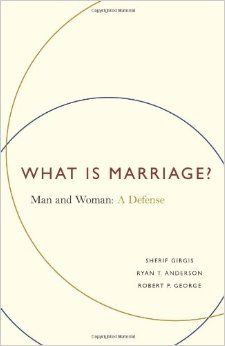
A Review of What is Marriage? Man and Woman: A Defense

The following are notes from a presentation delivered in partial fulfillment of the requirements for the course ME 8000 Contemporary Sexualities: Theological and Missiological Perspectives taught by Dr. Robert Priest and Dr. Stephen Roy at Trinity Evangelical Divinity School, October 2015.


Summary

Introduction

  • Authored by Sherif Girgis, Ryan Anderson, and Robert George.
  • Published in December 2012, about two and a half years before the Obergefell decision (June 2015).
  • Based on an article published in the Harvard Journal of Law and Public Policy.[1]
  • Considered by many to be the most formidable defense of the conjugal view of marriage and has been highly read and engaged.[2]
  • Seeks to defend the conjugal view of marriage and demonstrate its rational and therefore constitutional basis.[3] The authors argue that “redefining civil marriage is unnecessary, unreasonable, and contrary to the common good.”[4]
  • They seek to do so without appeal to religious authority[5] or historical precedent (i.e., “It’s always been this way”),[6] and only secondarily by the support from the social sciences.[7] Their argument is mainly philosophical in nature.[8]

Framework

The underlying assumption that drives the entire project is the following: To argue that gay and lesbian couples ought to have equal access to marriage assumes a priori that same-sex couples can actually constitute a marriage. But this begs the question—the question that serves as the title to this book—what is marriage? A couple is not restricted from access to marriage if that couple cannot—by definition—constitute a marriage. We cannot simply argue that everyone ought to have equal access to marriage. We first need to make a case for what that marriage is to which we think everyone, i.e., everyone who can actually constitute it, ought to have equal access. As they state very succinctly, the issue at stake here is “not about whom to let marry, but about what marriage is” (emphasis added).[9]

Continue reading

Legal Protections for the Church in Light of SOGI Rights and Laws

Gavel

The following is a paper submitted to Dr. Robert Priest and Dr. Stephen Roy in partial fulfillment of the requirements for the course ME 8000 Contemporary Sexualities: Theological and Missiological Perspectives at Trinity Evangelical Divinity School, December 2015.

** Note: This is not an opinion piece. And, therefore, I do not express my opinions about same-sex sexuality, gender dysphoria, and contemporary laws related to them in this paper. Thus, you will note, I refer to differing views on the subjects without expressing my approval or disapproval. Please do not interpret my silence in this regards as either an endorsement or condemnation of any of the herein mentioned views.


Introduction

Recent U.S. legislation and court decisions regarding sexual-orientation and gender identity (from now on SOGI) rights create a new frontier of potential legal concerns for American churches that affirm a traditional, historic view of marriage, sexuality, and gender. Although only time can tell what implications such laws will have for religious liberties,[1] as Justice Roberts said in his dissenting opinion of the Obergefell ruling, “Today’s [i.e., the Obergefell] decision . . . creates serious questions about religious liberty.”[2] From potential loss of tax-exempt status[3] to non-discrimination suits,[4] churches have reason to demonstrate concern. For example, think of the following scenarios that are now imaginable:

  • A discrimination lawsuit is filed against a church that refuses to accept a practicing gay man into its membership.
  • A church is sued for discrimination when it denies a gay couple’s request to host their wedding.
  • A church disciplines a member for unrepentant lesbian activity. She sues the church for malpractice and discrimination.
  • A church discovers that an employee is undergoing sex-realignment surgery. Is the church legally able to discharge them on these grounds?
  • A church’s pastor is sued for malpractice by an ex-counselee due to claimed damages caused by counsel to “repent of your homosexuality.”
  • A church with a housing ministry is sued for discrimination when it restricts applicants to heterosexual couples.

Continue reading

The Use of Scripture in Politics: A Comparison and Analysis of Jim Wallis and Wayne Grudem

The following is a paper submitted to Dr. Kevin Vanhoozer in partial fulfillment of the requirements for the course ST 7505 Use of Scripture and Theology at Trinity Evangelical Divinity School in December 2015 in Deerfield, Illinois.

The full title of the paper is The Use of Scripture in Evangelical Political Proposals – A Case Study: Comparing, Contrasting, and Analyzing Jim Wallis and Wayne Grudem’s Use Of Scripture to Authorize Their Distinct Approaches to Economics.

Note: I’m not the proudest of this paper. Due to time restraints I was forced to write it in the timespan of merely two days. Nonetheless, I share it in case anyone may benefit from it by its prompting critical reflection. I only ask they you read with an extra dose of grace on this one. Thank you.


Introduction

“Our guys won!” Those were the words of one of my fellow church members after Republican candidates largely swept their Democrat counterparts in the 2014 midterm elections. A neither small nor insignificant assumption was present in her statement: the Republican candidates were the evangelicals’ candidates; a victory for the Republicans meant a victory for Christendom.

Such a wedding of the religious right with the political right is not uncommon in the American evangelical consciousness, and, by extension, the perception of the popular culture at large. For example, if one listens consistently enough to Albert Mohler’s daily broadcast The Briefing,[1] one will be repeatedly “informed” that the ultimate difference between the political right and political left is one of worldview: progressive policies are spawned out of what is an unqualifiedly non-Christian worldview (either that or political liberalism is equated with theological liberalism) while political conservatism is described in such terms (and without nuance) so as to lead one to believe it is essentially a Christian (evangelical) worldview gone political.

One can trace this formalized “hypostatic union” of evangelicalism and republicanism—deeming theological conservatism and political conservatism “equally yoked,” and “deifying” the political right in the process—back to (at least) the emergence of the Moral Majority movement beginning in the 1980s with Christian leaders such as Jerry Falwell. However, authors such as Carl Trueman in his work Republocrat: Confessions of a Liberal Conservative challenge this “sacramental union” as “accident” not “essence.” As Michael Horton writes in his recommendation to Trueman’s work,

Carl Trueman points out in his witty, provocative, and deeply well-informed way [that] the alliance of conservative Christianity with conservative (neoliberal) politics is a circumstance of our own context in U.S. politics—neither historically nor logically necessary.[2]

“Amen, amen!” says fellow Brit N.T. Wright:

The combinations of issues [i.e., the bundling up of certain political issues as “conservative” and others as “liberal” and binding evangelicalism to the former] seem to make sense in America, but they don’t make sense to many people elsewhere in the world. . . .[3]

[T]he political spectrum in the United Kingdom, and indeed in Europe, is quite different from the spectrum in the United States. In Britain, issues are bundled up in different ways than in America. What’s more, over the last forty years, those in the United Kingdom who have tried to integrate faith and public life have mostly been on the left of the spectrum, while those who have done the same in the United States have tended to be on the right.[4]

“The British are coming! The British are coming!” and they are challenging our American political-religious bundlings in the process.

But lest we think these Brits are just off their rockers, interestingly a 2007 study by Baylor Religion Survey found that the more frequently one reads the Bible the more likely one is to lean politically liberal on certain issues. And, statistically, those who read their Bible’s most were found to be evangelicals—the stereotypical political conservatives. Expectedly, frequent Bible reading correlates with opposition to abortion and gay marriage. But it also surprisingly (at least given the contemporary stereotype of evangelicals) has the effect of making readers more prone to agree with political liberals on issues like criminal justice, the death penalty, environmental conservation, and, most interestingly for the purposes of this paper’s case study, social and economic justice. These results hold true “even when accounting for factors such as political beliefs, education level, income level, gender, race, and religious measures (like which religious tradition one affiliates with, and one’s views of biblical literalism).”[5]

Continue reading

Ten Principles for the Use of Scripture in Theology

Using Scripture

The following is minor paper completed in partial fulfillment of the requirements for the course ST 7505 Use of Scripture and Theology taught by Dr. Kevin Vanhoozer at Trinity Evangelical Divinity School in Deerfield, IL in December, 2015. Please note that the focus of this paper (and the class) is not hermeneutics, but the use of scripture in making dogmatic and moral theological proposals.


  1. One’s use of scripture for dogmatic and moral theology must be in keeping with the nature (ontology) and purpose (teleology) of scripture itself.[1]
  1. One’s use of scripture for dogmatic and ethical theology must share the very aims of scripture itself (and, by extension, theology), lest it distort and subvert the very nature of theology. This means that a proper use of scripture—in line with the very equipping-aims of scripture itself—must be, for example:
    • Theological (directed towards knowledge of and relationship with God), answering, “How does this text enhance knowledge of God and foster appropriate relationship with God?”
    • Doxological (directed towards the worship of God), answering, “How does this text fuel the worship of God?”
    • Mathetesical (directed towards Christian living), answering, “How does this text form disciples (mathetes)?”
    • Ecclesiological (directed towards the life of the church), answering, “How does this text shape God’s people to realize its calling?”
    • Missiological (directed towards equipping for mission), answering, “How does this text equip God’s people for mission?”
  1. If one’s use of scripture to authorize theological proposals is actually going to authorize those proposals with the authority of scripture itself (a derivative authority), one’s use must be born out of the very claims—which, one must remember, are communicated in a variety of ways through a variety of discourse forms[2]—of scripture itself (the locus of authority). Consequently, one’s appropriation of scripture for dogmatic and moral theological proposals must be based on the purpose, intent, or underlying reasoning of Biblical content, not its accidental, attendant, or purely descriptive features.[3]

Continue reading