Goodreads Review of Biblical Foundations for Baptist Churches: A Contemporary Ecclesiology by John Hammett

Biblical Foundations for Baptist Churches: A Contemporary EcclesiologyBiblical Foundations for Baptist Churches: A Contemporary Ecclesiology by John S. Hammett

My rating: 4 of 5 stars

Excellent book.

Well-written. Well-researched. Thoughtful. Generally fair to alternative positions.

One of its best strengths — thoroughly Biblical. He engages in critical exegetical and synthetical (or: systematizing) examination of scripture.

Main complaint (and I say this as one who adheres to Baptist distinctives) — I think he overestimates the clarity of scripture’s testimony to what we call “congregationalism” today, especially in his engagement with what is called “elder rule” polity. Furthermore, I think his actual case for congregationalism is weak. A better case can and should be made than the one he offers.

But, to avoid ending on a negative note — a solid book I will definitely recommend to others in the future.

View all my reviews

C.S. Lewis on the Limited Domain of Science

I’ve been reading Mere Christianity by C.S. Lewis lately. Over the next few weeks I plan on sharing some sections with some occasional commentary. (If you follow me on social media [Facebook; Twitter], you will see that I will be sharing some quotes there too.)


In Mere Christianity Lewis makes the following comment:

You cannot find out which view  is the right one by science in the ordinary sense.[1] Science works by experiments. It watches how things behave. Every scientific statement in the long run, however complicated it looks, really means something like, ‘I pointed the telescope to such and such a part of the sky at 2:20 a.m. on January 15th and saw so and-so,’ or, ‘I put some of this stuff in a pot and heated it to such -and such a temperature and it did so-and-so.’ Do not think I am saying anything against science: I am only saying what its job is. And the more scientific a man is, the more (I believe) he would agree with me that this is the job of science–and a very useful and necessary job it is too. But why anything comes to be there at all, and whether there is anything behind the things science observes–something of a different kind–this is not a scientific question. If there is ‘Something Behind,’ then either it will have to remain altogether unknown to men or else make itself known in some different way. The statement that there is any such thing, and the statement that there is no such thing, are neither of them statements that science can make. And real scientists do not usually make them. It is usually the journalists and popular novelists who have picked up a few odds and ends of half-baked science from textbooks who go in for them. After all, it is really a matter of common sense. Supposing science ever became complete so that it knew every single thing in the whole universe. Is it not plain that the questions, ‘Why is there a universe?’ ‘Why does it go on as it does?’ ‘Has it any meaning?’ would remain just as they were?

C.S. Lewis, Mere Christianity, book 1, chapter 4, paragraph 2 (emphasis added).

In short, Lewis is pointing out that science has a particular domain, and as such, has a limited object of study. It cannot, by definition of being that discipline which studies the observable (not the non-observable), reach outside of the observable into the realm of the non-observable (e.g., God) or into matters of meaning, e.g., why the observable is the way it is.

To be specific, Lewis’ comments serve as a rebuke to those who adapt the following sorts of arguments:

  • I believe what we can know through science (observation).
  • Science cannot observe God.
  • Therefore, God does exist.

(Besides the fact that this sort of argument is non sequitur) what this sort of argument fails to recognize is the limited domain of scientific study (i.e., it is limited to the observable). This form of argumentation makes a huge assumption–that science is not merely a means of gaining knowledge, but the means (i.e., the sole means) of gaining knowledge. But this is merely to preclude a prior–not by demonstration or argument, but simply out of hand, without any justification–all other means of inquiry.


Notes

[1] Here Lewis is referring to the following two views: on the one hand, a view that all there is is the material world and that there is no God, for instance (what he calls “the materialist view”), versus a view, on the other hand, that holds to a belief in a God who in some way stands behind the material world (“the religious view”).

D.A. Carson Illustrating the Difference Between Arminian and Calvinist Conceptions of Grace

In Exegetical Fallacies, D.A. Carson dismantles an analogy by which Donald Lakes seeks to deny alleged differences between the Arminian and Calvinist understandings of grace. Carson then counters with an example of his own that helpfully exemplifies the difference that is truly at play.

Donald M. Lake, for example, in attempting to argue that grace is no weaker in an Arminian system than in a Reformed system, offers us the analogy of a judge who condemns a guilty criminal and then offers him a pardon. Although the man must accept it, such acceptance, argues Lake, cannot be thought of as a meritorious work, a work that in any sense makes the man deserving of salvation. “Calvin and later Calvinists,” he adds, “never seem to be able to see this fundamental distinction unfortunately!”

But to argue that the role of grace in the two systems is not different, Lake would have to change his analogy. He would need to picture a judge rightly condemning ten criminals, and offering each of them pardon. Five of them accept the pardon, the other five reject it (the relative numbers are not important). But in this model, even though those who accept the pardon do not earn it, and certainly enjoy their new freedom because of the judge’s “grace,” nevertheless they are distinguishable from those who reject the offer solely on the basis of their own decision to accept the pardon. The only thing that separates them from those who are carted off to prison is the wisdom of their own choice. That becomes a legitimate boast. By contrast, in the Calvinistic scheme, the sole determining factor is God’s elective grace. Thus, although both systems appeal to grace, the role and place of grace in the two systems are rather different. Lake fails to see this because he has drawn an inadequate analogy; or, more likely, the inadequacy of his chosen analogy demonstrates he has not understood the issue.

D. A. Carson, Exegetical Fallacies, 2nd ed. (Carlisle, U.K.; Grand Rapids, MI: Paternoster; Baker Books, 1996), 121–122.

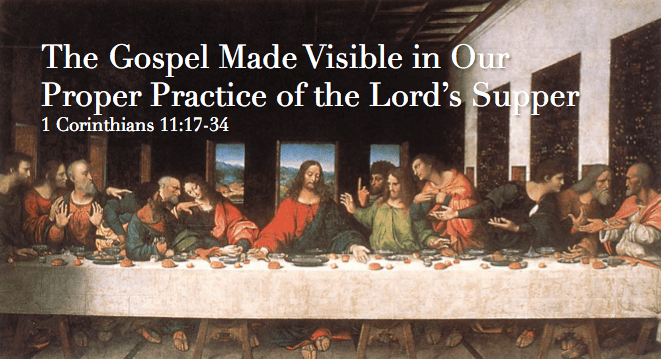
The Gospel Made Visible in Our Proper Practice of the Lord’s Supper (1 Corinthians 11:17-34)

The following was a sermon I delivered on November 22, 2015 as a guest preacher at Living Water Community Church in Vancouver, WA. Below you will find a link to the sermon audio as well as my sermon notes.


Podcast link.


Introductory illustration:

We’re aware of the fact that the clothing we wear needs to fit the occasion, event, or activity to which we wear them.

For example, when I was in high school, I worked at a restaurant. And I had to wear a uniform—this ugly purple polo shirt that felt like burlap. Or, when I refereed soccer, I didn’t just wear whatever I wanted; I wore a referee outfit.

Similarly, many of you probably have either a work uniform, a certain dress code that you have to follow, or, if you’re in school, maybe you have a school uniform.

We even have special gowns for graduating (although I’m slightly convinced that whoever invented these wanted to make graduates feel stupid—“Hey, you’re graduating. Congratulations! How ‘bout you wear this black-garbage-bag-looking thing and silly square hat. Oh! And while you’re at it, why don’t you walk across a stage while we take pictures of you? How does that sound?”).

We have these unwritten rules for what we wear and where we wear them: You don’t wear a tuxedo if you’re fixing your plumbing. And you probably don’t want to dress like Richard Simons if you’re going to a formal wedding… Or ever for that matter. And when you go shopping, you don’t wear your pajamas… well, unless, apparently, you’re shopping at Wal-Mart.

You see, there’s this recognized principle (at least among most of us) that what we wear needs to fit the occasion of the thing we’re wearing it to.

Now when it came to the Lord’s Supper for the Corinthian church, they found themselves wearing “the wrong clothes.” Of course, I don’t mean that they were literally wearing the wrong clothes. But think of this idea of clothing as an illustration—the way they practiced the Lord’s Supper did not match the meaning of the Lord’s Supper. Their practice was inappropriate for what the Lord’s Supper means. And so they found themselves “wearing the wrong clothes.”

But we too can easily find ourselves “wearing the wrong clothes” in how we practice the Lord’s Supper. We too can lose sight of the full, true, Biblical meaning of the Supper, and, consequently, practice it inappropriately.

Continue reading

We Partake of a Better Covenant (Jeremiah 31:31-34)

The following is a sermon delivered at Lake Drive Baptist Church on Sunday morning August 2nd, 2015. You will find both the audio and sermon notes below.

Podcast link.


Sermon Text: Jeremiah 31:31-34 (NASB)

31 “Behold, days are coming,” declares the Lord, “when I will make a new covenant with the house of Israel and with the house of Judah, 32 not like the covenant which I made with their fathers in the day I took them by the hand to bring them out of the land of Egypt, My covenant which they broke, although I was a husband to them,” declares the Lord.

33 “But this is the covenant which I will make with the house of Israel after those days,” declares the Lord,

“I will put My law within them
and on their heart I will write it;
and I will be their God,
and they shall be My people.
34 “They will not teach again, each man his neighbor
and each man his brother, saying,
‘Know the Lord,’
for they will all know Me,
from the least of them to the greatest of them,”
declares the Lord,
“for I will forgive their iniquity,
and their sin I will remember no more.”

Background:

Our salvation comes to us in the form of a covenant. [Pause] This may an be odd notion.

God’s purposes to save and restore his people and his creation are promised, planned, worked out, and achieved in human history beginning in the OT. And the covenants throughout the Bible structure, drive, and advance that salvation plan.

Covenant – a binding agreement involving promises and obligations. 

The Biblical covenants aim at and pursue what God’s original intention was in creation. Think about the Garden of Eden – to have a people, in a land, under God’s rule, and amidst God’s presence.Covenant with Noah – After the flood, God expresses his commitment to creation despite human sin. He will not scratch this creation project, but he will redeem it and restore it to his original design.

Continue reading