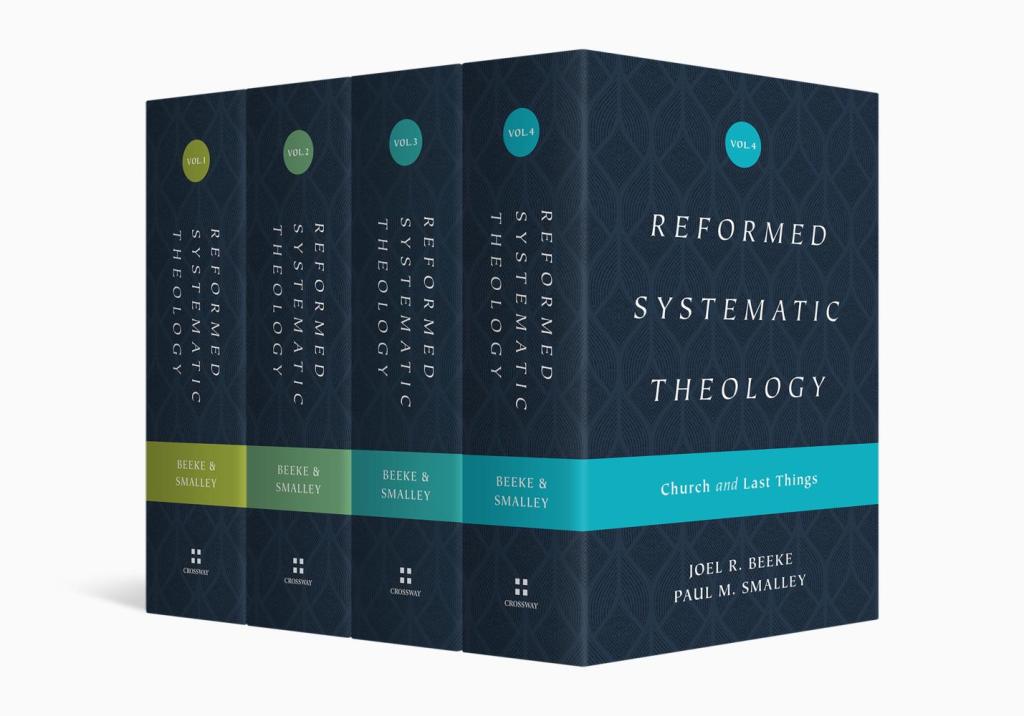
Crossway was kind enough to send me a review copy of Joel Beeke and Paul Smalley’s recently completed, four-volume Reformed Systematic Theology. Altogether it’s a hefty 5,216 pages.
I’ve created a reading plan that I thought I’d share in case others might benefit. The plan is currently set up with one chapter assigned per day, meaning one can complete all four volumes in a little less than seven months. However, one can adjust the spreadsheet according to preference.
The Christian faith consists of certain beliefs, called doctrines. And theology is the study of doctrine. Theology is important if we are to know God rightly and live in his world accordingly as those he has redeemed. Christopher Morgan’s Christian Theology: The Biblical Story and Our Faith provides a fantastic and accessible overview of our Christian beliefs.
For a while now, I’ve been on the hunt for a solid, entry-level systematic theology to use with people in my church. We have a wealth of in-depth, academic-level systematic theologies available to us today, especially for those of us in the Reformed tradition. But there’s a notable gap in literature that hits the sweet spot—at least for those of us who are Reformed and Baptist—between those more technical, lengthier works and systematic theologies that are geared to the average person in the pew.
This is partly why I think Wayne Grudem’s Systematic Theology has been so popular despite its methodological and theological problems. I’ll be honest; I’ve used it with people! It’s accessible, easy to understand, saturated with scripture, and generally takes Reformed positions. In terms of those qualities, it’s ideal for use in the church. But alas, there’s that pesky methodology (Biblicism) along with his odd (Grudem’s view of prophecy) to even straight-up aberrant (eternal subordination of the Son) theological positions at times.
So I’ve long desired a replacement, something that’s equally accessible, readable, scripture saturated, but without the problems of Grudem.
This post is part of a series entitled Key Bible and Theological Reference Tools. This series seeks to provide one with an introduction to some key Biblical and theological reference tools. In this series one will find basic explanations, significant examples, and other information about these reference tools.
Basic Description of Theologies
Generally speaking, one can divide theological reference tools into three broad categories.
Systematic Theologies – Seek to present theological material systematically according to specific categories that frame the discussion, e.g., the nature of God, the work of the Spirit, the essence of sin, etc.
Biblical Theologies – Seek to present theological material according to categories more directly related to those of the Biblical authors, books, and corpuses; seek to give special attention to the progressive unfolding of this theological material across Biblical history and the Biblical canon.
Historical Theologies – Seek to present developmnent of Christian theology throughout church history and spanning various theological traditions. Some are organized according to historical period while others are organized topically.
Shai Linne’s latest album, Lyrical Theology, Pt. 1, just released April 9th, 2013 via Lamp Mode Records. As the tile suggests, “this [album] is part one of a trilogy, with the other two albums ([Part 1: Theology,] Part 2: Doxology and Part 3: Sociology) to be released in the near future.” In this album Shai “expounds on a number of the core teachings of the historic Christian faith. Think Wayne Grudem’s ‘Systematic Theology’, but with rugged drums” (see source).


 Kirk E. Miller