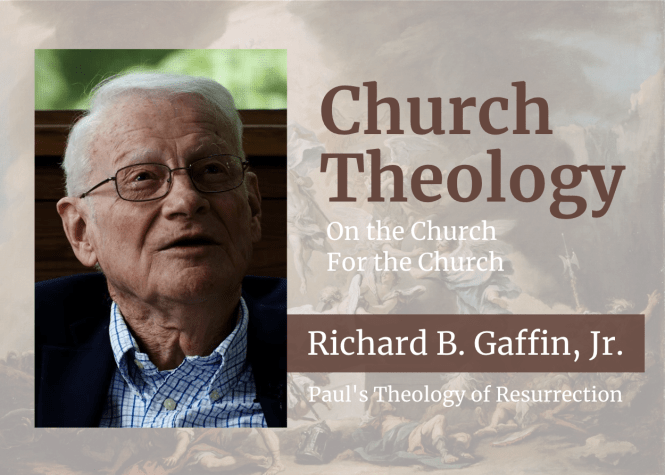
The Presence of the Future: The New Testament’s Inaugurated Eschatology (with G.K. Beale)

The Old Testament tells a unifying story of God working to restore his creation and establish his kingdom. This would finally happen permanently and irreversible at the end of history, the “last days.” But the New Testament presents this time as already having dawned in the arrival of Christ. We are living in those “last days,” as Peter said (Acts 2). Premier New Testament scholar, G.K. Beale, visits the Church Theology podcast to talk about the New Testament’s “inaugurated eschatology,” or as George Eldon Ladd put it, “the presence of the future.”

Access the episode here. (Available on Apple Podcasts, Spotify, Google Podcasts, Stitcher, and more.)

Best Children’s Books (Book Recommendation)

For this month’s book recommendation, Kirk reviews and composes a list of some of the best children’s books currently available.


Children’s Bibles

  • The Big Picture Story Bible by David Helm
  • The Biggest Story by Kevin DeYoung
  • The Biggest Story Bible Storybook by Kevin DeYoung
  • The Gospel Story Bible by Marty Machowski
  • The Jesus Storybook Bible by Sally Lloyd-Jones
  • The Beginners Gospel Story Bible by Jared Kennedy

Children’s Translations

  • New International Reader’s Version (NIrV)
  • International Children’s Bible (ICB)

Family Worship

  • The Trinity Hymnal
  • The New City Catechism
  • Family Worship by Donald Whitney

Topical Books

  • The Ology by Marty Machowski
  • Little Pilgrim’s Progress by Helen Taylor
  • The Garden, the Curtain, and the Cross by Carl Laferton
  • God’s Very Good Idea by Trillia Newbell
  • Any Time, Any Place, Any Prayer by Laura Wifler
  • God Made You and Me by Shai Linne
  • God Made Boys and Girls by Marty Machowski
  • God Made All of Me by Justin and Lindsey Holcomb
  • God Made Me Unique by Joni Eareckson Tada
  • Everything a Child Should Know about Prayer by Nancy Guthrie
  • Everyone a Child Should Know by Clare Heath-Whyte
  • Good News for Little Hearts series by Ed Welch
  • The Prince with Dirty Clothes by R.C. Sproul
  • The Poison Cup by R.C. Sproul
  • Psalm 23 by Sally Lloyd-Jones
  • Loved: The Lord’s Prayer by Sally Lloyd-Jones
  • The Lord’s Prayer by Harold L. Senkbeil
  • The Apostles Creed by Ben Myers
  • The Story of God Our King by Kenneth Padgett and Shay Gregorie
  • The Story of God with Us by Kenneth Padgett and Shay Gregorie
  • I See Jesus by Nancy Guthrie
  • That Little Voice in Your Head by Andy Naselli
  • His Grace is Enough by Melissa Kruger

Bonus: Audio

Other recommendations:

The Arrival of Salvation in the Arrival of the Son (Mark 1:1-13)

The Arrival of Salvation in the Arrival of the Son (Mark 1:1-13)
CrossWay Community Church
January 29th, 2023

Podcast link.

See all other content in this series.


Passage structure:

Themes & Theology of Mark’s Gospel (with Peter Orr)

In this episode, Kirk sits down with New Testament scholar, Dr. Peter Orr, for a conversation on theology and major themes of Mark’s Gospel. We discuss the identity of Jesus, the so-called “Messianic Secret,” the meaning of the cross and discipleship in Mark, the role of the temple in Mark, and much, much more. We hope this conversation helps you better understand the Gospel of Mark, even as you read it for yourself!

Access the episode here. (Available on Apple Podcasts, Spotify, Google Podcasts, Stitcher, and more.)

Advice for Your Friend Who Is Deconstructing

I was recently asked for advice from someone whose friend is struggling with their faith, and toying with deconstruction-type tendencies, due to failures in the Christian community. I thought I’d share my response below:


One thing that I think is important: don’t downplay or dismiss his sense of disillusionment or angst over the legit problems and failings of those in the church. As someone who very much sympathizes with many of these frustrations myself, I find it incredibly frustrating when folks simply dismiss my concerns with contemporary evangelicalism. It can be very disillusioning. Of course, the “deconstructionist” trend has lots of problems. But many (not all) of the things they are reacting to are real. I’ve met some evangelicals/fundamentalists who simply don’t seem bothered by the things others of us find deeply disturbing and unsettling. And for them to simply blow off our concerns is annoying, to say the least (often because they themselves are more sympathetic to the things we find problematic). But the problems are real. Acting like they aren’t won’t provide this man any solace. He won’t find it satisfying or convincing.

For me though, what’s been really helpful is (1) recognizing a global and historic church that goes deeper and wider than the craziness that unfortunately defines much of contemporary American evangelicalism/fundamentalism. Also, (2) recognizing that the NT predicted false teachers and problems in the church. So their existence doesn’t put in jeopardy the legitimacy of Christianity, as if for Christianity to be real the church mustn’t have issues. (3) Even the early church, which we sometimes hold up as pristine, was anything but. Look at Corinth. Or look at the messages to the churches in Revelation. As Augustine said, “The church is a whore, but she is my mother.” That quote has been a comfort to me these last few years, as odd as that may seem. (4) Also, online chatter and news reporting can give a skewed sense of reality. It highlights dramatic things, or the most radical voices. Instead (5) I want to focus on the actual flesh and blood community around me, my church. Yes, we’re not perfect, and there are folks that annoy me or are immature and in need of growth (I’m one of them). But focusing on my own community grounds me from ruminating in a downward spiral on some abstract sense of “the evangelical church.” (6) I’ve become okay with not having a particular tribe. From 2015 onward, we’ve seen conservative evangelicalism fracturing. And it was pretty painful for me, as people I thought were “my circle/tribe” clearly weren’t. It felt like betrayal. This caused me to realize how much I had valued having a tribe–but maybe in a way that wasn’t healthy. I feel more over that need now, because of these last few years, in hopefully a place that’s healthier. (7) Don’t give so much stock to evangelical leaders who say stupid stuff. Like yeah, they say stupid stuff. But why should I give them that much weight over how I think about my own faith or defining what Christianity is? Why should I let them have that sort of control over me, over Christianity? And ultimately (8) I’m a Christian because of Jesus. I follow him, not a church. And (9) I’m an evangelical because I believe this theological tradition reflects a right understanding of scripture and its gospel. I’m evangelical for convictional reasons, in other words, not sociological ones (like the state of evangelicalism).

Those are the ways I’ve dealt with this.