 Every semester I have this habit of overachieving on certain projects, not for the sake of spending tons of time on them or to assure that I get a good grade, but because I like to push myself in my study of God’s word. This last semester (Fall, 2011), one of the projects in which I overachieved was a paper I wrote on church discipline for a class on pastoral counseling. This was also the semester I got married, and so things were a bit busy to say the least. But I was still able to put together a pretty substantial work. My goal was to try and set forth a rather exhaustive “system” of church discipline that takes into account all of the relevant passages and answers every practical question of which I could possibly think. Continue reading
Christianity and Liberalism by J. Gresham Machen
 J. Gresham Machen, at this point in my life, is probably my favorite author. Last year around this time I read his book Christianity and Liberalism. It was great. The purpose of his book was to identify liberalism (Liberal Christianity) and Christianity (Christianity that holds to the historic Christian doctrines) as two distinct religions. At one point in the book he states,
Admitting that scientific objections may arise against the particularities of the Christian religion . . . the liberal theologian seeks to rescue certain of the general principles of religion, of which these particularities are thought to be mere temporary symbols, and these general principles he regards as constituting “the essence of Christianity.” . . . As a matter of fact . . . what the liberal theologian has retained after abandoning to the enemy one Christian doctrine after another is not Christianity at all, but a religion so entirely different as to belong in a distinct category.
Live Worthy of The Gospel by Means of the Gospel (Sermon on Philippians 1:27-30)
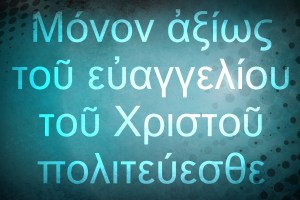 Having just posted my Greek exegetical commentary on Philippians 1:27-30, it seemed rather fitting to me to post the manuscript of a sermon I preached on Philippians 1:27-30. Unfortunately, although I’m somewhat sure the sermon was recorded, I have not been able to get a copy of the mp3 due to some difficulties. I believe the audio is lost forever. So, posting the manuscript is about all I can do. But if the audio ever shows up and I get access to it, I will surely post that as well. In either case, here is the introduction to the sermon, just to wet your whistle.
“Jesus loves me this I know, for the Bible tells me so.”
“For God so loved the world, that He sent His only begotten Son, that whosever believers in Him shall not perish but have everlasting life” (Jn 3:16).
These are things many of us have all learned from our youth, either when we were young physically or young spiritually. But have the truths of these words lost their impact on us?
Greek Exegetical Commentary on Philippians 1:27-30
 For one of my classes last semester (Greek Exegetical Method), outside of translating the book of Philippians, all I did was study the original text of Philippians 1:27-30. It was a rather laborious process and task, but at the same time the study was extremely beneficial, both in helping me develop my exegetical skills and in understanding God’s word more. At the end of the semester I wrote a lengthy, and I warn you, very technical and academically minded commentary on these four verses. I certainly trust it will not only answer questions you may have concerning the text but also tell you more than you wanted to know. For those of you who know Koine Greek, you will find this more helpful than those who don’t. However, most of the technical discussion takes place in the footnotes, so even if you don’t know Greek you will still benefit from the body of this commentary (and possibly the footnotes too).
A Mark Dever Quotation on Decisive Atonement
 On January 28th I posted a youtube video of an excerpt of a sermon by John Piper in which he described the real difference between the Arminian view of atonement (unlimited or universal) and the Calvinistic view of atonement (historically called limited atonement). (Click here to see that post). Yesterday I was reading a book by Mark Dever entitled The Gospel and Personal Evangelism. At one point in the book, Dever makes a statement in passing regarding the the decisiveness of Christ’s atonement which really hits at the crux of this “extent of the atonement” debate. Again, instead of being a debate over universal v. limited extent, the centerpiece of the issue is whether Christ’s death was a potential or effectual atonement.
The apostles clearly learned from Jesus how they were to understand his death on the cross; and to teach Christians about this, the Holy Spirit has inspired various images in the New Testament that convey the reality to us: Jesus as a sacrifice, a redemption, a reconciliation, a legal justification, a military victory, and a propitiation.
 Kirk E. Miller