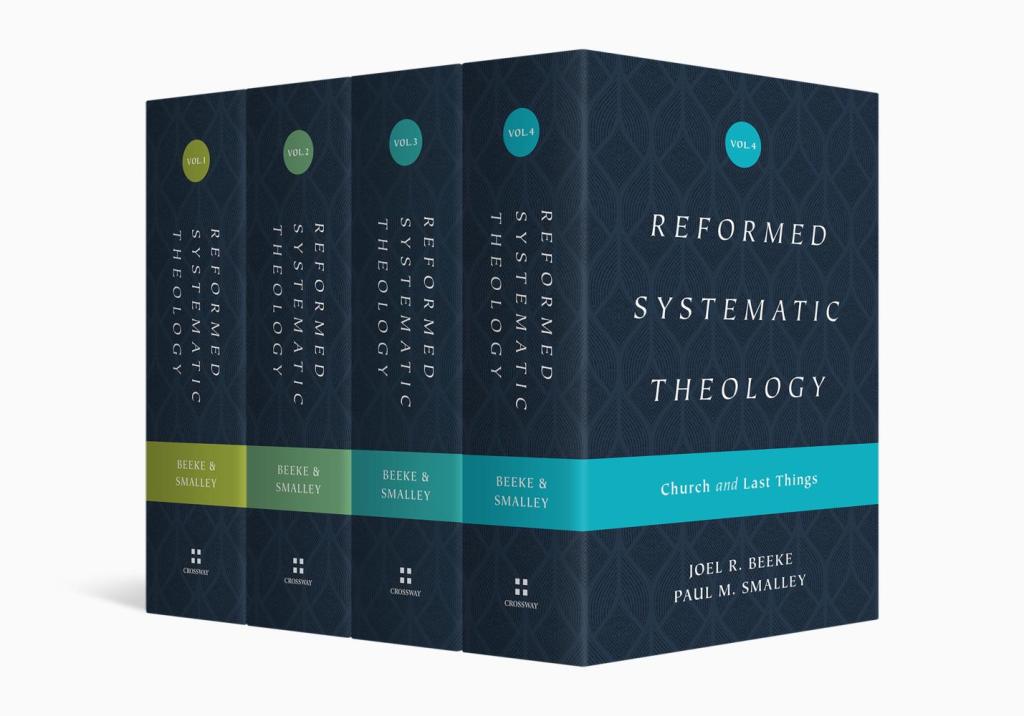
A Reading Plan: Reformed Systematic Theology by Joel Beeke and Paul Smalley

Crossway was kind enough to send me a review copy of Joel Beeke and Paul Smalley’s recently completed, four-volume Reformed Systematic Theology. Altogether it’s a hefty 5,216 pages.

I’ve created a reading plan that I thought I’d share in case others might benefit. The plan is currently set up with one chapter assigned per day, meaning one can complete all four volumes in a little less than seven months. However, one can adjust the spreadsheet according to preference.

The Chalcedonian Definition (with Stephen Wellum)

Delegates from throughout the ecumenical (universal or “catholic”) church met in Chalcedon in 451 AD to address the emergence of certain heresies surrounding the person and nature of Christ. Some were teaching that Jesus merely took on the material aspects of a human body (Apollinarianism). Others so distinguished Jesus’ humanity and divinity that they conceived of each as involving a distinct person (Nestorianism). Finally, some so emphasized Christ’s unity that they spoke of his divinity blending with his humanity to form a new mixed nature (Eutychianism or Monophysitism). The Council of Chalcedon thus responded to these errors, producing a confession of orthodoxy known as The Chalcedonian Definition (or the Symbol of Chalcedon). It affirmed that the incarnate Christ is one person with both a human and divine nature.

But why does this statement matter, and are its distinctions all that important? What, if anything, can we learn from it today? Dr. Stephen Wellum joins Kirk in this episode to discuss the meaning and significance of this important historical document.

Access the episode here. (Available on Apple Podcasts, Spotify, Google Podcasts, Stitcher, and more.)

See all other episodes in this series.

The Nicene Creed (with Matthew Barrett)

What was is The Nicene Creed and why does it matter? In this episode, Dr. Matthew Barrett joins Kirk to discuss the historical circumstances that gave rise to the creed as well as some of its central confessions. They discuss why it matters that Jesus is “of the same substance with the Father” and “eternally begotten” but “not made.” The Nicene Creed gives us categories by which to understand God’s self-revelation in scripture as it finds its center in the saving work of Christ.

Access the episode here. (Available on Apple Podcasts, Spotify, Google Podcasts, Stitcher, and more.)

See all other episodes in this series.
What Does it Mean to Be Baptist?: Baptist Distinctives, Origins, Significant Figures, and More

“What comes to mind when you hear the word “Baptist”? I asked this question online, and to no great surprise I received an array of answers. Some think of an energetic church choir with colorful robes. Others think of solemn, even stuffy Sunday services where expressions of emotion are frowned upon. Some think of fiery, revivalistic preaching complete with weekly altar calls. Others think of detailed doctrinal expositions. One friend remarked that, in his experience, when some folks try to describe Baptists, they have an easier time listing things some Baptists don’t believe in (alcohol, dancing) than providing what Baptists do believe!

These responses are all quite understandable. Baptists are a diverse bunch.

So who are Baptists? And what do Baptists actually believe? In this article, we seek to answer theses question, giving the reader a basic primer on the Baptist tradition—with a view to using its resources for one’s study of Scripture.”

Who Can Take the Lord’s Supper?: Understanding Close Communion (with Dallas Vandiver)

Who ought to be allowed to partake of the Lord’s Supper? Maybe this question has never occurred to you, or you’ve always assumed the answer was obvious! Well, in this episode, Dr. Dallas Vandiver joins me to talk about a historic position known as ‘close communion,’ that the Lord’s Supper ought to be reserved for baptized members in good standing of a gospel-believing church.

Access the episode here. (Available on Apple Podcasts, Spotify, Google Podcasts, Stitcher, and more.)


Dallas Vandiver’s book, Who Can Take the Lord’s Supper?: A Biblical-Theological Argument for Close Communion.

Dallas Vandiver’s shorter article summarizing the arguments of the book: