What makes a healthy church? In this episode of Logos Live, I talk with Mark Dever about the Bible’s vision for the church.
Church
The Keys of the Kingdom (Matthew 16:19) | Jonathan Leeman
What does Jesus mean by the “keys of the kingdom,” and to whom does he give them? Jonathan Leeman joins me on What in the Word? to discuss the Matthew 16:19.
Follow the show on YouTube, Spotify, Apple Podcasts, and more.
Ecclesial Crossbreeding: When Elders Answer to No One
Exegetical and theological differences aside:
Elder (presbuteros)-rule church government (polity) historically developed within an ecclesial ecosystem of broader presbyterian accountability structures. In other words, when the elders of a particular church (its “session”) functioned as its utmost governing body—as opposed to the congregation—those elders (session) were nonetheless governed by and accountable to its broader ecclesial system of accountability (e.g., its local presbytery, consisting of elders from other local congregations). Thus, although elder-rule existed, those elders’ authority in their church was not unchecked or absolute.
On the other side, congregational (e.g., Baptist) churches are autonomous, meaning each local church completely governs itself. It may affiliate with other churches (associations, conventions, etc.). But the church remains self-governing; there is no ecclesial authority that exists over it and governs it.
These churches have historically been congregationally governed, i.e., the members of the church (congregation) serve as the utmost governing body of the church. Certainly its congregationally appointed elders exercise a measure of delegated authority, but they remain accountable, in this case to the congregation.
In short, historically speaking both forms of elder-rule and congregational polity maintained mechanisms of accountability for its elders. Elders were never a pure, independent, unaccountable governing body in either system. In elder-rule, they had outside accountability from the elders of other churches in their denomination (known as presbyterianism). The accountability came from “above.” In congregational churches, the church (the congregation, the members) itself held them accountable. The accountability came from “below.”1
A dangerous—and from what I understand, historically aberrant and novel—iteration then are those churches that borrow from both these worlds, but thereby isolate pieces of these polities that were never meant to exist independent of their larger ecclesial commitments. Thus you get churches today that are autonomous but elder-rule. In short, the elders are not accountable to anyone, neither the congregation or an overseeing presbytery.
It’s dangerous and ripe for abuse.
Notes
- I mean “below” or “above” in terms of hierarchy, not value. ↩︎
What Does it Mean to Be Baptist?: Baptist Distinctives, Origins, Significant Figures, and More

“What comes to mind when you hear the word “Baptist”? I asked this question online, and to no great surprise I received an array of answers. Some think of an energetic church choir with colorful robes. Others think of solemn, even stuffy Sunday services where expressions of emotion are frowned upon. Some think of fiery, revivalistic preaching complete with weekly altar calls. Others think of detailed doctrinal expositions. One friend remarked that, in his experience, when some folks try to describe Baptists, they have an easier time listing things some Baptists don’t believe in (alcohol, dancing) than providing what Baptists do believe!
These responses are all quite understandable. Baptists are a diverse bunch.
So who are Baptists? And what do Baptists actually believe? In this article, we seek to answer theses question, giving the reader a basic primer on the Baptist tradition—with a view to using its resources for one’s study of Scripture.”
Who Can Take the Lord’s Supper?: Understanding Close Communion (with Dallas Vandiver)
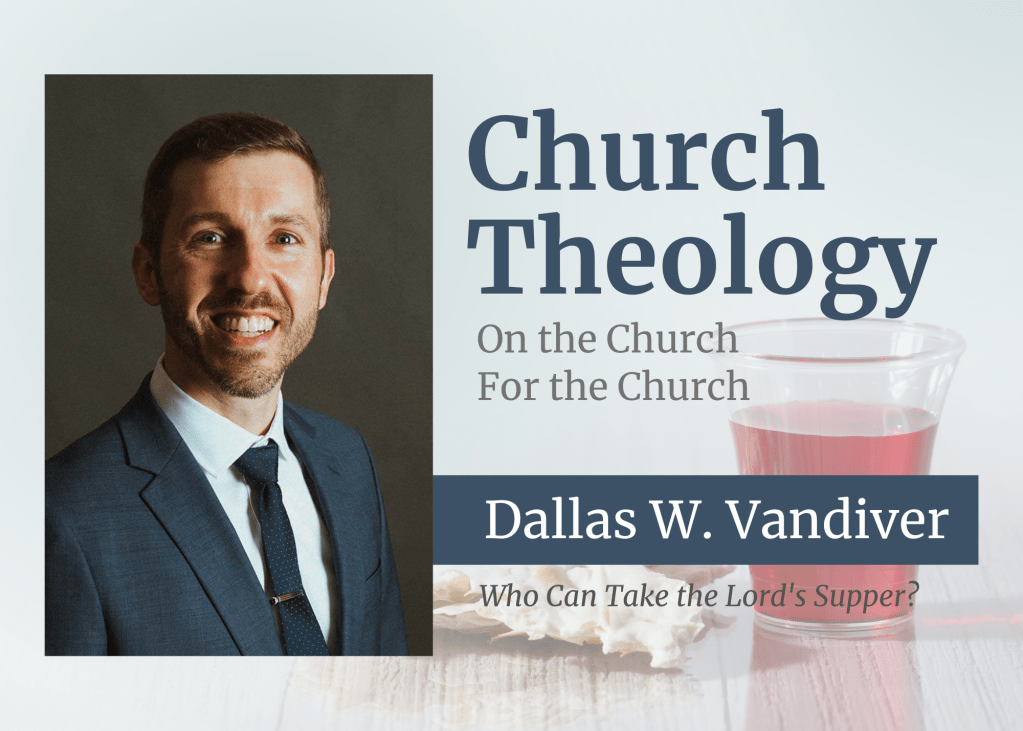
Who ought to be allowed to partake of the Lord’s Supper? Maybe this question has never occurred to you, or you’ve always assumed the answer was obvious! Well, in this episode, Dr. Dallas Vandiver joins me to talk about a historic position known as ‘close communion,’ that the Lord’s Supper ought to be reserved for baptized members in good standing of a gospel-believing church.
Access the episode here. (Available on Apple Podcasts, Spotify, Google Podcasts, Stitcher, and more.)
Dallas Vandiver’s book, Who Can Take the Lord’s Supper?: A Biblical-Theological Argument for Close Communion.
Dallas Vandiver’s shorter article summarizing the arguments of the book:
 Kirk E. Miller