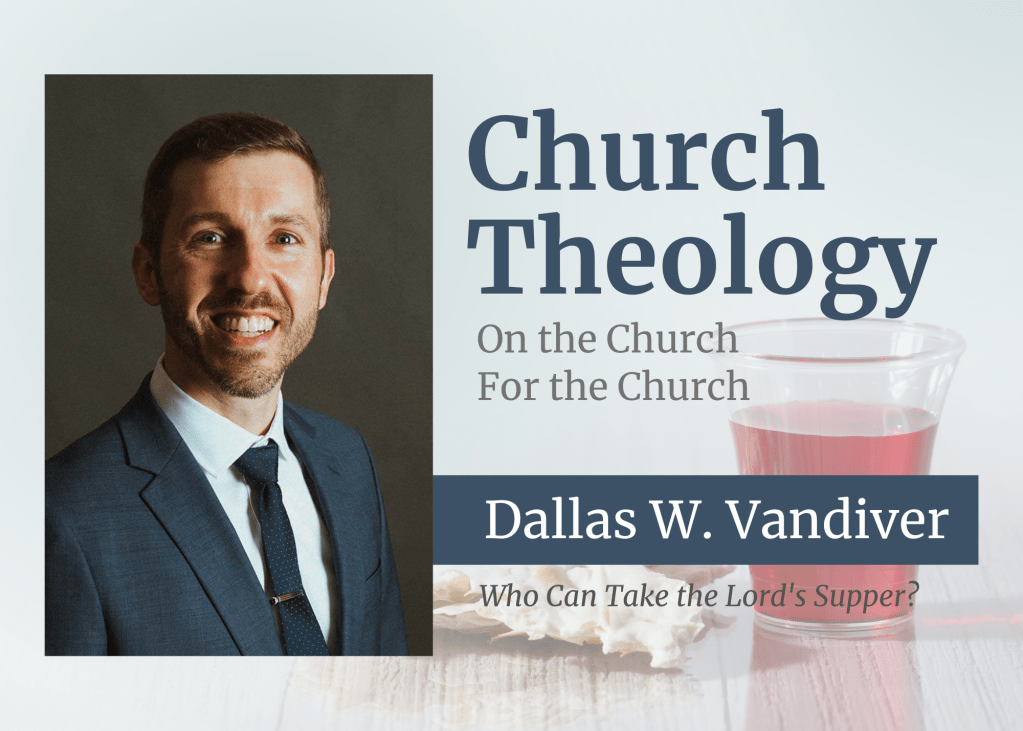
Who Can Take the Lord’s Supper?: Understanding Close Communion (with Dallas Vandiver)

Who ought to be allowed to partake of the Lord’s Supper? Maybe this question has never occurred to you, or you’ve always assumed the answer was obvious! Well, in this episode, Dr. Dallas Vandiver joins me to talk about a historic position known as ‘close communion,’ that the Lord’s Supper ought to be reserved for baptized members in good standing of a gospel-believing church.

Access the episode here. (Available on Apple Podcasts, Spotify, Google Podcasts, Stitcher, and more.)


Dallas Vandiver’s book, Who Can Take the Lord’s Supper?: A Biblical-Theological Argument for Close Communion.

Dallas Vandiver’s shorter article summarizing the arguments of the book:

Why Baptism is Required for Church Membership (with Bobby Jamieson)

Why does our church, and churches like ours, require people to be baptized before we will admit them as members of our church? Today Kirk is joined by Bobby Jamieson, associate pastor at Capitol Hill Baptist Church in Washington, D.C., to discuss the Biblical and theological reason for this practice.

Access the episode here. (Available on Apple Podcasts, Spotify, Google Podcasts, Stitcher, and more.)

Closed Membership & Close Communion in Baptist Confessions & Catechisms

The First London Confession of Faith (1644)

“Jesus Christ hath here on earth a spiritual kingdom, which is His Church, whom He hath purchased and redeemed to Himself as a peculiar inheritance; which Church is a company of visible saints, called and separated from the world by the word and Spirit of God, to the visible profession of faith of the gospel, being baptized into that faith, and joined to the Lord, and each other, by mutual agreement in the practical enjoyment of the ordinances commanded by Christ their head and king.”

“Baptism is an ordinance of the New Testament, given by Christ, to be dispensed upon persons professing faith, or that are made disciples; who upon profession of faith, ought to be baptized, and after to partake of the Lord’s Supper.

“That the way and manner of dispensing this ordinance, is dipping or plunging the body under water; it being a sign, must answer the things signified, which is, that interest the saints have in the death, burial, and resurrection of Christ.”

[Implicates closed membership. Makes explicit close communion.]

Benjamin Cox’s Appendix to the First London Confession (1646)

“Although a true believer, whether baptized, or unbaptized be in the state of salvation, and shall certainly be saved: yet in obedience to the command of Christ every believer ought to desire baptism, and to yield himself to be baptized according to the rule of Christ in His word: And where this obedience is in faith performed, there Christ makes this His ordinance a means of unspeakable benefit to the believing soul. Acts 2:38, 22:16; Rom. 6:3,4; I Pet. 3:21. And a true believer that here sees the command of Christ lying upon him, cannot allow himself in disobedience thereunto, Acts 24:16.”

“Believers baptized ought to agree and join together in a constant profession of the same doctrine of the Gospel, and in professed obedience thereunto, and also in fellowship, and in breaking of bread, and in prayers. Acts 2:42. And a company of baptized believers so agreeing and joining together are a church or congregation of Christ, Acts 2:47.”

[Assuming the First London Confession’s definition of baptism, this implicates closed membership.]

“Though a believer’s right to the use of the Lord’s Supper doth immediately flow from Jesus Christ apprehended and received by faith, yet in as much as all things ought to be done not only decently, but also in order; I Cor. 14:40, and the word holds forth this order, that disciples should be baptized. Matt. 28:19; Acts 2:38, and then be taught to observe all things (that is to say, all other things) that Christ commanded the Apostles, Matt. 28:20, and accordingly the Apostles first baptized disciples, and then admitted them to the use of the Supper, Acts 2:41,42, we therefore do not admit any to the use of the Supper, nor communicate with any in the use of this ordinance, but disciples [having once been] baptized, lest we should have fellowship with them in their doing contrary to order.”

[Makes explicit close communion.]

Continue reading