Goodreads Review of Four Views on Moving beyond the Bible to Theology by Stanley N. Gundry

Four Views on Moving beyond the Bible to TheologyFour Views on Moving beyond the Bible to Theology by Stanley N. Gundry

My rating: 4 of 5 stars

As always, these multiple views books can be a bit disjointed, especially when the editors fail to ensure that all the contributors are the same page (which they often do; come on, editors!). This book is probably a little guilty of some of that, because, as Al Wolters demonstrates on his essay, the contributors seem to mean different things by “moving beyond the Bible.” Thus, at times, the work is less of a presentation on competing views–although there is certainly some of that–and more of a collection of generally complementary essays addressing a range of related issues.

Overall, though, I felt like this book was one of the better multiple views books I’ve read. The essays were overall well written, provocative, and stimulating.

View all my reviews

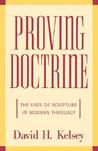
Goodreads Review of Proving Doctrine: The Uses of Scripture in Modern Theology by David Kelsey

Proving Doctrine: The Uses of Scripture in Modern TheologyProving Doctrine: The Uses of Scripture in Modern Theology by David H. Kelsey

My rating: 2 of 5 stars

I get the impression I am less enamored with this book than others I know.

First — No doubt, Kelsey excellently and insightfully frames the discussion of what it means to “be Biblical,” and “use scripture to authorize theological proposals,” etc. His posing questions and identification of the issues involved in this task of moving from scripture to theology are fantastic. However, I am less impressed and satisfied with his assessment of how one might go about answering those questions or navigating those issues. I would recommend John Frame’s critical review (http://www.frame-poythress.org/review…). Frame summarizes my thoughts well: “Kelsey has written something which deserves to be criticized at this length. He has elevated discussion of these matters to a new height of sophistication. His insights are indispensable, his mistakes eminently worth thinking about.”

Second — For a book that seeks to bring clarity to the discussion–and it certainly does much of that!–I think the book ironically suffers from being somewhat unclear and vague at points.

In short, I have rather mixed feelings about this book. That is why I gave it 2 stars–“it was ok.” I certainly benefitted from reading it. And it has definitely launched me on a new adventure of thinking through these issues.

View all my reviews

Goodreads Review of Bible, Gender, Sexuality: Reframing the Church’s Debate on Same-Sex Relationships by James Brownson

Bible, Gender, Sexuality: Reframing the Church's Debate on Same-Sex RelationshipsBible, Gender, Sexuality: Reframing the Church’s Debate on Same-Sex Relationships by James V. Brownson

My rating: 3 of 5 stars

If you hold to the traditional, historic Christian position on same-sex relationship (like myself), this is a fantastic book to read in order to engage with the best of the revisionist position. It is well written, structured, and formatted. And his position, although one with which I disagree, is one with which to wrestle. In other words, this is not a “pop” apologetic of the revisionist position. This is a rather scholarly defense. (Don’t read this if you merely want to be able to “straw man” the revisionist view.) I find its position unconvincing and unacceptable; but this position that I hold to be dangerously wrong is nonetheless well presented and argued here. It serves as a fantastic representation of the revisionist position. And it would greatly serve as a catalyst for strengthening and forming a well thought out traditional position on marriage and sexuality. With that said, even though I disagreed with Brownson’s final proposals, I nonetheless learned from him and agreed with much he had to say leading up to those conclusions.

View all my reviews

Goodreads Review of Freedom of the Will by Jonathan Edwards

Freedom of the WillFreedom of the Will by Jonathan Edwards

My rating: 5 of 5 stars

Absolutely brilliant!

Not any easy read by any stretch of the imagination. But what is given up in ease of ready is made up for in philosophical precision and leaving no stone unturned.

I can see how JE could be misunderstood as advocating a rather mechanistic view of human volition since he does argue for determinism. But in my understanding, that would be to misunderstand the fundamental premise of JE’s view–that man’s volitions, BECAUSE THEY ARE TRULY THE VOLITIONS OF MAN, are absolutely necessary as necessitated by man’s desire.

As JE himself says, “Nothing that I maintain, supposes that men are at all hindered by any fatal necessity, from doing, and even willing and choosing, as they please, with full freedom; yea, with the highest degree of liberty that ever was thought of, or that ever could possibly enter into the heart of any man to conceive.”

View all my reviews

Review of Grief Counseling and Grief Therapy by J. William Worden

Summary

In Grief Counseling and Grief Therapy: A Handbook for the Mental Health Practitioner (4th ed.), J. William Worden provides an introduction to bereavement/loss, grief, mourning, and providing grief counseling or therapy. Worden defines grief to be the experience one goes through during a loss (and specifically for the purpose of this book, the loss of a loved one due to death). Mourning indicates the process one undergoes as he or she endeavors to adapt to a loss. And bereavement may be understood as referring to the specific loss to which the mourning individual is trying to adapt.[1]

Worden begins by addressing the concept of attachment. According to Worden, grief is rather incomprehensible or unexplainable a part from attachment. Attachment—“the tendency in human beings to create strong affectional bonds”— to someone (or something) is what makes the loss of that something (or someone) something that needs to be grieved.[2]

Worden distinguishes between normal (or uncomplicated) and abnormal (or complicated) grief. Normal grief may entail or be accompanied by a large variety of emotions, thoughts, and behaviors such as sadness, anger, guilt, depression-like symptoms, shock, preoccupation, various somatic sensations and distresses, insomnia, etc.[3] Worden stresses the importance of recognizing this broad range of experiences (including those that may seem rather odd or abnormal according to everyday experience) “so that they [counselors] do not pathologize behavior that should be recognized as normal.”[4] What makes abnormal grief abnormal, according to Worden, is not the presence of experiences that may seem bizarre compared to regular functional existence, but the intensity and duration of otherwise normal grief-reactions.[5] Thus, abnormal grief includes the following expressions: chronic grief—grief that is excessive in length or lacks resolution; delayed grief—postponed, inhibited, or suppressed grief reactions; exaggerated grief, which involves excessive intensification of the grief experience resulting in maladaptive behavior or feelings of being overwhelmed; and masked grief, where grief reactions are expressed in covert forms.

Continue reading