Goodreads Review of Biblical Foundations for Baptist Churches: A Contemporary Ecclesiology by John Hammett

Biblical Foundations for Baptist Churches: A Contemporary EcclesiologyBiblical Foundations for Baptist Churches: A Contemporary Ecclesiology by John S. Hammett

My rating: 4 of 5 stars

Excellent book.

Well-written. Well-researched. Thoughtful. Generally fair to alternative positions.

One of its best strengths — thoroughly Biblical. He engages in critical exegetical and synthetical (or: systematizing) examination of scripture.

Main complaint (and I say this as one who adheres to Baptist distinctives) — I think he overestimates the clarity of scripture’s testimony to what we call “congregationalism” today, especially in his engagement with what is called “elder rule” polity. Furthermore, I think his actual case for congregationalism is weak. A better case can and should be made than the one he offers.

But, to avoid ending on a negative note — a solid book I will definitely recommend to others in the future.

View all my reviews

A Review of What is Marriage? Man and Woman: A Defense

The following are notes from a presentation delivered in partial fulfillment of the requirements for the course ME 8000 Contemporary Sexualities: Theological and Missiological Perspectives taught by Dr. Robert Priest and Dr. Stephen Roy at Trinity Evangelical Divinity School, October 2015.


Summary

Introduction

  • Authored by Sherif Girgis, Ryan Anderson, and Robert George.
  • Published in December 2012, about two and a half years before the Obergefell decision (June 2015).
  • Based on an article published in the Harvard Journal of Law and Public Policy.[1]
  • Considered by many to be the most formidable defense of the conjugal view of marriage and has been highly read and engaged.[2]
  • Seeks to defend the conjugal view of marriage and demonstrate its rational and therefore constitutional basis.[3] The authors argue that “redefining civil marriage is unnecessary, unreasonable, and contrary to the common good.”[4]
  • They seek to do so without appeal to religious authority[5] or historical precedent (i.e., “It’s always been this way”),[6] and only secondarily by the support from the social sciences.[7] Their argument is mainly philosophical in nature.[8]

Framework

The underlying assumption that drives the entire project is the following: To argue that gay and lesbian couples ought to have equal access to marriage assumes a priori that same-sex couples can actually constitute a marriage. But this begs the question—the question that serves as the title to this book—what is marriage? A couple is not restricted from access to marriage if that couple cannot—by definition—constitute a marriage. We cannot simply argue that everyone ought to have equal access to marriage. We first need to make a case for what that marriage is to which we think everyone, i.e., everyone who can actually constitute it, ought to have equal access. As they state very succinctly, the issue at stake here is “not about whom to let marry, but about what marriage is” (emphasis added).[9]

Continue reading

Goodreads Review of Four Views on Moving beyond the Bible to Theology by Stanley N. Gundry

Four Views on Moving beyond the Bible to TheologyFour Views on Moving beyond the Bible to Theology by Stanley N. Gundry

My rating: 4 of 5 stars

As always, these multiple views books can be a bit disjointed, especially when the editors fail to ensure that all the contributors are the same page (which they often do; come on, editors!). This book is probably a little guilty of some of that, because, as Al Wolters demonstrates on his essay, the contributors seem to mean different things by “moving beyond the Bible.” Thus, at times, the work is less of a presentation on competing views–although there is certainly some of that–and more of a collection of generally complementary essays addressing a range of related issues.

Overall, though, I felt like this book was one of the better multiple views books I’ve read. The essays were overall well written, provocative, and stimulating.

View all my reviews

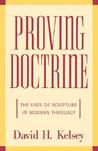
Goodreads Review of Proving Doctrine: The Uses of Scripture in Modern Theology by David Kelsey

Proving Doctrine: The Uses of Scripture in Modern TheologyProving Doctrine: The Uses of Scripture in Modern Theology by David H. Kelsey

My rating: 2 of 5 stars

I get the impression I am less enamored with this book than others I know.

First — No doubt, Kelsey excellently and insightfully frames the discussion of what it means to “be Biblical,” and “use scripture to authorize theological proposals,” etc. His posing questions and identification of the issues involved in this task of moving from scripture to theology are fantastic. However, I am less impressed and satisfied with his assessment of how one might go about answering those questions or navigating those issues. I would recommend John Frame’s critical review (http://www.frame-poythress.org/review…). Frame summarizes my thoughts well: “Kelsey has written something which deserves to be criticized at this length. He has elevated discussion of these matters to a new height of sophistication. His insights are indispensable, his mistakes eminently worth thinking about.”

Second — For a book that seeks to bring clarity to the discussion–and it certainly does much of that!–I think the book ironically suffers from being somewhat unclear and vague at points.

In short, I have rather mixed feelings about this book. That is why I gave it 2 stars–“it was ok.” I certainly benefitted from reading it. And it has definitely launched me on a new adventure of thinking through these issues.

View all my reviews

Goodreads Review of Bible, Gender, Sexuality: Reframing the Church’s Debate on Same-Sex Relationships by James Brownson

Bible, Gender, Sexuality: Reframing the Church's Debate on Same-Sex RelationshipsBible, Gender, Sexuality: Reframing the Church’s Debate on Same-Sex Relationships by James V. Brownson

My rating: 3 of 5 stars

If you hold to the traditional, historic Christian position on same-sex relationship (like myself), this is a fantastic book to read in order to engage with the best of the revisionist position. It is well written, structured, and formatted. And his position, although one with which I disagree, is one with which to wrestle. In other words, this is not a “pop” apologetic of the revisionist position. This is a rather scholarly defense. (Don’t read this if you merely want to be able to “straw man” the revisionist view.) I find its position unconvincing and unacceptable; but this position that I hold to be dangerously wrong is nonetheless well presented and argued here. It serves as a fantastic representation of the revisionist position. And it would greatly serve as a catalyst for strengthening and forming a well thought out traditional position on marriage and sexuality. With that said, even though I disagreed with Brownson’s final proposals, I nonetheless learned from him and agreed with much he had to say leading up to those conclusions.

View all my reviews