“It is the the doers of the law who will be justified” (Rom 2:13): G.K. Beale on Justification according to Works

In A New Testament Biblical Theology: The Unfolding of the Old Testament in the New, G.K. Beale asks, “How can believers be said to be judged by works and yet be justified by faith?” (e.g., Rom 2:13; Js 2:14-26; cf. Rom 3:28)

In the process of answering his question concerning what Beale tactfully calls this “consummate, manifestive stage of justification” (i.e., the justification according to works of which scripture speaks), Beale gives the following helpful illustration to help us understand this “twofold justification.”

A mundane illustration may help to clarify. In the United States, some large discount food stores require people to pay an annual fee to have the privilege of buying food at their store. Once this fee is paid, the member must present a card as evidence of having paid the fee. The card gets the members into the store, but it is not the ultimate reason that the person is granted access. The paid fee is the ultimate reason, the card being the evidence that the fee has been paid. We may refer to the paid fee as the “necessary causal condition” of store entrance and to the evidential card more simply as a “necessary condition.” The card is the external manifestation or proof that the price has been paid, so that both the money paid and the card issued are necessary for admittance, but they do not have the same conditional force for gaining entrance. We may call the paid fee a “first order” or “ultimate” condition and the card a “second order” condition.

He concludes,

Likewise, Christ’s justifying penal death is the price paid “once for all” (Heb. 9:12; cf. 9:26–28), and the good works done within the context of Christian faith become the inevitable evidence of such faith at the final judicial evaluation. Christ’s work is the “necessary causal condition” for justification, and the believer’s works are a “necessary condition” for it. Jonathan Edwards helpfully referred to Christ’s work as “causal justification” and the believer’s obedience at the end of the age as “manifestive justification.” This manifestive evidence not only is part of a judicial process but also becomes evidence that overturns the wrong verdict of the world on believers’ faith and works done in obedience to Christ.

G. K. Beale, A New Testament Biblical Theology: The Unfolding of the Old Testament in the New (Grand Rapids, MI: Baker Academic, 2011), 506–507.
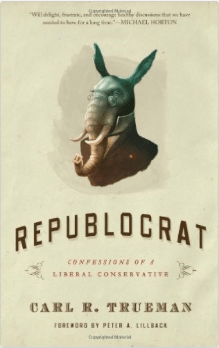
The Danger of Abortion as a Wedge Issue (Carl Trueman)

The use of abortion as a wedge issue and as a clear dividing line between Republican and Democratic parties has the potential to kill intelligent discussion on a host of other political topics.  After all, if Republican and Democrat are the only two credible electoral options in most places, then, according to many, the Christian way of voting is obvious, and it is pointless to discuss any other policies or issues.

Such an attitude is in my experience very common in Christian circles, and it is problematic for two reasons.  First, it fails to address the difference between Republican rhetoric on abortion and action on the same, which is often dramatic and serves to weaken the rather stark polarities that are often drawn between Republicans and Democrats.  Second, it preempts discussion on a host of other issues – poverty, the environment, foreign policy, etc. – and thereby runs the risk of provoking a reaction among younger evangelicals that relativizes the issue of abortion and thus achieves the opposite of what it intends.

Carl Trueman, Republocrat: Confessions of a Liberal Conservative, xx.

This is one of those cases where we have to make sure we are good and fair readers (I’m afraid we often fail in that respect…)

Notice: Trueman is not saying abortion isn’t horrendous. He’s not saying it isn’t an important political issue. Nor is he saying we shouldn’t oppose it with all of our political fiber. He’s not even necessarily saying here (he may say this elsewhere–I’m not sure; but he’s not saying it here at least) that one shouldn’t or can’t be what’s called “a single-issue voter,” if by that we mean that stances on certain issues necessarily disqualify a candidate from one’s vote (see someone like Denny Burk), not that only one issue should concern our vote (Trueman is obviously opposing that).

What he is saying, however, is that there is a danger (it’s just a danger, not an entailment) in using abortion as a litmus test for candidates. And that danger is shutting down the conversation on other important issues like foreign policy, the environment (think climate change), poverty and economic inequality, criminal justice, the racialized nature of our society, immigration, the refugee crisis, etc.

And, if I’m going to be honest, I’m afraid that’s what’s happened in much white American evangelical engagement in politics (note the recent fiasco criticizing Thabiti Anyabwile; see this Twitter thread for a good example). It would appear that abortion-as-wedge-issue has resulted in us becoming painfully partisan, in a way that results in us merely becoming pawns for a particular political party.

Lunatic, Lord, or Liar (C.S. Lewis)

The following two quotations, from Lewis’ Mere Christianity, constitute Lewis’ well known lunatic, lord, or liar argument, sometimes called Lewis’ “trilemma” or “mad, bad, or God.”

I am trying here to prevent anyone saying the really foolish thing that people often say about Him: “I’m ready to accept Jesus as a great moral teacher, but I don’t accept His claim to be God.” That is the one thing we must not say. A man who was merely a man and said the sort of things Jesus said would not be a great moral teacher. He would either be a lunatic-on a level with the man who says he is a poached egg-or else he would be the Devil of Hell. You must make your choice. Either this man was, and is, the Son of God: or else a madman or something worse. You can shut Him up for a fool, you can spit at Him and kill Him as a demon; or you can fall at His feet and call Him Lord and God. But let us not come with any patronising nonsense about His being a great human teacher. He has not left that open to us. He did not intend to.

We are faced, then, with a frightening alternative. This man we are talking about either was (and is) just what He said or else a lunatic, or something worse.

C.S. Lewis, Mere Christianity, book 2, chapter 3, paragraph 13; chapter 4, paragraph 1.

In short, Lewis argues the only two alternatives besides accepting that Jesus is God is to view him as either an immoral liar or an insane person who did not realize he was lying. Most non-Christians don’t exactly like those two alternatives to this Jesus figure who often seems to them seems like a pretty solid dude–just not God. But Lewis will have none of this riding the fence garbage. A good moral teacher would not claim to be God without actually being so. To falsely claim such, he must needs be either a lunatic or a liar. Thus, as Lewis argues, this common tact of taking Jesus as non-God, non-lord, great-moral-teacher is off the table.

C.S. Lewis on “Hate the sin; love the sinner”

Sometimes this phrase gets a bad rap, and maybe, at times, rightfully so when it is cliché or excusatory for unkind words and actions. But, interestingly, in Mere Christianity, none other than C.S. Lewis gives a defense/explanation of it. I find the way he slices it helpful.

[A]pparently I am allowed to loathe and hate some of the things my enemies do. Now that I come to think of it, I remember Christian teachers telling me long ago that I must hate a bad man’s actions, but not hate the bad man: or, as they would say, hate the sin but not the sinner.

For a long time I used to think this a silly, straw-splitting distinction: how could you hate what a man did and not hate the man? But years later it occurred to me that there was one man to whom I had been doing this all my life-namely myself. However much I might dislike my own cowardice or conceit or greed, I went on loving myself. There had never been the slightest difficulty about it. In fact the very reason why I hated the things was that I loved the man. Just because I loved myself, I was sorry to find that I was the sort of man who did those things. Consequently, Christianity does not want us to reduce by one atom the hatred we feel for cruelty and treachery. We ought to hate them. Not one word of what we have said about them needs to be unsaid. But it does want us to hate them in the same way in which we hate things in ourselves: being sorry that the man should have done such things, and hoping, if it is anyway possible, that somehow, sometime, somewhere, he can be cured and made human again.


C.S. Lewis, Mere Christianity, book 3, chapter 7, paragraph 6-7.

C.S. Lewis on the Problem with “the Problem of Evil”

In Mere Christianity, Lewis gives this great little response to the so-called problem of evil.

If a good God made the world why has it gone wrong? And for many years I simply refused to listen to the Christian answers to this question, because I kept on feeling “whatever you say, and however clever your arguments are, isn’t it much simpler and easier to say that the world was not made by any intelligent power? Aren’t all your arguments simply a complicated attempt to avoid the obvious?” But then that threw me back into another difficulty.

My argument against God was that the universe seemed so cruel and unjust. But how had I got this idea of just and unjust? A man does not call a line crooked unless he has some idea of a straight line. What was I comparing this universe with when I called it unjust? If the whole show was bad and senseless from A to Z, so to speak, why did I, who was supposed to be part of the show, find myself in such violent reaction against it? A man feels wet when he falls into water, because man is not a water animal: a fish would not feel wet. Of course I could have given up my idea of justice by saying it was nothing but a private idea of my own. But if I did that, then my argument against God collapsed too- for the argument depended on saying that the world was really unjust, not simply that it did not happen to please my private fancies. Thus in the very act of trying to prove that God did not exist–in other words, that the whole of reality was senseless–I found I was forced to assume that one part of reality–namely my idea of justice–was full of sense. Consequently atheism turns out to be too simple. If the whole universe has no meaning, we should never have found out that it has no meaning: just as, if there were no light in the universe and therefore no creatures with eyes, we should never know it was dark. Dark would be without meaning.

C.S. Lewis, Mere Christianity, book 2, chapter 1, paragraphs 5-6.

To be fair, this answer in particular does not resolve the dilemma for the Christian. He or she is still left to grapple with the nature of evil within the Christian worldview itself. Since this worldview simultaneously holds to a God who is all-loving and all-powerful, the question then is, why does this God not eliminate evil? Lewis does not resolve that dilemma (at least here).

But, regardless of that, Lewis’ argument nonetheless puts the non-Christian, who has some sense of evil, on his heels. From where does that sense of evil, goodness, justice, morality, etc. arise? This is their (=the non-Christians’) problem of evil–within their framework: they cannot explain why a sense of evil persists.