Explanation
 On Sunday, January 24th, 2016, I began a Core Seminar on Redemptive History & Biblical Theology at my church, Lake Drive Baptist Church. During the course of this series I’ll be sending out emails recapping lessons and directing recipients to resources for further study.
Rather than just share these recaps with my church family, I’ve decided to share them here on the blog for anyone else who might be interested. I will be posting them occasionally over the next couple of months on a weekly basis or so.
See previous posts:
- Introducing Biblical Theology and Redemptive History (LDBC Recap 1/24/16)
- The Significance and Relevance of Biblical Theology and Redemptive History (LDBC Recap 1/31/16)
- Foundational Principles and Basic Frameworks for Redemptive History and Biblical Theology (LDBC Recap 2/7/16)
- Redemptive-Historical, Biblical-Theological Hermeneutics (LDBC Recap 2/14/16 Pt. 1)
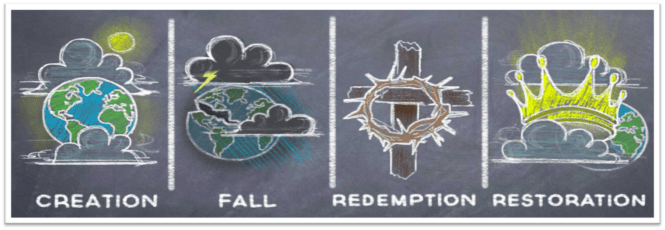
- Redemptive-Historical Survey: 1 | Creation (LDBC Recap 2/14/16 Pt. 2)
- Redemptive-Historical Survey: 2 | The Fall (LDBC Recap 2/21/16)
Recap/review

This week we covered the flood and the Noahic covenant, noting how this event and God’s dealing with humanity and creation in this event fits into redemptive history. (We also began discussing the Abrahamic Covenant; but since we did not finish our discussion on that topic, we will hold off on recapping that section until we make our way through it completely.)
Overview of Biblical material
As always, we began with an overview of the Biblical material in this stage of redemptive history. This is important because we want to make sure we know what we are talking about before we talk about how it actually fits into the all-encompassing storyline of scripture.

 this afternoon (I’m writing this on 2.1.16); and I came across a section in which Carson evaluates what he calls “The New Hermeneutic.” It reminded me of another place in Carson’s writings where he tackles the same issue. And I decided these were worth sharing here.
 None of us interprets anything from an entirely neutral stance. One would have to enjoy the attribute of omniscience to be entirely objective. Insofar as it reminds us that we are finite, and that our findings, at some level, must always be qualified by our limitations, postmodernism has been a salutary advance. It has been especially useful in checking the arrogance of modernist claims. The problem is that in the hands of many interpreters, postmodernism demands a nasty antithesis: either we claim we can know objective truth exhaustively, or we insist that our finitude means we cannot know objective truth and therefore cannot truly “know” reality. Since finite human beings can never know anything omnisciently, only the second alternative is defensible. In that case, all our “knowledge” is a social or a personal construct; the only “reality” we can know is the one we construct.
 Kirk E. Miller