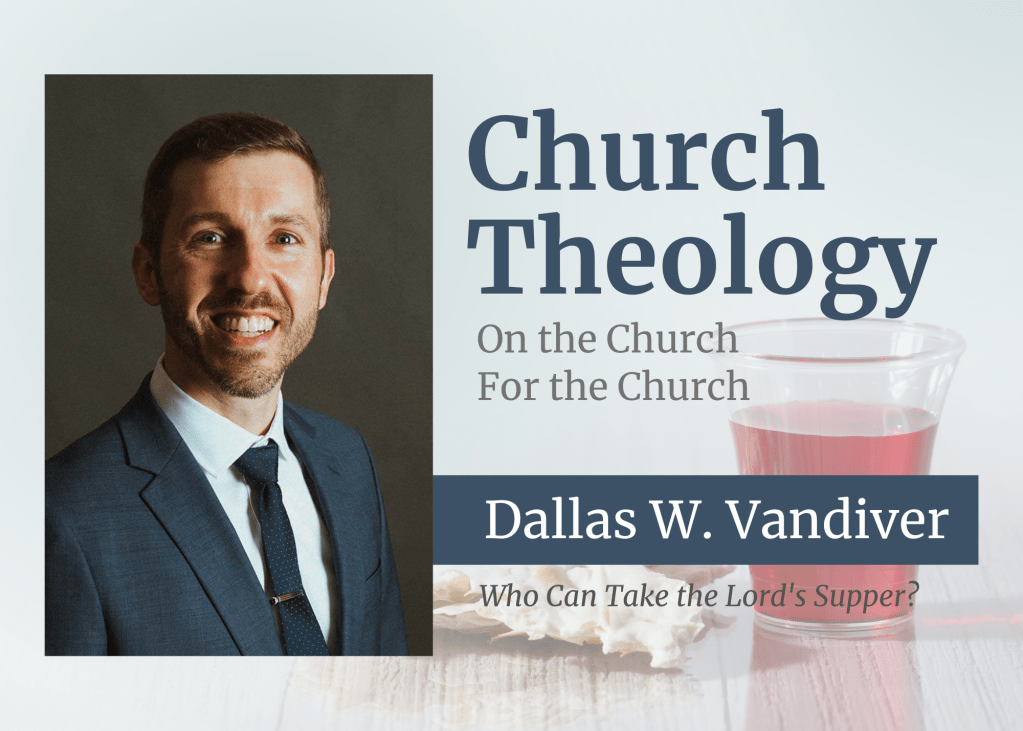
Who ought to be allowed to partake of the Lord’s Supper? Maybe this question has never occurred to you, or you’ve always assumed the answer was obvious! Well, in this episode, Dr. Dallas Vandiver joins me to talk about a historic position known as ‘close communion,’ that the Lord’s Supper ought to be reserved for baptized members in good standing of a gospel-believing church.
God has created various institutions within creation. To each one he gives particular domains of authority (e.g., parents/fathers over the home, elders the church, the government the state, etc.), and particular ways of enforcing their authority fitting to their particular type of authority.
In other words, not all institutions exercise or enforce their authority the same way. For instance, God has authorized the state to wield the sword (Rom 13). In other words, the state can coerce its citizens by threat of material punishment. The church however is a voluntary society. It doesn’t coerce; rather it persuades. People willingly believe and join, submitting to Christ’s rule.
But Christ did not leave the church without a means of exercising and enforcing its authority. Whereas he gave the state the “sword,” he gave the church the “keys of the kingdom” by which to state who is in and who is out of Christ’s kingdom (see Mt 16:18-19; 18:15-20; Jn 20:23).
The church is like an embassy of heaven that issues passports declaring who belongs to Jesus. Word (teaching, preaching) and sacrament (baptism, Lord’s Supper) are the means by which the church positively exercises this authority, persuading people to believe and obey (Word) and then marking off those who do (sacrament). And church discipline is the way the church negatively exercises this authority—declaring that one in fact is not a citizen of Christ’s kingdom.
But the church can’t make anyone believe and obey. The church doesn’t possess that sort of authority. We can only persuade (Word). And when persuasion fails and someone is unrepentant, which is characteristic of an unbeliever, we declare them so (church discipline). That’s the only authority we have; more importantly, the only authority Christ has given us, and so we dare not overstep those bounds.
If we are to read each portion of scripture in view of the broader story of scripture, then what is that bigger story? What is the overarching storyline of the Bible? In this episode, we cover the next three epochs of that overarching story: Jesus’ arrival, the church and her mission, and Christ’s second coming.



 Kirk E. Miller