 In Exegetical Fallacies, D.A. Carson dismantles an analogy by which Donald Lakes seeks to deny alleged differences between the Arminian and Calvinist understandings of grace. Carson then counters with an example of his own that helpfully exemplifies the difference that is truly at play.
Donald M. Lake, for example, in attempting to argue that grace is no weaker in an Arminian system than in a Reformed system, offers us the analogy of a judge who condemns a guilty criminal and then offers him a pardon. Although the man must accept it, such acceptance, argues Lake, cannot be thought of as a meritorious work, a work that in any sense makes the man deserving of salvation. “Calvin and later Calvinists,” he adds, “never seem to be able to see this fundamental distinction unfortunately!”
But to argue that the role of grace in the two systems is not different, Lake would have to change his analogy. He would need to picture a judge rightly condemning ten criminals, and offering each of them pardon. Five of them accept the pardon, the other five reject it (the relative numbers are not important). But in this model, even though those who accept the pardon do not earn it, and certainly enjoy their new freedom because of the judge’s “grace,” nevertheless they are distinguishable from those who reject the offer solely on the basis of their own decision to accept the pardon. The only thing that separates them from those who are carted off to prison is the wisdom of their own choice. That becomes a legitimate boast. By contrast, in the Calvinistic scheme, the sole determining factor is God’s elective grace. Thus, although both systems appeal to grace, the role and place of grace in the two systems are rather different. Lake fails to see this because he has drawn an inadequate analogy; or, more likely, the inadequacy of his chosen analogy demonstrates he has not understood the issue.
D. A. Carson, Exegetical Fallacies, 2nd ed. (Carlisle, U.K.; Grand Rapids, MI: Paternoster; Baker Books, 1996), 121–122.

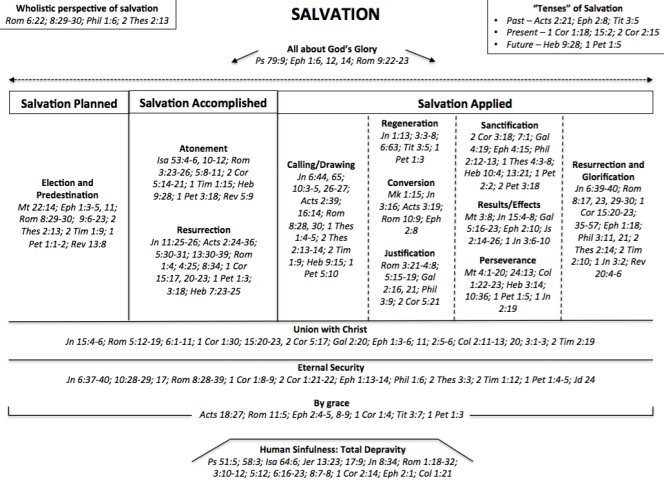
 In The Cross and Salvation Bruce Bruce Demarest takes the reader step by step through the doctrines of salvation in order of their logical and temporal occurrence. He groups the book into six sections: 1) the plan of salvation which includes an introduction, grace, and election/predestination, 2) the provision of salvation, being the atonement, 3) the application of salvation, including the subjective aspects such as divine calling, conversion, and regeneration, and 4) the objective aspects such as union with Christ and justification, 5) the progress of salvation which is sanctification as well as preservation and perseverance, and finally, 6) the perfecting of salvation, which is glorification.
 Kirk E. Miller