The Significance of Christ’s Resurrection: Scriptural Mediations for Resurrection Sunday

The following is the section on Christ’s resurrection from my personal statement of faith.

If you’d like, use the following, with its footnotes of scriptural references, to work your way  through relevant texts and mediate on the meaning and significance of Christ’s resurrection.

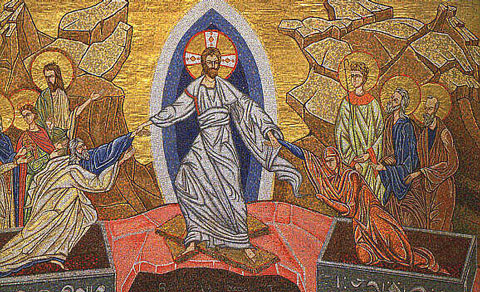
Christ’s bodily resurrection serves as the decisive validation of his ministry and claims.[1] God’s resurrection of Jesus[2] demonstrates that Christ’s sin-vanquishing (and thereby death-defeating) death was indeed effective[3] and vindicates him as God’s appointed Messiah.[4] In fact, it is regarded as his Messianic enthronement.[5] His appointment as judge is confirmed by his resurrection.[6] Because he lives indestructibly, he is permanently able to make intersession for those for whom he died.[7] Through his resurrection he triumphed over demonic forces.[8] Christ embodies the hope of resurrection.[9] In his resurrection, he annihilated death and obtained incorruptibility.[10] As such, in him the eschatological order of resurrection,[11] new creation,[12] new humanity,[13] and Spirit-empowered[14] existence has dawned. His personal resurrection inaugurates the general resurrection.[15] It functions representatively for all those united to him.[16] In him believers are already raised spiritually[17] and will eventually be raised bodily[18]—one holistic resurrection occurring in two installments.

See also my past series presenting a Biblical theology of resurrection.

Continue reading

New York Times, you had one job.

Last year the New York Times had a major journalist oopsy as they described the Christian holiday of Easter as a celebration of Christ’s “resurrection into heaven.”

Um, no. That doesn’t even make any theological sense. Easter is not the celebration of Christ’s ascension, if that’s what you were trying to describe. We do believe and celebrate the ascension. But we don’t conflate it with the resurrection.

Well, this year, they’ve done it again. Recently they described the Church of the Holy Sepulcher as the place “where many Christians believe that Jesus is buried.”

Continue reading

Christ’s Resurrection as the Accomplishment of God’s Faithfulness to His Creation (Vinoth Ramachandra)

Elsewhere I’ve written about this subject–the significance of Christ’s resurrection as inaugurated eschatology, the bursting of the new creation into the midst of this fallen creation in the person of Jesus Christ who is the resurrected new creation “pioneer” of sorts. But, I’m currently reading Ramachandra’s Faiths in Conflict?; and he summarizes this concept quite well. So, I thought I’d share his thoughts here. If it’s worth saying, it’s worth saying more than once and in more than one way by more than one person, right?

Resurrection, for all first-century Jews, was bound up with the hope of the kingdom of God, of God’s vindication of his people Israel before their pagan enemies and the renewal of his disfigured world.

Resurrection, then, was corporate… public, and physical. … The age to come would be a renewed space-time world in which the righteous dead would be given new bodies in order to inhabit a renewed earth. Thus, the resurrection of the dead – the righteous to eternal life and the wicked to destruction – marked the consummation of the human drama. It spelt the triumph of Israel’s God who was also the universal Creator and Judge of all humanity. Resurrection, marked the dawn of a new world order, the final and supreme manifestation of God’s justice, mercy and power in history.

But … the early Christians proclaimed that the resurrection had occurred in Jesus before the day of resurrection for all. … In the resurrection of Jesus, God not only gives a glimpse and pledge of the new creation, but he announces the dawn of that new creation before its promised fulfillment. Here is a foretaste of the future age in the present.

Resurrection [specifically the general resurrection inaugurated in Christ’s resurrection, the “first-fruits” of the general resurrection, to use Pauline language] is a fresh creative act of God in which he displays his faithfulness to his creation by raising it to new life in his presence beyond death and decay. Resurrection, then, is the Creator’s final act of faithfulness to his creation…

Continue reading

Athanasius’ On the Incarnation

I previously wrote a review On the Incarnation by Athanasius (c. 297-373). Well, I read the book again and wrote another review that I thought I’d share with you here. Hopefully this second review, which covers a lot of the same things as the first one, has greater insight and clarity. Enjoy!

* * * * *

In his work, On the Incarnation, Athanasius seeks to present “a brief statement of the faith of Christ and of the manifestation of His Godhead to us” (IX.56). Acknowledging that “such and so many are the Savior’s achievements that follow from His incarnation” (X.54) such that one is unable to present them satisfactorily, he nonetheless determines to set forth his understanding of “why it is that the Word of the Father . . . has been made manifest in bodily form” (I.1); his answer in short: “for the salvation of us men” (I.1). What follows is less a systematic doctrinal treatise and more an explanation and defense of the incarnation against its 4th century misconceptions and critiques.

Athanasius begins his account with creation and the fall. Of all His creatures, God bestowed upon mankind a special grace, the Image of God. For Athanasius this Image means a sharing in the divine being (“though in a limited degree”; I.3; III.11) and a unique incorruptibility because of this intimate knowledge of and union with the Incorruptible One (I.4-5; II.6-7; III.13). In such a state, man would have continued forever (I.3). But by “turning from eternal things to things corruptible” man embraced corruption—death—by forsaking union with the eternal (I.5; cf. I.4). Such is the setting for “the divine dilemma and its solution in the incarnation” (II).

Continue reading

Regeneration and the New Creation

An Introductory Biblical Theology of Regeneration as it Pertains to a Proper Understanding of Inaugurated Eschatology

In contrast to systematic theology, a discipline that tackles doctrines in a neat, organized, systematic, and generally atemporal fashion, Biblical theology seeks to examine Biblical themes through the lens of progressive revelation, that is, in light of scripture’s metanarrative or unfolding plotline. Biblically theology deliberately makes temporal sequence (time development) and Scripture’s broad storyline the grid through which theology, doctrines, and themes are studied and investigated.

The following post will seek to provide an introduction to a Biblical theology on regeneration as it pertains to a proper understanding of inaugurated (already initiated) eschatology (pertaining to “last things”).

If that sounds confusing, that’s okay; it’ll all makes sense in just a bit.

Continue reading