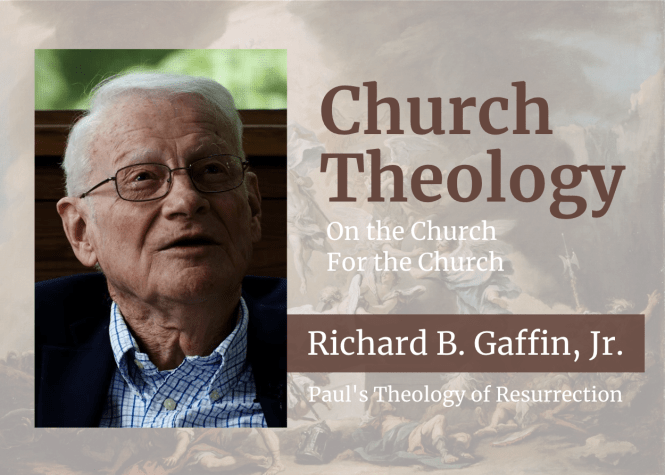
Paul’s Theology of Resurrection (with Richard Gaffin)

How did Paul think about resurrection, and what role did it play in his overall theological understanding? Kirk sits down for a conversation with retired professor, Dr. Richard Gaffin, about Paul’s theology of resurrection. We explore questions like, what is the connection between Christ’s resurrection and ours? What is the relationship between Christ’s resurrection and the ministry of the Spirit in our lives? What does Paul mean when he says that Jesus was “raised for our justification” (Rom 4:25)? And how does Christ’s resurrection empower us for our mission as a church?

Access the episode here. (Available on Apple Podcasts, Spotify, Google Podcasts, Stitcher, and more.)

Question: The Spirit’s Role in Salvation?

A friend of mine, Tyler Williamson, recently contacted me with a fantastic question about the role of the Holy Spirit leading people to salvation. In my experience, I have discovered that many others have similar questions. So, with his permission, I thought I’d share our informal internet conversation.

Now certainly the Holy Spirit’s role of  in salvation is a huge topic; but given the context of his question, my response more narrowly addressed the Holy Spirit’s work in what is called effectual calling and briefly touched on the Spirit’s related work of regeneration. (If the answer I provide is not as direct as you may like, please bear in mind that this was an informal conversation.)

* * * * *

Christian Tyler Williamson: The Holy Spirit–integral to the relationship of the believer with Christ. Many people talk of free will; many people talk of predestination. What do you believe is the role of the Holy Spirit in the salvation process? Detailed (as you typically are) would be great.

Me: The Bible speaks much of the Holy Spirit’s work of drawing individuals to faith in Christ. This is what theologians call the doctrine of “calling.”

Continue reading

Regeneration and the New Creation

An Introductory Biblical Theology of Regeneration as it Pertains to a Proper Understanding of Inaugurated Eschatology

In contrast to systematic theology, a discipline that tackles doctrines in a neat, organized, systematic, and generally atemporal fashion, Biblical theology seeks to examine Biblical themes through the lens of progressive revelation, that is, in light of scripture’s metanarrative or unfolding plotline. Biblically theology deliberately makes temporal sequence (time development) and Scripture’s broad storyline the grid through which theology, doctrines, and themes are studied and investigated.

The following post will seek to provide an introduction to a Biblical theology on regeneration as it pertains to a proper understanding of inaugurated (already initiated) eschatology (pertaining to “last things”).

If that sounds confusing, that’s okay; it’ll all makes sense in just a bit.

Continue reading

A Wholistic View of Salvation—“Already/Not Yet”

Introduction

In contemporary Christianity it is very common to hear that someone “got saved” or to have someone tell you that they were “saved” at such and such a time. But beyond that, the concept of “salvation” remains dormant. I believe this stems from a misunderstanding of salvation, that is, salvation in its entirety.

Now, it is true that many believers can point back to a specific moment of turning from sin towards initial trust in Christ for salvation. In theology we call this moment conversion and it is also the moment we are regenerated (given spiritual birth and life) and justified (counted as righteous before God). In this sense, then, we can rightly say that we were saved upon our conversion. But the idea of “salvation” is Biblically and theologically much more comprehensive than just that one precise moment.

Continue reading

Facing Trials with Spiritual Integrity (James 1:2-18)

The following is an adult Sunday School lesson based out of James 1:2-18 that I taught at my church, Lake Drive Baptist Church, in Milwaukee, WI on July 8th, 2012.

Download outline.

Download presentation.

Podcast link.