In Onward, Russell Moore provides a manifesto for Christian cultural engagement in a post-Christian society. As Christians, Moore calls us to embrace the “strangeness” of Christianity and to see an opportunity for Christian mission precisely in a society where a Christian veneer of nominalism is now out of style.
Politics
Goodreads Review of Living in God’s Two Kingdoms by David VanDrunen
 Living in God’s Two Kingdoms: A Biblical Vision for Christianity and Culture by David VanDrunen
My rating: 3 of 5 stars
I finished VanDrunen’s Living in God’s Two Kingdoms on a plane ride to Ethiopia. I generally liked it. There was a lot of good in it, particularly as it relates to understanding (1) the distinction between the realm of God’s saving kingdom and the realm of general society; (2) not confusing God’s kingdom with the state; (3) situating the redemptive-historical role of the church as being in exile in this world, more comparable to the Jews in Babylon or Abraham as a sojourner, and less like Israel in the Promised Land; and (4) establishing Christian liberty, especially in the area of politics and cultural engagement. In this way, this book is a good correction against the current theonomy and Christian nationalism trends.
But it also had some points where I think VanDrunen made some significant missteps, and actually went too far in the other direction: specifically (1) in arguing for Christ as the second Adam who completely fulfilled the cultural mandate (fulfilling God’s law for believers; justification), he seemed to leave no room for the fulfillment of God’s law in believers (sanctification). In other words, not only does Christ keep the covenant of works for us (instead of us, on our behalf), but then as believers Christ now also enables us to perform the law, not as a means of justification but as the growth of sanctification. It seems then that the believers’ current call to cultural engagement (fulfilling the cultural mandate) does not, therefore, jeopardize Christ’s finished work and justification by faith alone, as VanDrunen argues, but would fit within the category of sanctification—the image of God progressively renewed in believers (Col 3); (2) VanDrunen makes too sharp of a distinction between the original and new creation. Rather than seeing the new creation as the renewal and restoration of this creation, he seems instead to view it as a replacement, thus discounting that our current work to care for creation and culture could reflect, be a byproduct of, or have any continuity with Christ’s work of restoring creation (his new creation).
I still think VanDrunen’s work is worth reading; but I would encourage doing so critically, aware of these missteps. I can understand why some have negatively characterized this school of thought as a “radical” Two Kingdoms theology (R2K)–I see that. There are some oddly extreme (reductionistic) applications of some principles. So overall, I am ambivalent about the book, appreciating much of it, while maintaining my concerns and critiques.
Keith Mathison’s review at Ligonier is helpful. https://www.ligonier.org/learn/articl…
Discipleship Questions for Partisan Reactions to News Coverage
The following is a correspondence from a while back that I wrote to two friends who had reached out to me for thoughts regarding a recent news event and its coverage. I no longer remember the particular news item that gave rise to their question. But this advice holds regardless and applies beyond it. I thought I would share.
A couple of discipleship-oriented thoughts come to mind, that I hope could be helpful. I don’t follow all of this stuff terribly close, as you can tell. So I’m less interested in commenting on any of the specifics on the matter. But I do have a pastoral heart for helping us navigate this arena, as part of our all-of-life discipleship. So, at least in that respect, hopefully these questions and thoughts can be helpful.
(1) How do your hearts respond to these stories? Do you find yourself increasing in anger or vitriol towards perceived political opponents? Do you find your heart going, “Yes! More fuel I can use to defend ‘my side’”? And what might this say about our heart idols?
(2) How can you guard yourself against allowing these sorts of stories to fuel or further cement partisan biases in yourself? For instance, let’s assume the stories above are true, and they evidence clear partisan bias and corruption. It would be a terrible irony then if other people’s partisan bias became justification for becoming entrenched in that very same thing myself, and drinking the same partisan poison I’m condemning them for drinking.
(3) There’s always two sides to every story (Prov 18:17). Have we done the work to listen to the “other side” of any stories? And not just listen, but honestly and charitably listen and consider them? Not listen to deconstruct their arguments, but genuinely consider another perspective?
(4) As people centered on the gospel, i.e., “the Word of truth,” we want to be people who care about truth. This means we should place a high value on making sure we are always trying to be objective. We are after the truth, not after what scores the most points for a particular “side.” (An almost sure way to tell if you’re partisan/not objective is if you’re always in lockstep with a particular side, and never or rarely deviate). How can we best guard our hearts towards remaining objective? Especially when we know our hearts’ tendencies (and not only so, but also psychological realities, e.g., confirmation bias, choosing paths of least resistance, etc.)
(5) Our culture is increasingly becoming a post-truth society. What I mean by that, at least in part, is that we no longer have shared, agreed-upon sources of information, e.g., journalists’ reporting. A lot of this is fueled by political interests; they want to discredit reporters who negatively report on them. On the other hand, media bias exists too. Neither of these is good for society. People are skeptical, and they use that skepticism as justification and license to appeal to even less trustworthy sources (e.g., conspiracy theories, fake news)—as if that’s any better! We’re developing into a society where we all trust whatever sources “seem right in our own eyes.” Whether we agree with a source is up to our “discernment” and how we deem something is “trustworthy” — basically, does it agree with my side and its narrative? Again, not good. So the question: How do we navigate a landscape that is so polarized and partisan without falling prey to it? How do we pursue the truth, with a healthy distrust in our own hearts’ inclinations to listen to what it wants to hear? Do we distrust our own hearts as much as we distrust the bias of others (e.g., media, etc.)
Truth Over Tribe: Against Political Tribalism (with Patrick Miller)
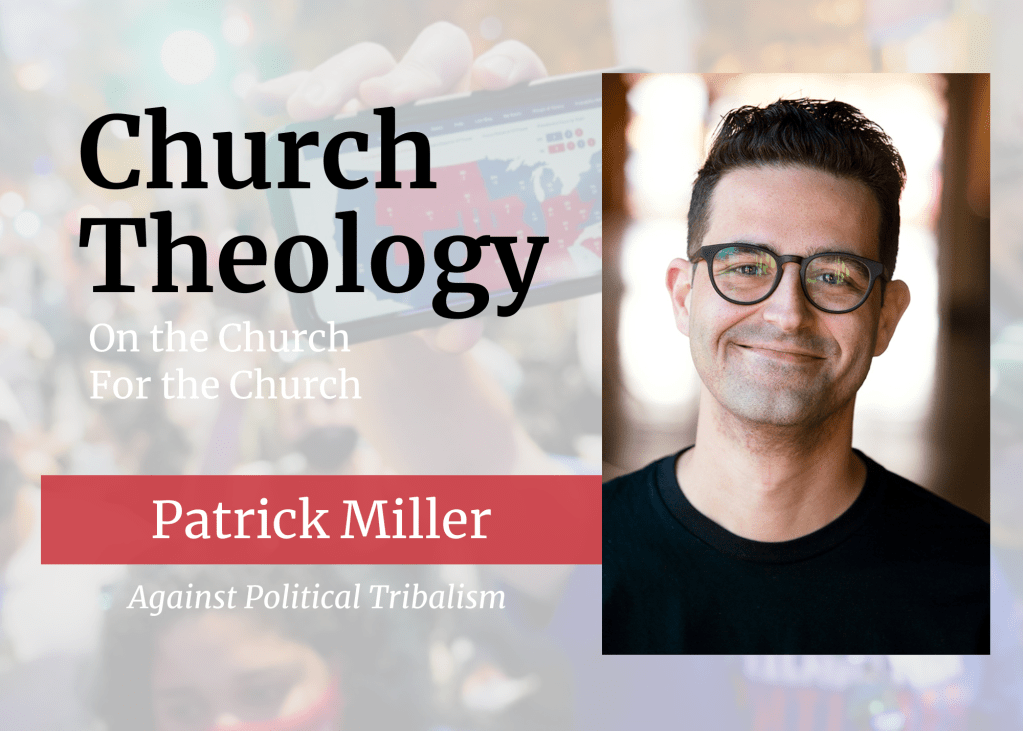
Have you noticed that you’ve been more anxious recently? Have political differences put a strain on a relationship with a friend or family member? Has politics caused division in your church? Society is increasingly polarized and tribal. And unfortunately, we as Christians are often not immune, but at times even the worst offenders. In this episode, Patrick Miller, an author of Truth Over Tribe, helps us see the causes of our tribalism to pursue a healthier Christian political engagement.
Access the episode here. (Available on Apple Podcasts, Spotify, Google Podcasts, Stitcher, and more.)
A Christian Case Against Christian Nationalism (with Paul Miller)

Talk about “Christian nationalism” is quite the buzz right now. Many are currently decrying it. Some now though are readily embracing the label to champion it. So what exactly is Christian nationalism? And is it something we, as Christians, should be concerned about? Paul Miller answers, “yes,” helping us understand why Christian nationalism is both bad for our neighbors and harmful to the church.
Access the episode here. (Available on Apple Podcasts, Spotify, Google Podcasts, Stitcher, and more.)
 Kirk E. Miller