In Onward, Russell Moore provides a manifesto for Christian cultural engagement in a post-Christian society. As Christians, Moore calls us to embrace the “strangeness” of Christianity and to see an opportunity for Christian mission precisely in a society where a Christian veneer of nominalism is now out of style.
Political Theology
Goodreads Review of Living in God’s Two Kingdoms by David VanDrunen
 Living in God’s Two Kingdoms: A Biblical Vision for Christianity and Culture by David VanDrunen
My rating: 3 of 5 stars
I finished VanDrunen’s Living in God’s Two Kingdoms on a plane ride to Ethiopia. I generally liked it. There was a lot of good in it, particularly as it relates to understanding (1) the distinction between the realm of God’s saving kingdom and the realm of general society; (2) not confusing God’s kingdom with the state; (3) situating the redemptive-historical role of the church as being in exile in this world, more comparable to the Jews in Babylon or Abraham as a sojourner, and less like Israel in the Promised Land; and (4) establishing Christian liberty, especially in the area of politics and cultural engagement. In this way, this book is a good correction against the current theonomy and Christian nationalism trends.
But it also had some points where I think VanDrunen made some significant missteps, and actually went too far in the other direction: specifically (1) in arguing for Christ as the second Adam who completely fulfilled the cultural mandate (fulfilling God’s law for believers; justification), he seemed to leave no room for the fulfillment of God’s law in believers (sanctification). In other words, not only does Christ keep the covenant of works for us (instead of us, on our behalf), but then as believers Christ now also enables us to perform the law, not as a means of justification but as the growth of sanctification. It seems then that the believers’ current call to cultural engagement (fulfilling the cultural mandate) does not, therefore, jeopardize Christ’s finished work and justification by faith alone, as VanDrunen argues, but would fit within the category of sanctification—the image of God progressively renewed in believers (Col 3); (2) VanDrunen makes too sharp of a distinction between the original and new creation. Rather than seeing the new creation as the renewal and restoration of this creation, he seems instead to view it as a replacement, thus discounting that our current work to care for creation and culture could reflect, be a byproduct of, or have any continuity with Christ’s work of restoring creation (his new creation).
I still think VanDrunen’s work is worth reading; but I would encourage doing so critically, aware of these missteps. I can understand why some have negatively characterized this school of thought as a “radical” Two Kingdoms theology (R2K)–I see that. There are some oddly extreme (reductionistic) applications of some principles. So overall, I am ambivalent about the book, appreciating much of it, while maintaining my concerns and critiques.
Keith Mathison’s review at Ligonier is helpful. https://www.ligonier.org/learn/articl…
Truth Over Tribe: Against Political Tribalism (with Patrick Miller)
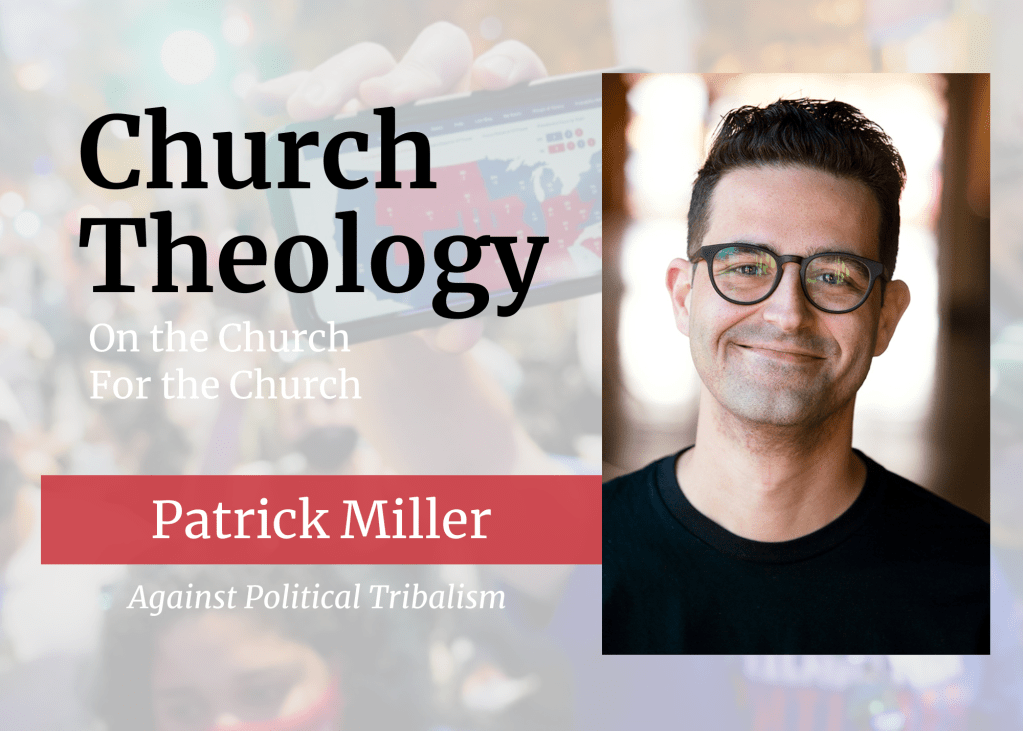
Have you noticed that you’ve been more anxious recently? Have political differences put a strain on a relationship with a friend or family member? Has politics caused division in your church? Society is increasingly polarized and tribal. And unfortunately, we as Christians are often not immune, but at times even the worst offenders. In this episode, Patrick Miller, an author of Truth Over Tribe, helps us see the causes of our tribalism to pursue a healthier Christian political engagement.
Access the episode here. (Available on Apple Podcasts, Spotify, Google Podcasts, Stitcher, and more.)
A Christian Case Against Christian Nationalism (with Paul Miller)

Talk about “Christian nationalism” is quite the buzz right now. Many are currently decrying it. Some now though are readily embracing the label to champion it. So what exactly is Christian nationalism? And is it something we, as Christians, should be concerned about? Paul Miller answers, “yes,” helping us understand why Christian nationalism is both bad for our neighbors and harmful to the church.
Access the episode here. (Available on Apple Podcasts, Spotify, Google Podcasts, Stitcher, and more.)
The Uneasy Conscience of Modern Fundamentalism by Carl F.H. Henry (Book Recommendation)
Originally published in 1947, The Uneasy Conscience of Modern Fundamentalism provided a manifesto for evangelical Christians who are serious about bringing their Christian faith to bear in contemporary culture. In this classic book, Carl F. H. Henry, the father of the modern evangelical movement, pioneered a path forward that avoids, on the one hand, the error of disengagement and apathy towards today’s social ills, and, on the other hand, the error that is the social gospel. In our current cultural climate, in which evangelicalism is still wrestling with how to engage social matters, this book is as relevant as ever.

