Must Pastors Be Good Managers? Paul Says So (1 Timothy 3:4–5)

“He must manage his own household well … for if someone does not know how to manage his own household, how will he care for God’s church?” (1 Timothy 3:4–5)


Sometimes we pit being pastoral against being organized and professional. But, according to Paul, part of being pastoral is managing well.

The word Paul uses for “manage” here (προΐστημι) is elsewhere used in the sense of ruling or leading.1 Thus, some translate it to “be in charge of, preside over,”2 “to superintend,”3 or to govern, as one governs a city.4

What is the significance of this requirement that overseers (pastors, elders) must manage their own household well? As Luke Timothy Johnson answers, “With this qualification, we reach the specifically administrative capacities of the potential supervisor. The participle ‘ruling well’ comes from the verb prohistēmi, which means to ‘govern or administer…'”5 In other words, it relates to the administrative competencies of a potential overseer.

Paul specifically mentions ruling one’s “house” well though. But as Philip H. Towner reminds us, given the nature of

“the ancient household concept (oikos), the stipulation here initially exceeds issues of parenting and husbanding to include management of slaves, property, business interests and even maintenance of important relationships with benefactors/patrons or clients. … The dominance of the oikos in shaping patterns of leading, management, authority and responsibility within the cultural framework made it the natural model for defining the overseer’s position. The adverb ‘well’ (3:12, 13; 5:17) attached to the verb of management establishes the high standard of proficiency Paul expects in candidates for church leadership.”6

Thus, we shouldn’t pit these against each other—pastoring and managing. In fact, to the contrary: we must hold them together. Managing well, being organized, and leading in an orderly way is a way to shepherd and care well for people.

In contrast, recklessness, carelessness, disorganization, and miscommunication often hurt people and result in the opposite of caring well for people. Paul even goes as far as to say such poor management is disqualifying.


Notes

  1. See BDAG. ↩︎
  2. Andreas J. Köstenberger, 1-2 Timothy & Titus, ed. T. Desmond Alexander, Thomas R. Schreiner, and Andreas J. Köstenberger, Evangelical Biblical Theology Commentary (Bellingham, WA: Lexham Press, 2021), 130. ↩︎
  3. R. C. H. Lenski, The Interpretation of St. Paul’s Epistles to the Colossians, to the Thessalonians, to Timothy, to Titus and to Philemon (Columbus, OH: Lutheran Book Concern, 1937), 585. ↩︎
  4. Martin Dibelius and Hans Conzelmann, The Pastoral Epistles: A Commentary on the Pastoral Epistles, Hermeneia—a Critical and Historical Commentary on the Bible (Philadelphia: Fortress Press, 1972), 53. ↩︎
  5. He goes on to cite contemporaneous uses of this Greek word for support. Luke Timothy Johnson, The First and Second Letters to Timothy: A New Translation with Introduction and Commentary, vol. 35A, Anchor Yale Bible (New Haven; London: Yale University Press, 2008), 216. ↩︎
  6. Philip H. Towner, The Letters to Timothy and Titus, The New International Commentary on the New Testament (Grand Rapids, MI: Wm. B. Eerdmans Publishing Co., 2006), 254-255. ↩︎
The Harmful Simplicity of Reductionistic Theology

I take no issue with making the gospel central in all things (the church, preaching, the Christian life, etc.)

But one of the results of a malformed gospel-centeredness is a reductionistic theology that treats nearly every issue someone faces as a matter of sin to be dealt with. Sin is always seen, diagnosed, and treated as a root cause. Why? Because if the gospel is the solution to everything, and that gospel is primarily, if not exclusively, understood in terms of addressing sin, then sin is always the issue, and addressing sin with the gospel is always the solution.

I theorize we’re also susceptible due to a simplistic conception of total depravity. We give our doctrine of total depravity what we might call “maximalist” interpretive power. Yes, we are pervasively sinful (Isa 1:6). Total depravity is true. But, along with our simplistic gospel-centeredness, we misconstrue the doctrine of total depravity into a fixation on looking for sin everywhere. We misapply the doctrine of total depravity by searching for sin “behind every bush” and over-spiritualizing situations. But not everything is sin or is to explained by sin—at the very least, not exclusively so.

Added to this, training in pastoral counseling often focuses on teaching pastors how to address sin. So pastors are hardwired to approach situations in terms of sin and sanctification. Those are their default operating categories. The danger is, when you’re a hammer, you start to see everything as a nail.

I call all of this “reductionistic” because it takes true things (e.g., sin and a gospel that addresses it), but embraces these true things at the exclusion of other true things. For instance, someone comes to a pastor in suffering. But, instead of seeing their signs of trauma and affliction for what they are, the pastor diagnoses them as displaying a sinful refusal trust in God, rest in Christ, and obey the call to contentment. Instead of caring for the person and acknowledging their plight, they add insult to injury: they take someone who is suffering, and now further inflict them with wrongful condemnation. Often the suffering is ignored as not the “real” issue. Moreover, the sufferer may be treated as contentious or unrepentant when they (rightly) push back at the bad counsel.

The reality, though, is that humans are both sinners and sufferers. We are not only perpetrators of evil, but also victims to it. We not only sin; we are also sinned against. And the gospel meets not merely our sin but also our suffering. The good news (gospel) is not only that our sin is forgiven, but that Christ will undue the curse in all its effects—including evil and suffering.

This means, for example, that:

  • Although the Bible tells us to cast our cares on God (1 Peter 5:7), it also leads us in lament (complaint) to God (see the Psalter). Apparently the two are not mutually exclusive!
  • Or again, God is sovereign, but humans are also responsible. God’s sovereignty is not an excuse for inaction and resigning ourselves to evil and injustice. Sovereignty isn’t the same as fatalism; God uses means.
  • Yes, we are to forgive those who sinned against us (Eph 4:32). Yes, God will ultimately judge when Christ comes again (Acts 17:31). But God also establishes means for provisional justice in this life too (e.g., Rom 13:1–7). These are not mutually exclusive.
  • God works all things for good for those who love him (Rom 8:28). Yet among the things he works for good are things that are evil (see vv.35–39). Just because he works something for good does not mean it itself is good—and we don’t need to pretend that it is! These, too, are not mutually exclusively.

We could go on…

Why this matters? Bad theology makes for bad counsel. More pointedly, bad pastoral theology makes for pastoral malpractice—even spiritual abuse.

An Unbusy Pastor | Eugene Peterson

From The Pastor: A Memoir by Eugene Peterson. Excerpt originally published at YouthWorker.com.


‘As a congregation, we had achieved critical mass, we were self-supporting financially, we had built a sanctuary that gave visibility to our worshipping presence in the neighborhood. It was the beginning of what I earlier called the badlands era in which the euphoria of establishing a church had gone flat,the adrenaline of being involved in a challenging enterprise had drained out. I had worked hard for those three years. The congregation had worked hard. We couldn’t sustain it.

Except that I tried. I formed committees. I made home visits. Longer hours. A longer workweek. Just a few years previous to this, Roger Bannister, the first 4-minute miler, wrote his autobiography in which he described life following his high-profile athletic celebrity. He wasn’t breaking records anymore.He compensated by working harder and harder. He described himself as a carpenter who “made up for his lack of skill by using a lot of nails.” That was me. I had tried to slow down. I had tried to relax, but I was afraid of failing. I couldn’t help myself.

One evening after supper, Karen—she was 5years old at the time—asked me to read her a story. I said, “I’m sorry, Karen, but I have a meeting tonight.” “This is the 27th night in a row you have had a meeting.” She had been keeping track, counting.

The meeting I had to go to was with the church’s elders, the ruling body of the congregation. In the 7-minute walk to the church on the way to the meeting I made a decision. If succeeding as a pastor meant failing as a parent, I was already a failed pastor. I would resign that very night.

Continue reading

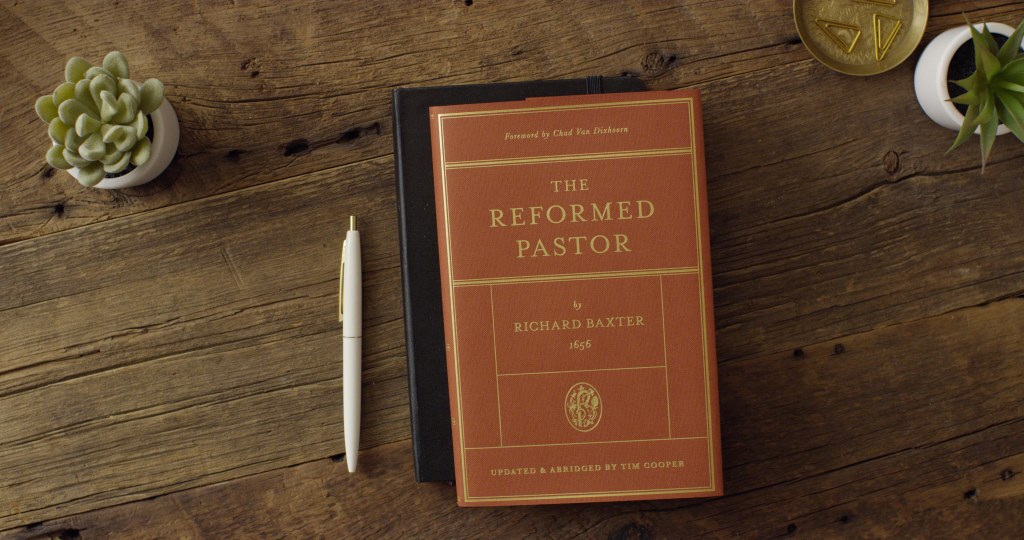
The Reformed Pastor by Richard Baxter, Updated and Abridged by Tim Cooper

Tim Cooper, professor of church history at the University of Otago in New Zealand, has done us a great service by updating and abridging Richard Baxter’s classic pastoral text, The Reformed Pastor.

Originally published in 1656, The Reformed Pastor is Baxter’s exposition of Acts 20:28 (“Take heed unto yourselves and all the flock, over which the Holy Spirit has made you overseers, to feed the church of God, which he has purchased with his own blood”). Baxter delivered these words to his fellow local pastors as they renewed their commitment to a “reformed” pastoral ministry (i.e., one that was re-formed to the original shape of the New Testament). Baxter reminds his fellow pastors of the seriousness of their calling, invites them to confess their neglect, and calls for a new resolve to their work, with a particular emphasis on the ministry of home visitation.

Whether or not one will agree with all the particulars of Baxter’s application of Acts 20, namely the specific form he says home visitations ought to take, his voice continues to serve a clarion call to the essential work of pastoral ministry: take heed of the flock. The message of The Reformed Pastor seems needful all the more as much of modern American evangelicalism seems to clamor for the opposite—”big box” megachurches where most pastors and congregants often remain relatively unknown to each other, churches that pursue production value, programs, and metrics over actual disciple-making, and thus pastors who are expected to be more like corporate CEOs than true shepherds.

“In the history of pastoral life, certain books stand out as classics that must be read by anyone who is serious about this utterly vital sphere of the Christian world. … Among this select group is Richard Baxter’s The Reformed Pastor. It can be a daunting read, for Baxter demands much of anyone who would seek to serve as a pastor to the souls of men and women and children. Daunting though it is, it is a must-read. For here we find not only a book that has influenced generations since it was first published but a work that sets forth the high calling of being a minister of the gospel. The latter is not in vogue today for a number of reasons, and to some extent we are reaping the fruit of our failure to highly prize pastoral leadership. May the reading of this new edition, rightly abridged, serve to rekindle among God’s people a prizing of the pastorate and a prayer for those who serve in it. May it be a key vehicle to help refocus the passions and goals and energies of those currently serving as shepherds of God’s people!”

Michael A. G. Haykin

Tim Cooper has sought to make this classic text a great deal easier to read by updating much of Baxter’s seventeenth-century language. Also, by eliminating Baxter’s redundancies, he’s reduced the book’s length to 30,000 words, down from its original 160,000, presenting the best of Richard Baxter’s timeless advice, while making it all the more accessible to a new generation of pastors.

Table of Contents

Foreword by Chad Van Dixhoorn
Introduction

Chapter 1: Take Heed unto Yourselves
Chapter 2: Take Heed unto All the Flock
Chapter 3: The Ministerial Work
Chapter 4: What a Subtle Enemy Is This Sin of Pride!
Chapter 5: Many Things Sadly out of Order
Chapter 6: Reasons Why You Should Take Heed unto All the Flock
Chapter 7: The Greatest Benefits of Our Work
Chapter 8: Many Difficulties We Will Find
Chapter 9: Some May Object
Chapter 10: The Best Directions I Can Give

Appendix 1: The Catechism
Appendix 2: Book Outline


Note: I received a free copy of this book from the publisher in exchange for this honest review.

Must Elders Be Old? (Or, Can Elders Be Young?)

The following is from a correspondence I had with some area pastors over the question, Must those who hold the office of elder (aka: pastors, overseers) be old. Or, in other words, can they be young? Does the term “elder” necessitate a certain age criteria?


On the age of elders:

The word undoubtedly comes from the Jewish context, in which it refers to the leadership office within the Jewish community. The term seems to originate from the fact that those leaders were generally the aged and experienced men in the community.

However, the word seems to come to serve as something of a technical term for that leadership office, not necessarily implying in any absolute way a certain age requirement. (We want to avoid the etymological fallacy here of equating etymological origin with meaning.) This seems to be the type of use that is carried over into the New Testament church context, where it serves as a technical term for the leadership office.

But don’t hear me wrong. The terms used for the office seem to convey something of the meaning and nature of the office. So, for example, the parallel term “overseer” implies that this office is one of oversight. Likewise, designating the office as “elder” implies a certain wisdom and experience. (So, whereas the terms “overseer” and “pastor” seems to designate something of the function of the office, “elder” seems to designate a qualification to the office.) And no doubt (cf. 1 Pet 5:5) this sort of wisdom and experience implied by the term “elder” often does come with age (although age does not guarantee this maturity any more than youth makes this impossible). So I don’t think it’s entirely moot or irrelevant to consider the age of potential elders.

But, especially when we note the context of the church as a “spiritual” community, it becomes clearer that the sort of wisdom and experience in view here is likely that of one’s Christian faith. So for example, an older man who newly coverts would not qualify, even if he is an “elder” in terms of his physical age. This is made clear when Paul says that an elder cannot be a recent convert (1 Tim 3:6), which seems to show that it is a candidate’s “spiritual” experience that is in view in the idea of “elder.”

On the other hand, this implies that a young man may be qualified if particularly wise and experienced “spiritually.” Paul seems to assume this when he tells Timothy not much to allow anyone to look down on him for his youth (1 Tim 4:12). He also assumes this when he gives instruction to elders on how they are to relate to those who are much older than them (1 Tim 5:1ff), which implies these elders must be relatively young, or at least much younger than many of their congregants (so not the “elders” of this community as far as physical age).

Again, this is not to say that age is not a relevant factor. Often times experience does come with age. But I would hold that the Bible does not outline age as an absolute requirement (or qualification for that matter), given the sort of maturity in view — primarily “spiritual.”

Doug Wilson wrote a good article on this here.