“I asked a group of over 1,500 pastors: ‘What are the top things people in your congregation have done, or could do, for you to show you appreciation during Pastor Appreciation Month?’ … In addition, I’ll weave in my own ideas and insights from having served as a pastor.”
Gregory the Great wrote The Pastoral Rule to provide guidance for “spiritual directors” (clergy) on the responsibilities and tasks of pastoring. It is widely considered one of the best works of pastoral theology.
He breaks his work into four parts.
He addresses the qualifications of those who would obtain pastoral authority.
He provides directions on the proper life and work of the pastor.
He offers specific guidance and insight on how to pastor particular types of people given their unique temperaments, struggles, characteristics, and circumstances.
He closes with an exhortation to humility in pastoral ministry.
He sets out to write his book, among other reasons, “to express my opinion of the severity of their weight [i.e., the burdens of pastoral care] so that he who is free of these burdens might not recklessly pursue them and he who has already attained them might tremble for having done so.”1 At the close of his book, he says, “I have tried to show what the qualities of a spiritual director ought to be.”2
The following are some of my favorite quotes from the work, organized loosely by subject matter.3
1. The dangers of the pastoral authority
“No one does more harm in the Church than he who has the title or rank of holiness and acts perversely. … [B]ecause such a sinner is honored by the dignity of his rank, his offenses spread considerably by way of example. And yet everyone who is unworthy would flee from such a great burden of guilt if, with the attentive ear of the heart, he pondered the saying of the Truth: ‘He that scandalizes one of these little ones who believes in me, it would be better for him that a millstone was hung around his neck and that he was cast into the depth of the sea.’ … Whoever, therefore, gives off the appearance of sanctity but destroys another by his words or example, it would be better for him that his earthly acts, demonstrated by worldly habits, would bind him to death than for his sacred office to be a source for the imitation of vice in another. Indeed, his punishment in hell would be less terrible if he fell alone.” (32)
“[Jesus] chose instead the penalty of a shameful death so that his [followers] might also learn to flee the applause of the world, to fear not its terrors, to value adversity for the sake of truth, and to decline prosperity fearfully. This final concern [i.e. prosperity] often corrupts the heart through pride, while adversities purge it through suffering. In the one, the soul becomes conceited; while in the other (even if the soul is occasionally conceited), it humbles itself. In the one, the man forgets who he is; while in the other, he is recalled, even unwillingly, to know what he is. … For commonly in the school of adversity, the heart is subdued by discipline; but if one rises to a position of spiritual authority, the heart is immediately altered by a state of elation that accompanies the experience of glory.” (33)
The following is from Harold L. Senkbeil, “Leading Your Sheep,” in Pastoral Leadership: For the Care of Souls, Lexham Ministry Guides (Bellingham, WA: Lexham Press, 2021), 54–56.
“The Bible, however, makes a clear distinction between authorized power and unauthorized power. The only legitimate way to do ministry is by way of the authority of Jesus: doing what he’s given you to do. … Many unfortunate dysfunctions arise when power is confused with authority. When pastors operate not out of their divinely commissioned authority but rather out of their private opinions and desires, conflict usually occurs. …
This works for a while; it may even work for quite a while, depending on the strength of the pastor’s personality. But you can see that it’s a strategy fraught with danger. It breeds resentment and discontent within a congregation for sure, and often these situations get ugly. People may suffer silently for a while, but eventually their resentment spills over into open resistance and rebellion. Now you’ve got a power struggle and contest of wills on your hands, as the pastor keeps trying to outsmart the opposition and form allegiances among his fans against his enemies. It’s a powder keg situation politically speaking. And you know for sure you’re in for trouble when the church is viewed increasingly from a political point of view.
So when you do ministry by power, you’ve got a potential brouhaha on your hands organizationally speaking. Worst of all, where pastor and people lock horns in a political power struggle, a church is collectively delivered into the hands of the great politician, the great power broker: Satan.”
Richard Baxter was a 17th-century English Puritan pastor best known for his rigorous and methodical approach to pastoral care. What can we today learn from Baxter about pastoring, what it looks like to be pastored, and the nature of the Christian life experienced within the church. Church history professor, Tim Cooper, joins Kirk to talk about the legacy of Baxter for the church today.
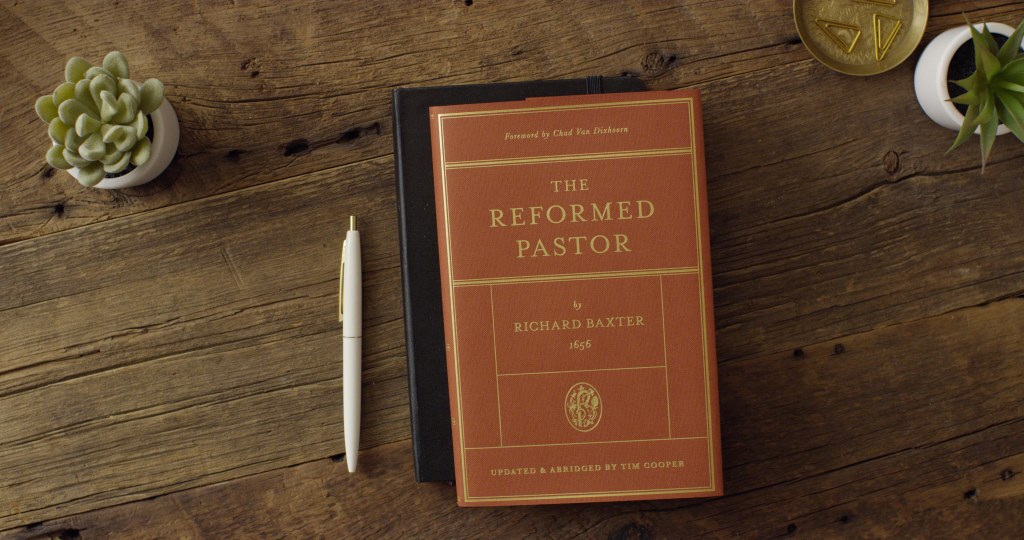
Originally published in 1656, The Reformed Pastor is Baxter’s exposition of Acts 20:28 (“Take heed unto yourselves and all the flock, over which the Holy Spirit has made you overseers, to feed the church of God, which he has purchased with his own blood”). Baxter delivered these words to his fellow local pastors as they renewed their commitment to a “reformed” pastoral ministry (i.e., one that was re-formed to the original shape of the New Testament). Baxter reminds his fellow pastors of the seriousness of their calling, invites them to confess their neglect, and calls for a new resolve to their work, with a particular emphasis on the ministry of home visitation.
Whether or not one will agree with all the particulars of Baxter’s application of Acts 20, namely the specific form he says home visitations ought to take, his voice continues to serve a clarion call to the essential work of pastoral ministry: take heed of the flock. The message of The Reformed Pastor seems needful all the more as much of modern American evangelicalism seems to clamor for the opposite—”big box” megachurches where most pastors and congregants often remain relatively unknown to each other, churches that pursue production value, programs, and metrics over actual disciple-making, and thus pastors who are expected to be more like corporate CEOs than true shepherds.
“In the history of pastoral life, certain books stand out as classics that must be read by anyone who is serious about this utterly vital sphere of the Christian world. … Among this select group is Richard Baxter’s The Reformed Pastor. It can be a daunting read, for Baxter demands much of anyone who would seek to serve as a pastor to the souls of men and women and children. Daunting though it is, it is a must-read. For here we find not only a book that has influenced generations since it was first published but a work that sets forth the high calling of being a minister of the gospel. The latter is not in vogue today for a number of reasons, and to some extent we are reaping the fruit of our failure to highly prize pastoral leadership. May the reading of this new edition, rightly abridged, serve to rekindle among God’s people a prizing of the pastorate and a prayer for those who serve in it. May it be a key vehicle to help refocus the passions and goals and energies of those currently serving as shepherds of God’s people!”
Michael A. G. Haykin
Tim Cooper has sought to make this classic text a great deal easier to read by updating much of Baxter’s seventeenth-century language. Also, by eliminating Baxter’s redundancies, he’s reduced the book’s length to 30,000 words, down from its original 160,000, presenting the best of Richard Baxter’s timeless advice, while making it all the more accessible to a new generation of pastors.
Table of Contents
Foreword by Chad Van Dixhoorn Introduction
Chapter 1: Take Heed unto Yourselves Chapter 2: Take Heed unto All the Flock Chapter 3: The Ministerial Work Chapter 4: What a Subtle Enemy Is This Sin of Pride! Chapter 5: Many Things Sadly out of Order Chapter 6: Reasons Why You Should Take Heed unto All the Flock Chapter 7: The Greatest Benefits of Our Work Chapter 8: Many Difficulties We Will Find Chapter 9: Some May Object Chapter 10: The Best Directions I Can Give
Appendix 1: The Catechism Appendix 2: Book Outline
Note: I received a free copy of this book from the publisher in exchange for this honest review.

 Kirk E. Miller