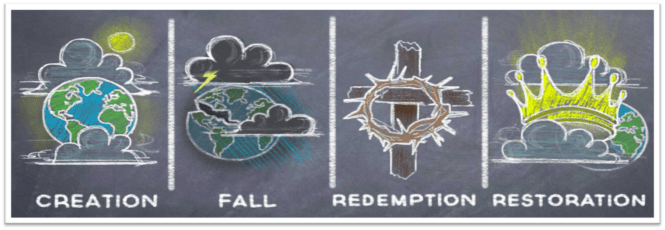
Christ’s Resurrection as the Accomplishment of God’s Faithfulness to His Creation (Vinoth Ramachandra)

Elsewhere I’ve written about this subject–the significance of Christ’s resurrection as inaugurated eschatology, the bursting of the new creation into the midst of this fallen creation in the person of Jesus Christ who is the resurrected new creation “pioneer” of sorts. But, I’m currently reading Ramachandra’s Faiths in Conflict?; and he summarizes this concept quite well. So, I thought I’d share his thoughts here. If it’s worth saying, it’s worth saying more than once and in more than one way by more than one person, right?

Resurrection, for all first-century Jews, was bound up with the hope of the kingdom of God, of God’s vindication of his people Israel before their pagan enemies and the renewal of his disfigured world.

Resurrection, then, was corporate… public, and physical. … The age to come would be a renewed space-time world in which the righteous dead would be given new bodies in order to inhabit a renewed earth. Thus, the resurrection of the dead – the righteous to eternal life and the wicked to destruction – marked the consummation of the human drama. It spelt the triumph of Israel’s God who was also the universal Creator and Judge of all humanity. Resurrection, marked the dawn of a new world order, the final and supreme manifestation of God’s justice, mercy and power in history.

But … the early Christians proclaimed that the resurrection had occurred in Jesus before the day of resurrection for all. … In the resurrection of Jesus, God not only gives a glimpse and pledge of the new creation, but he announces the dawn of that new creation before its promised fulfillment. Here is a foretaste of the future age in the present.

Resurrection [specifically the general resurrection inaugurated in Christ’s resurrection, the “first-fruits” of the general resurrection, to use Pauline language] is a fresh creative act of God in which he displays his faithfulness to his creation by raising it to new life in his presence beyond death and decay. Resurrection, then, is the Creator’s final act of faithfulness to his creation…

Continue reading

Regeneration and the New Creation

An Introductory Biblical Theology of Regeneration as it Pertains to a Proper Understanding of Inaugurated Eschatology

In contrast to systematic theology, a discipline that tackles doctrines in a neat, organized, systematic, and generally atemporal fashion, Biblical theology seeks to examine Biblical themes through the lens of progressive revelation, that is, in light of scripture’s metanarrative or unfolding plotline. Biblically theology deliberately makes temporal sequence (time development) and Scripture’s broad storyline the grid through which theology, doctrines, and themes are studied and investigated.

The following post will seek to provide an introduction to a Biblical theology on regeneration as it pertains to a proper understanding of inaugurated (already initiated) eschatology (pertaining to “last things”).

If that sounds confusing, that’s okay; it’ll all makes sense in just a bit.

Continue reading

Resurrection | The Pauline Epistles

The following belongs to a series entitled “An Introductory Biblical Theology of Resurrection.” Read other posts belonging to this series here.

__________

The Pauline Epistles

Of all Biblical authors, the resurrection is most prolific in Paul’s writings.[1] Of first importance, Paul confesses the bodily resurrection and appearance of Christ (1 Cor 15:3-8; Gal 1:1; 1 Thes 1:10; 2 Tim 2:8). Christ is raised for the imputation of His righteousness to all who are united to Him by faith (Rom 4:25),[2] and lives to make intercession for all those for whom He died (Rom 8:34). But even more so, the central motif in Paul’s resurrection-framework is union with Christ.[3]

Continue reading

Belief–The Only Valid Frame of Reference for the Resurrection of Christ

“The risen Jesus Christ cannot be discerned within the frame of the old conditions of life which by his resurrection he has transcended, and cannot be understood except within the context of the transformation which it has brought about. . . . The evidence for the resurrection can be handled and tested, appropriately, only within the orbit of its impact.”[1]

“We are not concerned here simply with what is often called ‘the hermeneutical circle’, but with the kind of circle which is posited by an ultimate fact which in the nature of the case cannot be brought within the same circle as other facts, but which stakes out the very grounds upon which experience and knowledge of it are possible.”[2]

Continue reading