Jonathan Edwards on God’s Affecting Design of Corporate Worship

Jonathan Edwards on “the nature and design of the ordinances and duties, which God hath appointed, as means and expressions of true religion.

To instance in the duty of prayer: it is manifest, we are not appointed, in this duty, to declare God’s perfections, his majesty, holiness, goodness, and all-sufficiency; our own meanness, emptiness, dependence, and unworthiness, our wants and desires, in order to inform God of these things, or to incline his heart, and prevail with him to be willing to show us mercy; but rather suitably to affect our own hearts with the things we express, and so to prepare us to receive the blessings we ask. And such gestures and manner of external behaviour in the worship of God, which custom has made to be significations of humility and reverence, can be of no further use, than as they have some tendency to affect our own hearts, or the hearts of others.

And the duty of singing praises to God, seems to be appointed wholly to excite and express religious affections. No other reason can be assigned, why we should express ourselves to God in verse, rather than in prose, and do it with music, but only, that such is our nature and frame, that these things have a tendency to move our affections.

The same thing appears in the nature and design of the sacraments, which God hath appointed. God, considering our frame, hath not only appointed that we should be told of the great things of the gospel and the redemption of Christ, and be instructed in them by his word; but also that they should be, as it were, exhibited to our view in sensible representations, the more to affect us with them.

And the impressing of divine things on the hearts and affections of men, is evidently one great end for which God has ordained, that his word delivered in the Holy Scriptures, should be opened, applied, and set home upon men, in preaching. And therefore it does not answer the aim which God had in this institution, merely for men to have good commentaries and expositions on the Scripture, and other good books of divinity; because, although these may tend, as well as preaching, to give a good doctrinal or speculative understanding of the word of God, yet they have not an equal tendency to impress them on men’s hearts and affections. God hath appointed a particular and lively application of his word, in the preaching of it, as a fit means to affect sinners with the importance of religion, their own misery, the necessity of a remedy, and the glory and sufficiency of a remedy provided; to stir up the pure minds of the saints, quicken their affections by often bringing the great things of religion to their remembrance, and setting them in their proper colours…. God has appointed preaching as a means to promote in the saints joy.” (Religious Affections, I.II.9)

And if this be the case then…

“If true religion lies much in the affections, we may infer, that such means are to be desired, as have much tendency to move the affections. Such books, and such a way of preaching the word and the administration of ordinances, and such a way of worshipping God in prayer and praises, as has a tendency deeply to affect the hearts of those who attend these means, is much to be desired. … Indeed there may be such means, as have a great tendency to stir up the passions of weak and ignorant persons, and yet have none to benefit their souls: for though they may have a tendency to excite affections, they have little or none to excite gracious affections. But, undoubtedly, if the things of religion in the means used, are treated according to their nature, and exhibited truly, so as tends to convey just apprehensions and a right judgment of them; the more they have a tendency to move the affections, the better.” (I.III.2)


The Church: Identity, Mission, & Cultivation

The below is a Gospel Life Course taught during May 2018 at CrossWay Community Church.

Week 1 — Introduction, Identity, & Mission
May 6th, 2018

Week 2 — Cultivation, pt. 1
May 13th, 2018

Week 3 — Cultivation, pt. 2
May 20th, 2018

Week 4 — Cultivation, pt. 3
May 27th, 2018

Understanding the Lord’s Supper as a Means of Grace

This past week, at our church plant’s Thursday night gathering, we took some time to talk about the importance of the Lord’s Supper in the life of the believer and the church.

We looked at our philosophy of ministry, which says,

The ordained rites of Baptism and the Lord’s Supper are faith-nourishing signs that tangibly portray Gospel realities to believers. As such, they are not to be neglected, devalued, or misused, but, rather, are to be guarded, administered conscientiously, and cherished as gracious gifts from Christ.

Mt 26:26-28; Mk 14:22-24; Lk 22:19-20; Acts 22:16; Rom 6:3-4; 1 Cor 10:16; 11:23-27; Gal 3:27; Col 2:12; Tit 3:5; 1 Pet 3:21.

I want to follow up on that discussion here in this post.

Often times, in the more baptistic, non-denominational, believers’-church-tradition circle in which I find myself, the Lord’s Supper is seen as nothing more than a cognitive aid for rehearsing the sacrificial death of Jesus. We call this the memorial view of the Supper: the Supper is a means of remembering (hence “memorial”) the death of Christ.

Now, I don’t want to downplay the importance of simply remembering Christ’s work on our behalf. But I do want to ask, What is that “remembering” suppose to look like and involve? What does the New Testament have in mind when it talks of this “remembering.” Is it merely a recall, a cognitive exercise like running scenes from the Passion of the Christ in your head? Or is it something more like what we refer to today as “preaching the truths of the Gospel to yourself”?

Continue reading

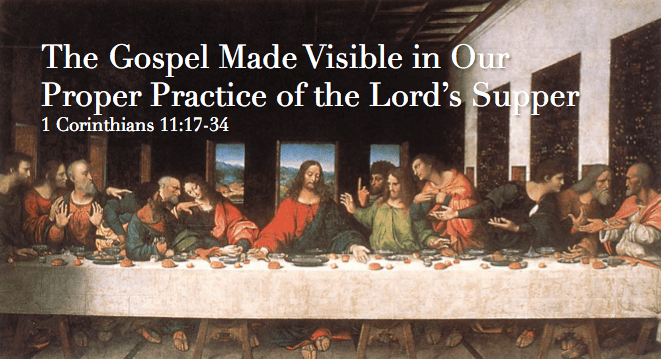
The Gospel Made Visible in Our Proper Practice of the Lord’s Supper (1 Corinthians 11:17-34)

The following was a sermon I delivered on November 22, 2015 as a guest preacher at Living Water Community Church in Vancouver, WA. Below you will find a link to the sermon audio as well as my sermon notes.


Podcast link.


Introductory illustration:

We’re aware of the fact that the clothing we wear needs to fit the occasion, event, or activity to which we wear them.

For example, when I was in high school, I worked at a restaurant. And I had to wear a uniform—this ugly purple polo shirt that felt like burlap. Or, when I refereed soccer, I didn’t just wear whatever I wanted; I wore a referee outfit.

Similarly, many of you probably have either a work uniform, a certain dress code that you have to follow, or, if you’re in school, maybe you have a school uniform.

We even have special gowns for graduating (although I’m slightly convinced that whoever invented these wanted to make graduates feel stupid—“Hey, you’re graduating. Congratulations! How ‘bout you wear this black-garbage-bag-looking thing and silly square hat. Oh! And while you’re at it, why don’t you walk across a stage while we take pictures of you? How does that sound?”).

We have these unwritten rules for what we wear and where we wear them: You don’t wear a tuxedo if you’re fixing your plumbing. And you probably don’t want to dress like Richard Simons if you’re going to a formal wedding… Or ever for that matter. And when you go shopping, you don’t wear your pajamas… well, unless, apparently, you’re shopping at Wal-Mart.

You see, there’s this recognized principle (at least among most of us) that what we wear needs to fit the occasion of the thing we’re wearing it to.

Now when it came to the Lord’s Supper for the Corinthian church, they found themselves wearing “the wrong clothes.” Of course, I don’t mean that they were literally wearing the wrong clothes. But think of this idea of clothing as an illustration—the way they practiced the Lord’s Supper did not match the meaning of the Lord’s Supper. Their practice was inappropriate for what the Lord’s Supper means. And so they found themselves “wearing the wrong clothes.”

But we too can easily find ourselves “wearing the wrong clothes” in how we practice the Lord’s Supper. We too can lose sight of the full, true, Biblical meaning of the Supper, and, consequently, practice it inappropriately.

Continue reading

“Partaking in a Worthy Manner” (Sermon on 1 Corinthians 11:17-34)

Sunday morning sermonLord's Supper - 1 Cor 11
Lake Drive Baptist Church
Delivered August 31st, 2014
 Text: 1 Corinthians 11:17-34


 17 But in giving this instruction, I do not praise you, because you come together not for the better but for the worse. 18 For, in the first place, when you come together as a church, I hear that divisions exist among you; and in part I believe it. 19 For there must also be factions among you, so that those who are approved may become evident among you. 20 Therefore when you meet together, it is not to eat the Lord’s Supper, 21 for in your eating each one takes his own supper first; and one is hungry and another is drunk. 22 What! Do you not have houses in which to eat and drink? Or do you despise the church of God and shame those who have nothing? What shall I say to you? Shall I praise you? In this I will not praise you.

23 For I received from the Lord that which I also delivered to you, that the Lord Jesus in the night in which He was betrayed took bread; 24 and when He had given thanks, He broke it and said, “This is My body, which is for you; do this in remembrance of Me.” 25 In the same way He took the cup also after supper, saying, “This cup is the new covenant in My blood; do this, as often as you drink it, in remembrance of Me.” 26 For as often as you eat this bread and drink the cup, you proclaim the Lord’s death until He comes.

27 Therefore whoever eats the bread or drinks the cup of the Lord in an unworthy manner, shall be guilty of the body and the blood of the Lord. 28 But a man must examine himself, and in so doing he is to eat of the bread and drink of the cup. 29 For he who eats and drinks, eats and drinks judgment to himself if he does not judge the body rightly. 30 For this reason many among you are weak and sick, and a number sleep. 31 But if we judged ourselves rightly, we would not be judged. 32 But when we are judged, we are disciplined by the Lord so that we will not be condemned along with the world.

33 So then, my brethren, when you come together to eat, wait for one another. 34 If anyone is hungry, let him eat at home, so that you will not come together for judgment. The remaining matters I will arrange when I come. (NASB)


Introduction:

Without necessarily consciously thinking about it, we are aware of the idea that the clothing we wear needs to fit the occasion, event, or activity to which we wear them. For example, when I was in high school, I worked at a restaurant. And I had to wear a uniform—this ugly purple polo shirt that felt like burlap. Or, when I refereed soccer, I didn’t just wear anything; I wore a referee outfit. Similarly, many of you probably have either a work uniform, school uniform, or a certain dress code. We even have special gowns for those who are graduating (although I’m slightly convinced that whoever invented these wanted to make graduates feel humiliated—“Hey, you’re graduating. So… wear this black garbage bag and silly hat while we make you walk on a stage”). We have unwritten rules: You don’t wear a tuxedo to go swimming at the beach. When you go to a funeral, you’re not going to dress like Richard Simons. And when you go shopping, you don’t wear your pajamas… unless, apparently, you’re shopping at Wal-Mart.

Continue reading