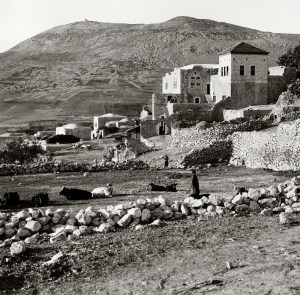
As I read and meditated on this passage, something with which I was initially struck that I hadn’t paid much attention to before was the significance of this well in the story. In v.5, John goes out of his way to point out this well’s significance. It was Jacob’s well, the great forefather of Israel. Moreover, after Jesus mentions His “living water,” the woman asks in v.12, Are you greater than our father Jacob who gave us this well and drank out of it himself? In other words, do you think that your water is somehow better than Jacob’s, our great forefather? And of course, likely alluding to the OT imagery of the Holy Spirit as water, Jesus argues that His “water” is superior. Jesus is greater than Jacob. And, if D.A. Carson’s understanding of “truth” (i.e., the reality, the antitype) in v.24 is correct, this insight correlates to Jesus’ statement about worshipping in “truth.” Jesus is that “true” everything that the OT anticipated according to John. Specifically here, He is superior to Jacob; His well, i.e., Himself, is the “true” well.
 In this article, Andy Naselli discusses the beginning of John 15 and Jesus’ command, “Abide in Me, and I in you” (v.4). The article seeks to answer two questions many have posed regarding this passage. First, who are those represented by first type of branch that abide in Christ and therefore bear much fruit? Does this speak of some or all believers? Are these spiritual Christians or is abiding in Christ a characteristic of every true believer? Second, who are those represented by the second type of branch that never bears fruit and is therefore cut off? Is this a once saved believer who loses his salvation? Is this a saved yet unfruitful believer whom God is chastising? Or might this simply be a professing believer is not truly saved? Obviously, such questions have immense soteriological implications.
 Kirk E. Miller