Ten Principles for the Use of Scripture in Theology

Using Scripture

The following is minor paper completed in partial fulfillment of the requirements for the course ST 7505 Use of Scripture and Theology taught by Dr. Kevin Vanhoozer at Trinity Evangelical Divinity School in Deerfield, IL in December, 2015. Please note that the focus of this paper (and the class) is not hermeneutics, but the use of scripture in making dogmatic and moral theological proposals.


  1. One’s use of scripture for dogmatic and moral theology must be in keeping with the nature (ontology) and purpose (teleology) of scripture itself.[1]
  1. One’s use of scripture for dogmatic and ethical theology must share the very aims of scripture itself (and, by extension, theology), lest it distort and subvert the very nature of theology. This means that a proper use of scripture—in line with the very equipping-aims of scripture itself—must be, for example:
    • Theological (directed towards knowledge of and relationship with God), answering, “How does this text enhance knowledge of God and foster appropriate relationship with God?”
    • Doxological (directed towards the worship of God), answering, “How does this text fuel the worship of God?”
    • Mathetesical (directed towards Christian living), answering, “How does this text form disciples (mathetes)?”
    • Ecclesiological (directed towards the life of the church), answering, “How does this text shape God’s people to realize its calling?”
    • Missiological (directed towards equipping for mission), answering, “How does this text equip God’s people for mission?”
  1. If one’s use of scripture to authorize theological proposals is actually going to authorize those proposals with the authority of scripture itself (a derivative authority), one’s use must be born out of the very claims—which, one must remember, are communicated in a variety of ways through a variety of discourse forms[2]—of scripture itself (the locus of authority). Consequently, one’s appropriation of scripture for dogmatic and moral theological proposals must be based on the purpose, intent, or underlying reasoning of Biblical content, not its accidental, attendant, or purely descriptive features.[3]

Continue reading

What not to say about interpreting the Bible literally – Gregory of Nyssa

The following is taken and modified from a outline on Gregory of Nyssa’s Life of Moses I will be presenting for a class.

In this work, Gregory of Nyssa presents a spiritual-moral-contemplative-allegorical interpretation of Moses’ life with the theme of virtue as its driving paradigm for his interpretive ‘insights.’ To say the least, most of his interpretations are rather outlandish. His goal is that “by transferring to your own life what is contemplated through spiritual interpretation of things spoken literally” (II.320) “those who have been striving toward virtue may find aid in living the virtuous life” (II.49, 148).

Below I’ll present something like a critique of his interpretive method that I’ll offer in my class presentation. My critique is stated as such: “Inappropriate use of allegorical interpretation.”


  • Allegorical interpretation of literature is legitimate if the literature is meant to be interpreted allegorically (e.g., Pilgrim’s Progress). The Pentateuch is not such literature.
  • Continue reading

The Hermeneutical Element of Godly Character

Athanasius

At the very end of his book, On the Incarnation, Athanasius makes a very interesting comment that has always stuck out to me.

But for the searching and right understanding of the Scriptures there is need of a good life and a pure soul, and for Christian virtue to guide the mind to grasp, so far as human nature can, the truth concerning God the Word. One cannot possibly understand the teaching of the saints unless one has a pure mind and is trying to imitate their life. Anyone who wants to look at sunlight naturally wipes his eye clear first, in order to make, at any rate, some approximation to the purity of that on which he looks; and a person wishing to see a city or country goes to the place in order to do so. Similarly, anyone who wishes to understand the mind of the sacred writers must first cleanse his own life, and approach the saints by copying their deeds. Thus united to them in the fellowship of life, he will both understand the things revealed to them by God….

~ Athanasius, On the Incarnation, chapter 9, section 57.

Illustration

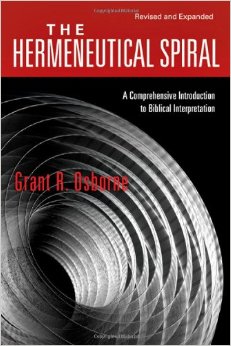
Grant Osborne has popularized an idea known as the ‘hermeneutical spiral’ according to which various elements like exegesis of the text, biblical theology, systematic theology, historic theology, etc. create a ‘hermeneutical spiral’ something like the following admittedly simplistic explanation:

Trust the New Testament; and Give It Logical Priority

I was having a conversation with some individuals yesterday regarding Old Testament hermeneutics and the relationship between the Old Testament and the New.

As we were discussing the interpretation of the Old Testament, and particularly an insistence on literal interpretation of the Old Testament, I brought up the fact that too often of this sort discussion neglects how the New Testament develops and progresses what the Old Testament said. Further, it ignores the New Testament’s very use of the Old Testament (e.g., citations, allusions, calling things “fulfilled,” etc.).

Although the New Testament doesn’t violate or contradict the Old Testament voice, it often interprets and applies the Old Testament in non-literal ways (if by “literal” we mean an exact correspondence in meaning). Again, I would argue that the New Testament doesn’t violate or contradict the Old Testament. But it does use it and relate to it in such a way that it develops it, complements it, and applies it in light of the progress and unfolding of God’s plan in Christ and the Church.

Continue reading

Gospel and Kingdom by Graeme Goldsworthy

In Gospel and Kingdom by Graeme Goldsworthy, two prominent argument-themes emerge. For that sake of organization, I’ll present this review according to those two categories.

The Kingdom Pattern

The fact that God acts in the history of men and interprets his acts means that these historical events will form a pattern that relates to the purpose of God [pg. 42].

And the central pattern that spans Biblical history, for Goldsworthy, is the concept of kingdom [42].

For Goldsworthy, the kingdom of God involves (a) God’s people, (b) in God’s place, (c) under God’s rule [53-54]. Both the content of the central Biblical covenants and the goal of redemption history is this kingdom of God [53]. Therefore, as an implication, under various Biblical covenants and within various eras of redemption history, different forms or stages of development of this kingdom exist on a trajectory ultimately consummating in the final realization of this kingdom in the Jesus Christ.

Continue reading