What does the Evangelical Free Church of America (EFCA) believe? What are the theological convictions that unite this broad collection of churches? In this episode, Kirk is joined by Greg Strand, executive director of theology and credentialing for the EFCA, to discuss and exposit the EFCA’s Statement of Faith. As we hope you’ll see, this Statement of Faith is an articulation of nothing less than the core elements of gospel itself.
The following is an excerpt from chapter 1, “A Bible Belt No More,” in Russell Moore’s OnWard: Engaging the Culture Without Losing the Gospel.
It’s not just the cultural landscape that has changed. American Christianity is changing too, though not in the ways that some in the wider culture hope and some in the older generation fear. Many recognize that younger generations of evangelical Christians, especially pastors and other leaders, seem different from their culture warrior predecessors. Because of this, many assume that this wing of the church is headed Left, especially on the contentious questions of sexual morality, which are at the root of the most contested issues of abortion, marriage/family, and even, increasingly, religious liberty and church/state relations. The standard trope I hear often from secular journalists is that the historic Christian commitment to sexual morality, in which sexual relations are limited to the marriage of a man to a woman, is a stumbling block to growth. We are losing our young, this narrative holds, and we would reclaim them if only we would soften our views on sex. If we would, the pews would be filled and the baptisteries bubbling as our leftward Christian soldiers return home.
Now, it’s true that newer generations of American evangelicals are interested in more than just the culture war issues of the past. Many are actively engaged on issues of orphan care, ecological stewardship, human trafficking, racial justice, prison reform, poverty, as well as abortion, marriage, and so on. This is not repudiation but an outgrowth of very conservative cultural impulses. Those working to alleviate poverty are, first of all, in continuity with every generation of conservative Christians who have done the same thing. Even when they deviate from the talking points of the Republican business class, they are hardly repudiating their moral and gospel roots. They focus on systemic problems but also on marriage stability, family accountability, and personal responsibility. And they are as committed as ever to the sanctity of human life and to marriage as a one-flesh union between a man and a woman.
Indeed, often the “broader” agenda items reinforce the social conservatism of the next generation of conservative Christians. Those working with the urban poor and the rural underclass see firsthand the devastation of family breakdown, no-fault divorce, the drug culture, predatory gambling, and so on. Moreover, the broader vision hardly makes orthodox Christianity any more palatable to the culture. When evangelicals adopt children, the secularist Left accuses them of “stealing” children for evangelism. And, if they didn’t adopt, the same voices would accuse them of caring for “fetuses” without providing homes for “unwanted” children after they’re born. Regardless of how broad the concern, and regardless of where this concern sometimes overlaps with that of progressives, the question usually comes around to, “Yes, but what about sex?”
…
That said, the older generations are mistaken if they assume the next generation will be more of the same, just with even more prayer for “revival” and “Great Awakening” in the land. The typical younger pastor is less partisan than his predecessor, less likely to speak from the pulpit about “mobilizing” voters and “reclaiming Judeo-Christian values” through political action and economic boycotts. This is not because he is evolving leftward. It is because he wants to keep Christianity Christian. As a matter of fact, the center of evangelical Christianity today is, theologically speaking, well to the right of the old Religious Right. It’s true that the typical younger pastor of a growing urban or suburban church doesn’t look like his cuff-linked or golf-shirted forefather. But that doesn’t mean he’s a liberal. He might have tattoos, yes, but they aren’t of Che Guevara. They’re of Hebrew passages from Deuteronomy.
His congregation’s statement of faith isn’t the generic sloganeering of the last generations’ doctrinally oozy consumerist evangelical movements, but is likely a lengthy manifesto with points and subpoints and footnotes rooted in one of the great theological traditions of the historic church. This pastor might preach forty-five minutes to an hour, sometimes calling out backsliding Christians from the pulpit with all the force of hellfire-and-brimstone revivalists of yesteryear. He is pro-life and pro-marriage, although he is likely to speak of issues like homosexuality in theological and pastoral terms rather than in rhetoric warning of “the gay agenda.”
Unlike the typical Bible Belt congregation of the twentieth century, the new kind of evangelical church has strict membership requirements, both in terms of what it takes to enter the believing community and what it takes to say there. There aren’t likely to be four-year-olds baptized after repeating sinner’s prayers in a backyard Bible club, and the unrepentant often face what their parents never seemed to notice in their red-and-black-lettered Bibles: excommunication. If this is liberalism, let’s have more of it.
… But they are often unsure of how to think of political engagement. Again, this is not due to liberalism but to theological conservatism. They have seen social gospels of the Left and the Right try to package a transcendent message for decidedly this-worldly, and sometimes downright cynical, purposes of pulling the levers of political power.
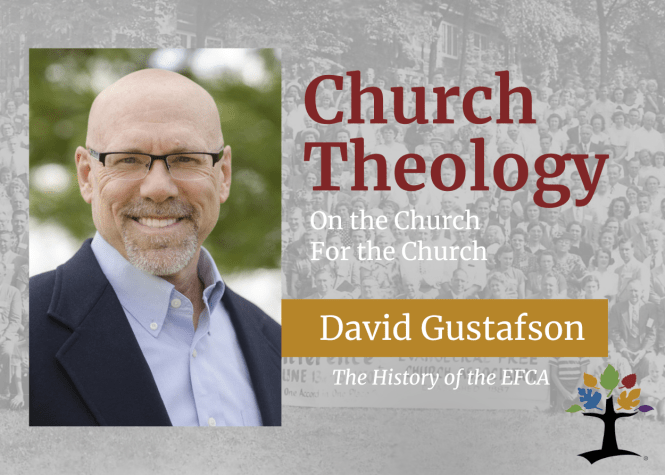
What is the EFCA (Evangelical Free Church of America)? And where did it originate? In order to help us better understand the EFCA heritage, Kirk interviewed Dr. David Gustafson who is currently writing a book on the history of the EFCA.
I was recently asked for advice from someone whose friend is struggling with their faith, and toying with deconstruction-type tendencies, due to failures in the Christian community. I thought I’d share my response below:
One thing that I think is important: don’t downplay or dismiss his sense of disillusionment or angst over the legit problems and failings of those in the church. As someone who very much sympathizes with many of these frustrations myself, I find it incredibly frustrating when folks simply dismiss my concerns with contemporary evangelicalism. It can be very disillusioning. Of course, the “deconstructionist” trend has lots of problems. But many (not all) of the things they are reacting to are real. I’ve met some evangelicals/fundamentalists who simply don’t seem bothered by the things others of us find deeply disturbing and unsettling. And for them to simply blow off our concerns is annoying, to say the least (often because they themselves are more sympathetic to the things we find problematic). But the problems are real. Acting like they aren’t won’t provide this man any solace. He won’t find it satisfying or convincing.
For me though, what’s been really helpful is (1) recognizing a global and historic church that goes deeper and wider than the craziness that unfortunately defines much of contemporary American evangelicalism/fundamentalism. Also, (2) recognizing that the NT predicted false teachers and problems in the church. So their existence doesn’t put in jeopardy the legitimacy of Christianity, as if for Christianity to be real the church mustn’t have issues. (3) Even the early church, which we sometimes hold up as pristine, was anything but. Look at Corinth. Or look at the messages to the churches in Revelation. As Augustine said, “The church is a whore, but she is my mother.” That quote has been a comfort to me these last few years, as odd as that may seem. (4) Also, online chatter and news reporting can give a skewed sense of reality. It highlights dramatic things, or the most radical voices. Instead (5) I want to focus on the actual flesh and blood community around me, my church. Yes, we’re not perfect, and there are folks that annoy me or are immature and in need of growth (I’m one of them). But focusing on my own community grounds me from ruminating in a downward spiral on some abstract sense of “the evangelical church.” (6) I’ve become okay with not having a particular tribe. From 2015 onward, we’ve seen conservative evangelicalism fracturing. And it was pretty painful for me, as people I thought were “my circle/tribe” clearly weren’t. It felt like betrayal. This caused me to realize how much I had valued having a tribe–but maybe in a way that wasn’t healthy. I feel more over that need now, because of these last few years, in hopefully a place that’s healthier. (7) Don’t give so much stock to evangelical leaders who say stupid stuff. Like yeah, they say stupid stuff. But why should I give them that much weight over how I think about my own faith or defining what Christianity is? Why should I let them have that sort of control over me, over Christianity? And ultimately (8) I’m a Christian because of Jesus. I follow him, not a church. And (9) I’m an evangelical because I believe this theological tradition reflects a right understanding of scripture and its gospel. I’m evangelical for convictional reasons, in other words, not sociological ones (like the state of evangelicalism).
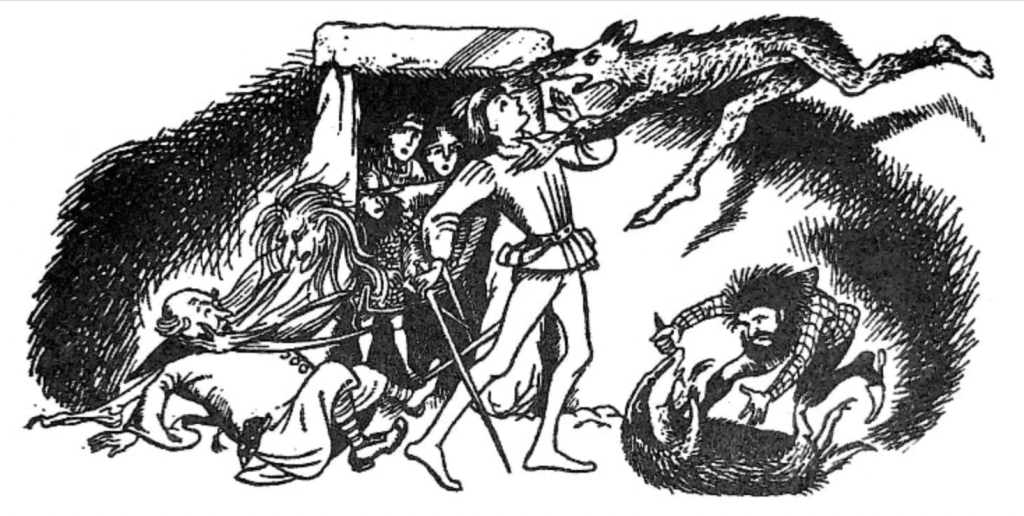
C.S. Lewis’ Prince Caspian (New York: Scholastic Inc., 1979) tells the story of a young Prince Caspian who must win back his kingdom against his evil Telmarine uncle, Miraz.
Early on in his ventures, one of Caspian’s comrades, a dwarf named Nikabrik, hints at his true colors (p. 77):
“Do you believe in Aslan?” said Caspian to Nikabrik.
“I’ll believe in anyone or anything,” said Nikabrik, “that’ll batter these cursed Telmarine barbarians to pieces or drive them out of Narnia. Anyone or anything, Aslan or the White Witch, do you understand?”
Finding themselves in dire straights, Caspian blows Susan’s magical horn in expectation that it will summon help, either of Aslan himself or the Pevensie children, Peter, Susan, Edmund, and Lucy (pp. 95–96).
But Nikabrik eventually grows impatient (pp. 163–144):
”Whether it was that the Horn was blown too late, or whether there was no magic in it, no help has come. You, you great clerk, you master magician, you know-all; are you still asking us to hang our hopes on Aslan and King Peter and all the rest of it?” …
“The help will come,” said Trufflehunter. “I stand by Aslan. Have patience, like us beasts. The help will come. It may be even now at the door.”
“Pah!” snarled Nikabrik. “You badgers would have us wait till the sky falls and we can all catch larks. I tell you we can’t wait. Food is running short; we lose more than we can afford at every encounter; our followers are slipping away.”
Nikibrik proposes an alternative, wanting to take matters in his own hands (pp. 166–168):
“Well, Nikabrik, ” [Prince Caspian] said, “we will hear your plan.” …
“All said and done,” he [Nikabrik] muttered, “none of us knows the truth about the ancient days in Narnia. Trumpkin believed none of the stories. I was ready to put them to the trial. We tried first the Horn and it has failed. If there ever was a High King Peter and a Queen Susan and a King Edmund and a Queen Lucy, then either they have not heard us, or they cannot come, or they are our enemies—”
“Or they are on the way,” put in Trufflehunter.
“You can go on saying that till Miraz has fed us all to his dogs. As I was saying, we have tried one link in the chain of old legends, and it has done us no good. Well. But when your sword breaks, you draw your dagger. The stories tell of other powers beside the ancient Kings and Queens. How if we could call them up?” ….
“Who do you mean?” said Caspian at last.
“I mean a power so much greater than Aslan’s that it held Narnia spellbound for years and years, if the stories are true.”
“The White Witch!” cried three voices all at once….
“Yes, said Nikabrik very slowly and distinctly, “I mean the Witch. … We want power: and we want a power that will be on our side. … They say she ruled for a hundred years: a hundred years of winter. There’s power, if you like. There’s something practical.”
As I read the above section from C.S. Lewis’ Prince Caspian this evening, I couldn’t help but think of how it unfortunately seemed to parabolize much of the current posture of contemporary, American evangelicalism. We’re pragmatic over principled. Over against the “foolish” call to cruciformly, we’re entangled in a love affair with the corrupting influence of power. We want power—who cares if that power happens to be the “White Witch”?
Luckily, Prince Caspian and crew have the wherewithal to see through Nikabrik’s proposal, and they dismantle his plot right then and there. May we have the foresight in this moment to revive our call and do the same.

 Kirk E. Miller