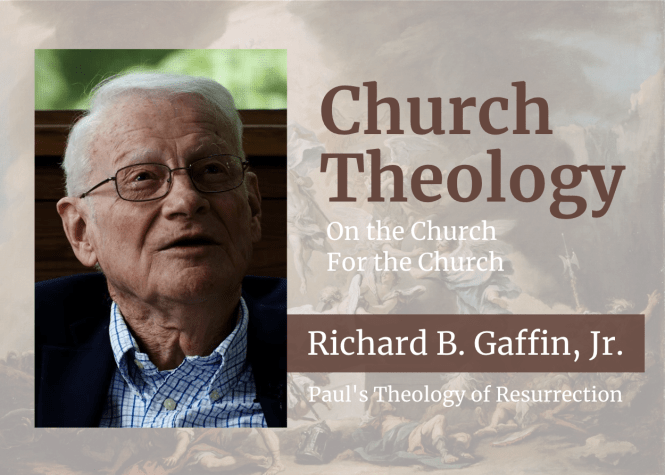
Paul’s Theology of Resurrection (with Richard Gaffin)

How did Paul think about resurrection, and what role did it play in his overall theological understanding? Kirk sits down for a conversation with retired professor, Dr. Richard Gaffin, about Paul’s theology of resurrection. We explore questions like, what is the connection between Christ’s resurrection and ours? What is the relationship between Christ’s resurrection and the ministry of the Spirit in our lives? What does Paul mean when he says that Jesus was “raised for our justification” (Rom 4:25)? And how does Christ’s resurrection empower us for our mission as a church?

Access the episode here. (Available on Apple Podcasts, Spotify, Google Podcasts, Stitcher, and more.)

RECOMMENDED: Ferguson, Empathy, & Hope by Jefferson Bethke

Wise words from Jefferson Bethke on the Ferguson situation.


Here are some tweets for context and more wise comments.

Unfortunately, Bethke started getting attacked for that tweet.

For example… (below) Yet Bethke responds with insight into the situation that I wish more within evangelicalism had.

He concludes,

Tongues | The Nature and Function of Tongues Speaking

The following belongs to a series on the continuation or cessation of the miraculous phenomena of tongues-speaking. Read the previous post here.

__________

One of the most significant and decisive factors concerning the cessation or continuation of tongues is the purpose that tongues had/has, or said differently, the essence of the presence of tongues. Temporary function and provisional existence would argue for the momentary presence of tongues. But on the other hand, a continual function and permanent nature would necessitate continuation.

A Sign

Of the Hardening of Israel

In 1 Corinthians 14:1 Paul begins an argument that prophecy is to be preferred over tongues, namely, uninterpreted tongues (14:1-25). Paul’s first reason is that uninterpreted tongues do not edify the congregation (14:2-19; cf. 12:7; 13:1-3). Paul’s second reason, found in verses 20-25, is that tongues repel unbelievers1 due to its apparent bizarre manifestation when uninterpreted (v.23). Paul says this repelling effect is due to the fact that tongues is not primarily for the church. The essence of tongues’ existence is found in it being a sign to Israel of their hardened hearts (vv.21-22).2 However, prophecy, which is given for the congregation’s good (v.22),3 can serve to draw the unsaved to repentance (vv.24-25).

Continue reading