As a pastor and teacher in the church, folks often ask me for suggestions on useful resources to help them understand the Bible.
The amount of books being written today on how to read and understand the Bible, however, can be rather dizzying. It’s a great blessing to have such an extent of literature and resources available to us. But what if someone is not as acquainted with these things? How does one even know where to start? How does one know what’s good and what isn’t? Or even if I am able to determine what’s valuable, maybe I’m not the sort of person who intends on building a massive library. What if I just want to acquire a handful of really helpful books that cover a large stretch of Biblical material?
If that describes you (or maybe even if it doesn’t*), I want to recommend to you The New Bible Commentary (NBC), 21st Century Edition.
The New Bible Commentary
 Voted one of Christianity Today’s 1995 Books of the Year, The New Bible Commentary is a one-volume commentary on the entire Bible. It’s one volume, in other words, that contains 66 individual commentaries for each book of the Bible.
The NBC is thoroughly evangelical in outlook. It’s edited by D.A. Carson, R. T. France, J. Alec Motyer, and Gordon J. Wenham, and has contributors from top-notch evangelical scholars like T.D. Alexander, Bruce Waltke, Derek Kidner, Moises Silva, Christopher Wright, Doug Moo, Leon Morris, Howard Marshall, and many others.
And that’s actually one of the unique advantages of a work like The New Bible Commentary. Many comparable resources and study Bibles, which also seek to cover the whole of scripture, are often times written by just one author, maybe a popular pastor. Without dismissing the value of those other works, the advantage of the NBC, however, is that rather than getting the opinion of author who undoubtedly does not possess specialization on every book of the Bible, with the NBC you get a full roster of specialists. The NBC contains a collection of scholars who each write on their particular area of expertise. In other words, you’re always reading from someone who actually specializes in the subject at hand.
The NBC is incredibly accessible. Any believer, no matter what their skill level, should be able to pick up this book and gain from it. The NBC provides commentary on each section of scripture, and supples helpful explanation of all major interpretive issues in a passage. At the same time, it strives to remain concise and succinct, not getting bogged down in overly-technical and lengthy discussion.
Each commentary begins with introductory material about the book’s author, date, setting, outline, major themes, and much more. In addition, the NBC includes articles on Biblical history, how to read and understanding the Bible, as well as briefs on the nature of specific Biblical genres like poetry, the epistles, and apocalyptic literature.
Logos Bible Software

Logos Bible Software is the primary tool I use for collecting my books and doing in-depth Bible study. As such, my particular version of the NBC is owned in my Logos Bible Software.
I recommend Logos Bible Software for anyone looking to do serious study of the Bible. There are many advantages to owning a book in Logos over buying just a regular physical copy. As the Logos website explains, a book in Logos becomes more than just a book; it becomes “a robust resource that works dynamically with every other book in your library. Each resource is packed with tags and hyperlinks, serving as a gateway to an entire world of textual and visual resources. This network effect dramatically boosts the value of each book.” In other words, it becomes more than just a book; it becomes a piece of a whole, high-powered Bible study system. –This in addition to the advantages that come with any ebook: easily portable, searchable, editable notations and note taking (copy and paste function), etc.
 Of course their are downsides to electronic books — no doubt. But there are also a ton of positives, and, as noted, even more so in the case of Logos.
Anyone can get Logos for free here (this free package includes 20+ free books, with resources valued at over $1,500)… yeah, all free. And then you can buy the NBC to have added to your Logos library here.
As an official partner with Logos, I’m also able to offer highest rate discounts on all base packages if you actually want to purchase something with even more resources — like the current Fundamentals Base Package, which includes the NBC.
Use my special partner code KIRK8 at checkout for all purchases.
Further Info
For many years I recommended the old New Bible Commentary as the best of its kind on the market. I expect to find myself saying the same of this new work that replaces it.
—J. I. Packer, author of Knowing God
- 21st Century Edition.
- InterVarsity Press, 1994.
- 1,455 pages.
Notes:
- Even if you are someone like me who buys a lot of commentaries and more in-depth resources, I still recommend considering the NBC. I frequently use the NBC in my Bible study and sermon preparation, alongside more lengthy, technical resources for its succinct overview of a passage and its major interpretive issues.
Full disclosure: I received compensation in exchange for this review. However, that compensation did not impact the content of this review.
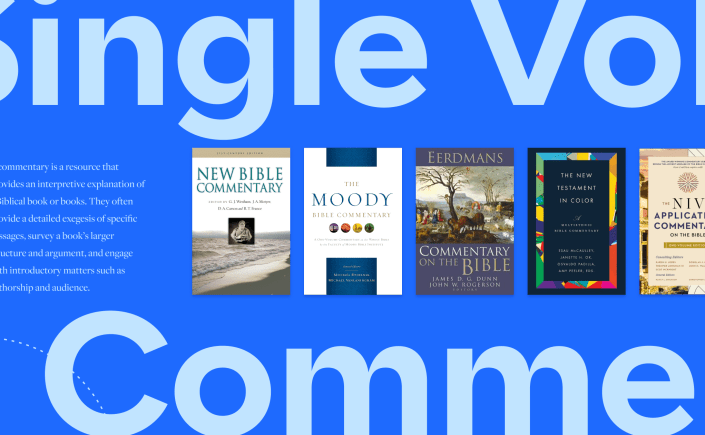

 A Biblical Commentary is a book that provides an interpretive explanation of a Biblical book or books. Commentaries provide a detailed explanation of specific Biblical passages, an explanation of a Biblical book’s larger structure or argument, and typically engage with introductory matters such as authorship, audience, date of writing, purpose of writing, composition, etc.
 Kirk E. Miller