What makes a healthy church? In this episode of Logos Live, I talk with Mark Dever about the Bible’s vision for the church.
Church Membership
The Keys of the Kingdom (Matthew 16:19) | Jonathan Leeman
What does Jesus mean by the “keys of the kingdom,” and to whom does he give them? Jonathan Leeman joins me on What in the Word? to discuss the Matthew 16:19.
Follow the show on YouTube, Spotify, Apple Podcasts, and more.
Do You Reach Out When Church Members Leave?
Church member, when someone resigns their membership and leaves your church, do you take the time to reach out to them?
If someone leaves your church due to a life transition, such as moving away for work or school, I hope you connect with them, say goodbye, and pray for them as they go. But I also have in view those who leave for other, often unannounced, reasons. What about those who leave? Do you also reach out to them to care for them as they go?
What if you made it a point to never let a fellow member leave without reaching out to them?
Tweet
If we take church membership seriously—as a covenant to the church and to one another—then our commitment to fellow members certainly includes caring for and looking out for each other while we are members of the same church. Being a part of a church involves promises and obligations to every member.
But it would also seem that part of honoring that covenant means caring about members as they leave and caring enough about the circumstances that led to their exit. Or do you simply cut ties, as if their departure doesn’t matter?
Consider what it communicates when someone leaves a church only to have zero—or very few—show even the most minimal amount of care so as to reach out. Departing from a church is often a difficult decision, at times occurring under already painful circumstances. For no one to reach out likely adds to that pain, making such people feel forgotten, neglected, like they apparently must not have mattered much to those who were once their fellow members, of no consequence to the very church they once called “family.”
Perhaps you’re thinking, “But that’s uncomfortable.” When, though, was church membership ever about your own personal comfort? Christlike community (see Phil 2:4b) involves caring enough about others to endure any personal discomfort for the good and care of others. It requires de-centering ourselves: our comfort and interests are not the priority (Phil 2:4a).
2:4a Let each of you look not only to his own interests, but also to the interests of others. 2:4b Have this mind among yourselves, which is yours in Christ Jesus.—Philippians 2:4
Who Can Take the Lord’s Supper?: Understanding Close Communion (with Dallas Vandiver)
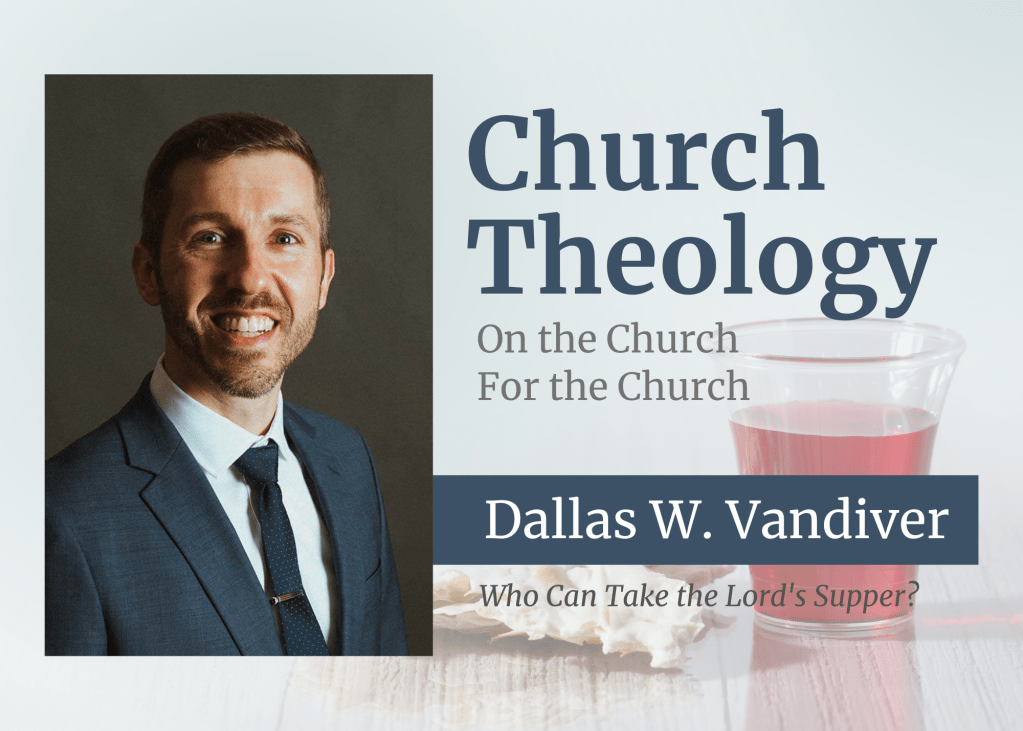
Who ought to be allowed to partake of the Lord’s Supper? Maybe this question has never occurred to you, or you’ve always assumed the answer was obvious! Well, in this episode, Dr. Dallas Vandiver joins me to talk about a historic position known as ‘close communion,’ that the Lord’s Supper ought to be reserved for baptized members in good standing of a gospel-believing church.
Access the episode here. (Available on Apple Podcasts, Spotify, Google Podcasts, Stitcher, and more.)
Dallas Vandiver’s book, Who Can Take the Lord’s Supper?: A Biblical-Theological Argument for Close Communion.
Dallas Vandiver’s shorter article summarizing the arguments of the book:
Why Baptism is Required for Church Membership (with Bobby Jamieson)

Why does our church, and churches like ours, require people to be baptized before we will admit them as members of our church? Today Kirk is joined by Bobby Jamieson, associate pastor at Capitol Hill Baptist Church in Washington, D.C., to discuss the Biblical and theological reason for this practice.
Access the episode here. (Available on Apple Podcasts, Spotify, Google Podcasts, Stitcher, and more.)
 Kirk E. Miller