What Does it Mean to Be Baptist?: Baptist Distinctives, Origins, Significant Figures, and More

“What comes to mind when you hear the word “Baptist”? I asked this question online, and to no great surprise I received an array of answers. Some think of an energetic church choir with colorful robes. Others think of solemn, even stuffy Sunday services where expressions of emotion are frowned upon. Some think of fiery, revivalistic preaching complete with weekly altar calls. Others think of detailed doctrinal expositions. One friend remarked that, in his experience, when some folks try to describe Baptists, they have an easier time listing things some Baptists don’t believe in (alcohol, dancing) than providing what Baptists do believe!

These responses are all quite understandable. Baptists are a diverse bunch.

So who are Baptists? And what do Baptists actually believe? In this article, we seek to answer theses question, giving the reader a basic primer on the Baptist tradition—with a view to using its resources for one’s study of Scripture.”

The Church’s Exercise of the Keys of the Kingdom: What Sort of Authority Does the Church Have?

God has created various institutions within creation. To each one he gives particular domains of authority (e.g., parents/fathers over the home, elders the church, the government the state, etc.), and particular ways of enforcing their authority fitting to their particular type of authority.

In other words, not all institutions exercise or enforce their authority the same way. For instance, God has authorized the state to wield the sword (Rom 13). In other words, the state can coerce its citizens by threat of material punishment. The church however is a voluntary society. It doesn’t coerce; rather it persuades. People willingly believe and join, submitting to Christ’s rule.

But Christ did not leave the church without a means of exercising and enforcing its authority. Whereas he gave the state the “sword,” he gave the church the “keys of the kingdom” by which to state who is in and who is out of Christ’s kingdom (see Mt 16:18-19; 18:15-20; Jn 20:23).

The church is like an embassy of heaven that issues passports declaring who belongs to Jesus. Word (teaching, preaching) and sacrament (baptism, Lord’s Supper) are the means by which the church positively exercises this authority, persuading people to believe and obey (Word) and then marking off those who do (sacrament). And church discipline is the way the church negatively exercises this authority—declaring that one in fact is not a citizen of Christ’s kingdom.

But the church can’t make anyone believe and obey. The church doesn’t possess that sort of authority. We can only persuade (Word). And when persuasion fails and someone is unrepentant, which is characteristic of an unbeliever, we declare them so (church discipline). That’s the only authority we have; more importantly, the only authority Christ has given us, and so we dare not overstep those bounds.

A Case for Believers’ Baptism by Immersion from Colossians 2:11-12

Paul’s argument in Colossians 2:11-12 assume the following three things:

  1. Believers are baptized.
  2. Those who are baptized are believers.
  3. Baptism is immersion.

Allow me to briefly elaborate on each of these assertions.

1. Believers are baptized

You’ll notice in this passage, as Paul addresses the Colossians, he can assume all of them have been baptized (“you been buried with him in baptism, in which you were also raised with him”). It was assumed that believers were baptized, such that Paul can readily appeal to their baptism as part of his argument here. Paul, along with the rest of the New Testament, has no category or conception of an unbaptized believer.

Continue reading

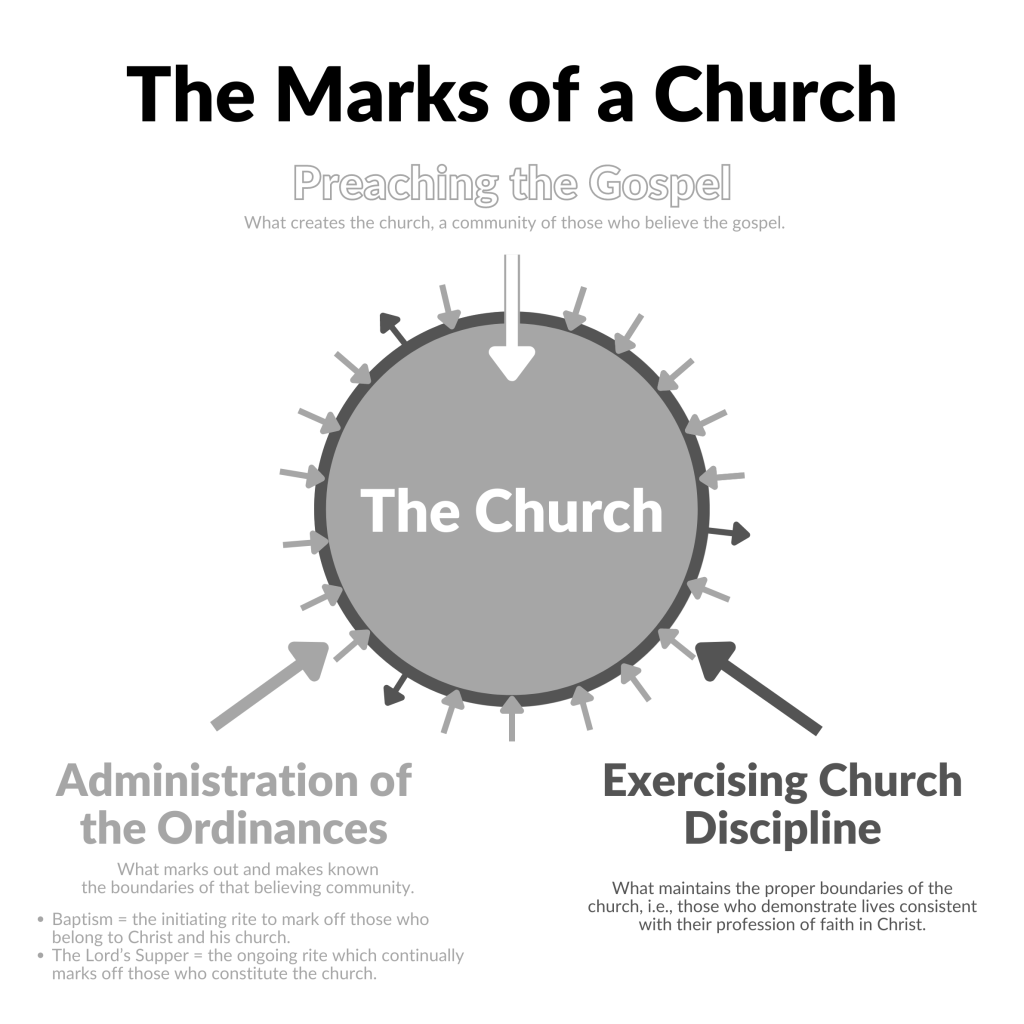
Marks of a Church (Diagram)

The following is a chart that seeks to capture the logic of the following confession from Article 29 of The Belgic Confession:

The true church can be recognized if it has the following marks: The church engages in the pure preaching of the gospel; it makes use of the pure administration of the sacraments as Christ instituted them; it practices church discipline for correcting faults. In short, it governs itself according to the pure Word of God, rejecting all things contrary to it and holding Jesus Christ as the only Head. By these marks one can be assured of recognizing the true church—and no one ought to be separated from it.

Marks of a Church

Preaching the Gospel – What creates the church, a community of those who believe the gospel.

Administration of the Ordinances – What marks out and makes known the boundaries of that believing community.

  • Baptism = the initiating rite to mark off those who belong to Christ and his church.
  • The Lord’s Supper = the ongoing rite which continually marks off those who constitute the church.

Exercising Church Discipline – What maintains the proper boundaries of the church, i.e., those who demonstrate lives consistent with their profession of faith in Christ.