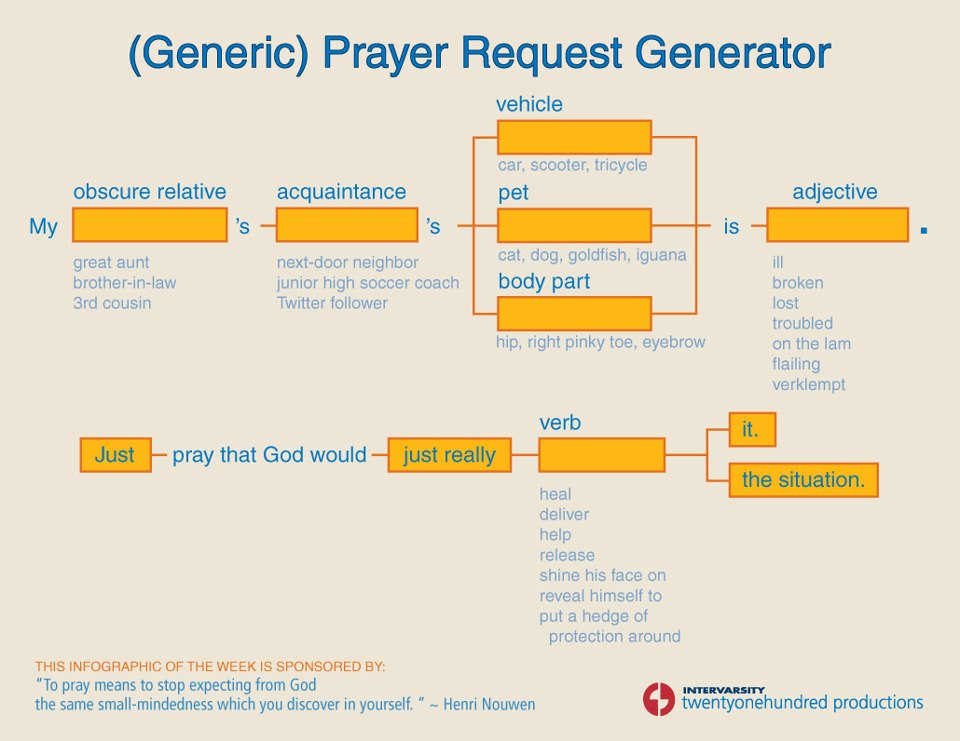
[Click on image for full size.]
I found this pretty funny. And I could probably just share this picture and leave the post “as is.” But I imagine the maker of this “prayer request generator” probably wanted to get us to think. So… let’s think.
[Click on image for full size.]
I found this pretty funny. And I could probably just share this picture and leave the post “as is.” But I imagine the maker of this “prayer request generator” probably wanted to get us to think. So… let’s think.

If I had to summarize typology simply and briefly, this is how I’d do it.
 See this article entitled, The 15 Best Colleges for Studying the Bible.
Two statements about my school, Trinity International University, that I found interesting:
(1) “The student body and professoriate are intentionally diverse, allowing for an international flavor, and a heightened sense of ‘global missions.'”
— Absolutely true. And I love this!
(2) “Some students will find the political leanings of the school to be too liberal, with notable tones of ‘social justice’ and ‘globalism.'”
— That some would find TIU too political liberal is probably somewhat true as well. And I tend to think this reality relates to the first statement (directly above). However, this perception isn’t the same thing as TIU actual being politically liberal. That’d be a tough case to make given our incredible diversity. Nonetheless, I believe our diversity and international composition resists a narrow-minded approach to politics, whatever that approach might be. And I appreciate this about Trinity as well.
Just a shameless plug for my school.

The following is taken from “Presbyterian Worship” by Edmund Clowney in Worship: Adoration and Action (page 117), edited by D.A. Carson. Although some may skibble over certain aspects of this composition, Clowney provides a succinct summary of the elements of corporate worship according to the New Testament’s testimony. (I have reformatted his collection into a bulleted list.) He states, “The New Testament indicates, by precept and example [emphasis mine], what the elements of [corporate] worship are.” According to Clowney, they are the following.
 I first read the following a few months ago. It stood out to me as an excellent articulation of the relationship between works and justification by faith alone.
This passage exists within The Institutes of the Christian Religion’s third book entitled “The mode of obtaining the grace of Christ. The benefits it confers, and the effects resulting from it” (especially note the “benefits” and “effects” “resulting from” grace received). In this section Calvin seeks to refute the idea that the reformers “destroy good works, and give encouragement to sin” by their doctrine of justification by faith alone. On the contrary, Calvin desires to prove that “justification by faith establishes the necessity of good works” (emphasis mine).
Our last sentence may refute the impudent calumny of certain ungodly men, who charge us, first, with destroying good works and leading men away from the study of them, when we say, that men are not justified, and do not merit salvation by works; and, secondly, with making the means of justification too easy, when we say that it consists in the free remission of sins, and thus alluring men to sin to which they are already too much inclined. These calumnies, I say, are sufficiently refuted by that one sentence; however, I will briefly reply to both. The allegation is that justification by faith destroys good works. … They pretend to lament that when faith is so highly extolled, works are deprived of their proper place. But what if they are rather ennobled and established? We dream not of a faith which is devoid of good works, nor of a justification which can exist without them: the only difference is, that while we acknowledge that faith and works are necessarily connected, we, however, place justification in faith, not in works. Continue reading

