What did Jesus mean when he said to “Render to Caesar the things that are Caesars and to God that which is God’s”? Mike Bird joins me on What in the Word? to discuss the Matthew 22:21.
Follow the show on YouTube, Spotify, Apple Podcasts, and more.
What did Jesus mean when he said to “Render to Caesar the things that are Caesars and to God that which is God’s”? Mike Bird joins me on What in the Word? to discuss the Matthew 22:21.
Follow the show on YouTube, Spotify, Apple Podcasts, and more.
To what extent are Christians told to submit to governing authorities? What exceptions exist, and how do we know? Kaitlyn Schiess joins me on What in the Word? to discuss Romans 13:1–7.
Follow the show on YouTube, Spotify, Apple Podcasts, and more.
The following are quotes from Jonathan Leeman and Andy Naselli, How Can I Love Church Members with Different Politics?, 9Marks: Building Healthy Churches (Wheaton, IL: Crossway, 2020),
In the same way that faith creates deeds, so God’s work of justifying a person by grace through faith creates a concern about justice. And in the same way that deeds display and give evidence of faith, so our concern for justice demonstrates and gives evidence for our justification. … Politics involves questions of justice. [Therefore] when fellow Christians disagree with you on significant political matters, you question their commitment to justice, which in turn can sometimes tempt you to question their justification. We’re not saying you’re always right to do so. We’re merely saying it makes sense that this happens. There are theologically correct instincts at play. (14–15)
We are tempted to scorn and second-guess our fellow church members whose politics disagree with ours because every one of us is naturally self-righteous and self-justifying, and fallen politics is fueled by such self-righteousness and self-justification. We’re talking about the basic posture of the fallen heart to always think that it’s right. (15–16)
Are you convinced about your own political opinions? If so, maybe that’s because you are walking in the Spirit, you love your neighbor as yourself, and you have rightly formed judgments about the issues of the day. Then again, it also might be because you are following the self-justifying script of every other political party, of every other tribe and nation, throughout the history of the world. (17)
[T]he anger you feel when people disagree with you politically might be the right response to injustice. But … [t]oo often we use our anger as a weapon to destroy anything that opposes our personalized version of a just universe. We’re self-serving with our anger. (17)
When we were born again, wonderfully, we lost the need to justify ourselves before God through our personal and political pursuits. Christ became our justification. … [W]e become able … to fight for what’s right, not to justify ourselves but for the sake of love. Born-again politics is a different kind of politics. (16)
Most political judgments we make depend on wisdom not on directly applying explicit biblical principles. To put this another way, there is some space between our biblical and theological principles and our specific political judgments. Two Christians might agree on a biblical or theological principle but disagree on which policies, methods, tactics, or timing best uphold that principle. … Political judgments depend on figuring out how to apply our biblical and ethical principles to the vast and complex set of circumstances that surround every political decision. … Remembering this should create some room for charity and forbearance. (18, 21, 24–25)
Personally, we would be shocked if any political party ever felt like a perfect fit for a Christian, as that just might suggest one’s Christianity has been subverted by party thinking. (24)
If you look around and notice that your church is politically uniform, you might ask, Where did it come from? Are there non-biblical pressures to conform to certain class, generational, ethnic, or political-party standards? Is something (besides the gospel) creating that uniformity? If so, might those cultural standards be wrongly binding consciences about what Christians must believe? (26)
Here, then, is a big irony: even if your church is healthy, your members will likely not be entirely uniform in their politics. Your members might even feel some measure of political tension. What unites them is Jesus, not partisan politics. // Unity amid diversity, furthermore, can be a strength of a church’s witness to outsiders. You want outsiders to see your church and think, Wow, you guys love one another across political divides! I’ve never seen anything like that! (26–27)
Jesus did not design our churches to be a national or ethnic or class gathering or the gathering of a political party. Rather, he designed them to be gatherings of his followers from every tribe and tongue and nation. Your church and ours are communities of former enemies learning to love one another. They are communities of political rivals working together. // We are natural-born enemies. Each of us wants to rule. … The local church is where enemy tribes start beating swords into plowshares and spears into pruning hooks. (27–29)
We have his Book. He has revealed himself. That’s amazing, isn’t it? Yet a huge danger looms. We get into a political argument in which we’re telling someone what we think. But we also have a Bible in our hands, and so we begin to blur the lines between what we think and what God thinks. … To avoid confusing our thoughts with God’s thoughts, therefore, we must treat God’s Book with holy reverence and fear. We must take great care to distinguish its authoritative and inerrant wisdom from our own. (44–45)
[S]ometimes the best way to critique the present system and to resist the false worship that so much of politics demands is simply to talk about something else. // Jesus will win. His kingdom does not hang in the balance. Christians who possess this happy confidence can engage with one another amid these secondary political matters while simultaneously enjoying unity and fellowship and hope as they together anticipate the coming of Christ’s perfect reign. (54–55)
The following is a correspondence from a while back that I wrote to two friends who had reached out to me for thoughts regarding a recent news event and its coverage. I no longer remember the particular news item that gave rise to their question. But this advice holds regardless and applies beyond it. I thought I would share.
A couple of discipleship-oriented thoughts come to mind, that I hope could be helpful. I don’t follow all of this stuff terribly close, as you can tell. So I’m less interested in commenting on any of the specifics on the matter. But I do have a pastoral heart for helping us navigate this arena, as part of our all-of-life discipleship. So, at least in that respect, hopefully these questions and thoughts can be helpful.
(1) How do your hearts respond to these stories? Do you find yourself increasing in anger or vitriol towards perceived political opponents? Do you find your heart going, “Yes! More fuel I can use to defend ‘my side’”? And what might this say about our heart idols?
(2) How can you guard yourself against allowing these sorts of stories to fuel or further cement partisan biases in yourself? For instance, let’s assume the stories above are true, and they evidence clear partisan bias and corruption. It would be a terrible irony then if other people’s partisan bias became justification for becoming entrenched in that very same thing myself, and drinking the same partisan poison I’m condemning them for drinking.
(3) There’s always two sides to every story (Prov 18:17). Have we done the work to listen to the “other side” of any stories? And not just listen, but honestly and charitably listen and consider them? Not listen to deconstruct their arguments, but genuinely consider another perspective?
(4) As people centered on the gospel, i.e., “the Word of truth,” we want to be people who care about truth. This means we should place a high value on making sure we are always trying to be objective. We are after the truth, not after what scores the most points for a particular “side.” (An almost sure way to tell if you’re partisan/not objective is if you’re always in lockstep with a particular side, and never or rarely deviate). How can we best guard our hearts towards remaining objective? Especially when we know our hearts’ tendencies (and not only so, but also psychological realities, e.g., confirmation bias, choosing paths of least resistance, etc.)
(5) Our culture is increasingly becoming a post-truth society. What I mean by that, at least in part, is that we no longer have shared, agreed-upon sources of information, e.g., journalists’ reporting. A lot of this is fueled by political interests; they want to discredit reporters who negatively report on them. On the other hand, media bias exists too. Neither of these is good for society. People are skeptical, and they use that skepticism as justification and license to appeal to even less trustworthy sources (e.g., conspiracy theories, fake news)—as if that’s any better! We’re developing into a society where we all trust whatever sources “seem right in our own eyes.” Whether we agree with a source is up to our “discernment” and how we deem something is “trustworthy” — basically, does it agree with my side and its narrative? Again, not good. So the question: How do we navigate a landscape that is so polarized and partisan without falling prey to it? How do we pursue the truth, with a healthy distrust in our own hearts’ inclinations to listen to what it wants to hear? Do we distrust our own hearts as much as we distrust the bias of others (e.g., media, etc.)
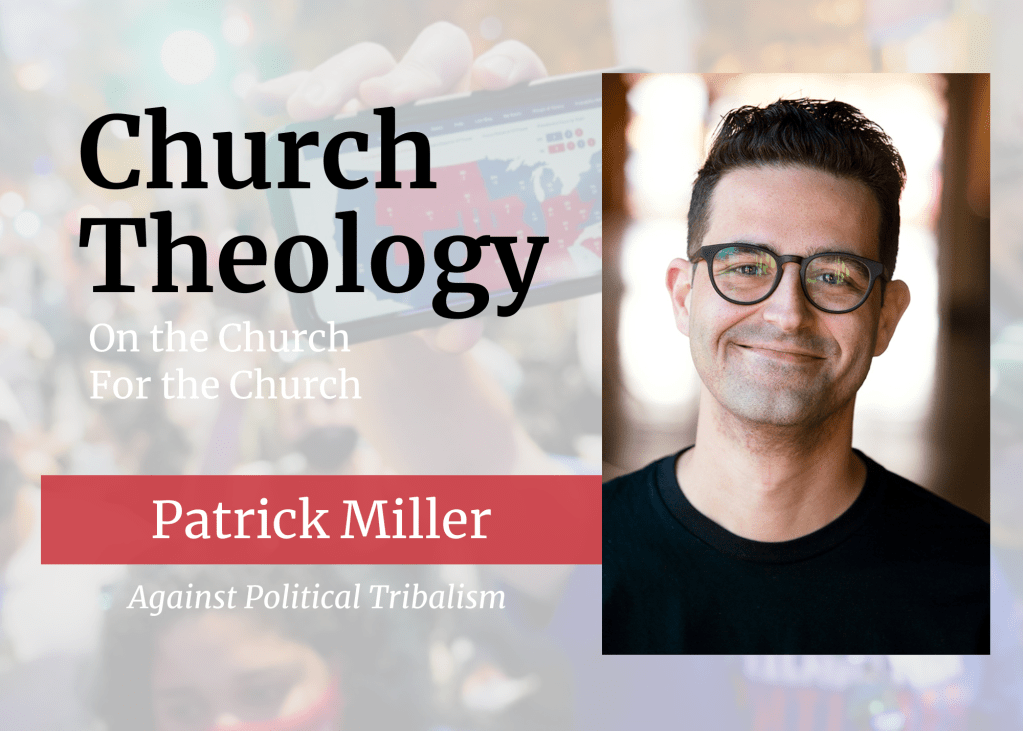
Have you noticed that you’ve been more anxious recently? Have political differences put a strain on a relationship with a friend or family member? Has politics caused division in your church? Society is increasingly polarized and tribal. And unfortunately, we as Christians are often not immune, but at times even the worst offenders. In this episode, Patrick Miller, an author of Truth Over Tribe, helps us see the causes of our tribalism to pursue a healthier Christian political engagement.
Access the episode here. (Available on Apple Podcasts, Spotify, Google Podcasts, Stitcher, and more.)
 Kirk E. Miller