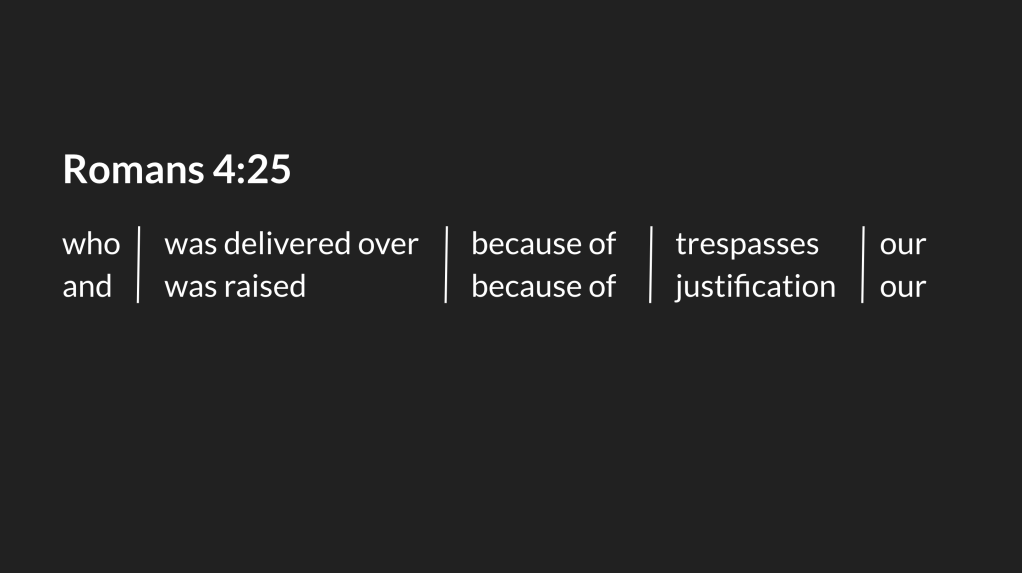
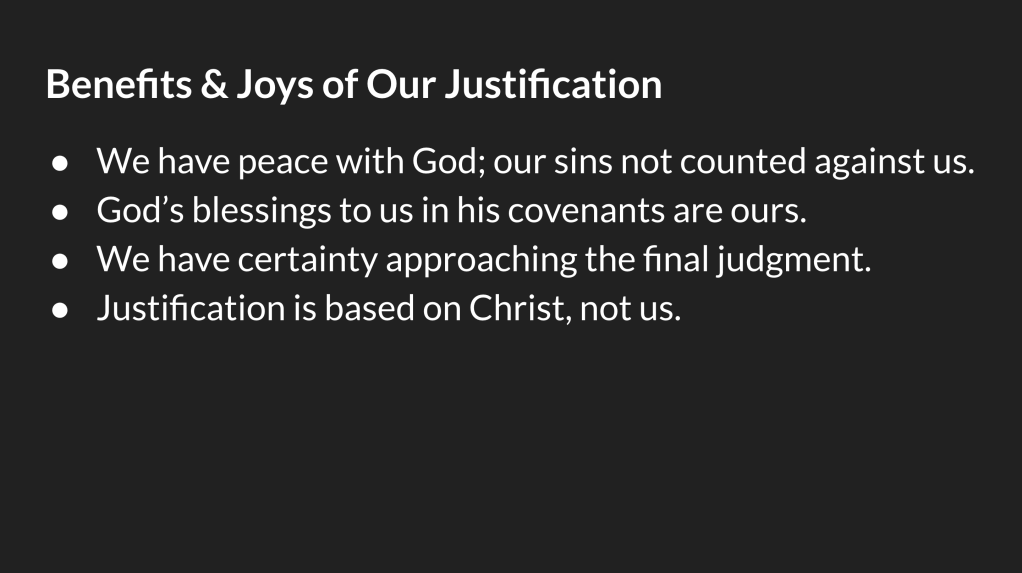
Raised for Our Justification (Romans 4:25)

This sermon was delivered during the Coronavirus “stay at home” order, and so was conducted virtually as we held our services over Zoom.


Raised for Our Justification (Romans 4:25)
CrossWay Community Church
April 12th, 2020

Podcast link.


Redemption Accomplished and Applied, John Murray (Goodreads Review)

Redemption Accomplished and AppliedRedemption Accomplished and Applied by John Murray
My rating: 5 of 5 stars

Lead a group of men in my church through this book. A lot of them found the initial chapters a bit more difficult to weigh through. I would agree that part 1 felt more polemical, and could feel a bit more technical or abstract for those less familiar with this sort of writing or subject matter. However, part 2 seems to take a shift in tone. In these latter chapters especially, one of the things I appreciated about this book was the doxological tone and orientation naturally woven throughout. As I read, I found myself experiencing gratitude to God and standing in awe of Christ. I believe this book originally came out of a series of lectures Murray delivered (?). And it certainly reads like that. It feels a bit different in that way from other systematic treatments of soteriology. Very insightful and well done.

View all my reviews.

Does God Love the Non-Elect?

The following is a response I put together in regard to a question that came up in a book study I was leading through John Murray’s Redemption Accomplished and Applied.


So one of the questions that emerged from our discussion tonight was, does God love the non-elect?

Clearly he loves the elect. And if nothing else, he loves them in a unique way unto salvation. But the question was raised, does he also love everyone in some sense (even if not having chosen to save them), even the non-elect?

Here are some helpful resources:

(All of these men are Calvinists by the way. So they are working from these same assumptions that God has a distinguishing love for the elect.)

At least one example of the Bible actually using the word “love” in reference to God’s disposition to the seemingly non-elect is Matthew 5:43-48. Here Jesus tells us to love our enemies precisely based on the model that God — it is the seemingly necessary implication of the analogy — loves his enemies (if God doesn’t love his enemies, the comparison would seem to break down). Namely, God here shows his love to enemies by causing rain to fall on the just and unjust. So we are likewise to love our enemies by showing good to all as well, even enemies.

Similarly Luke 6:35 – “But love your enemies, and do good, and lend, expecting nothing in return, and your reward will be great, and you will be sons of the Most High, for he is kind to the ungrateful and the evil.” How are we sons of God (i.e., like God here — “like father, like son”)? By loving our enemies like he does. In other words, he loves his enemies. And I think “enemies” here most naturally (at least) includes the non-elect.

As I said during our discussion, God is also said to love Israel (e.g., Deut 7-8), which was a nation composed of both believers and, maybe even more predominantly, non-believers.

An example of this might be Hosea 9:15, where God speaks of no longer loving unbelieving Israel who is about to experience his judgment. This is certainly by and large an unbelieving, non-elect people here; and yet he speaks of having shown them love.

You might also argue there’s a seeming ludicrousness if God were to command us to love all people as something morally right that we must do if it were not something he himself was also doing. It would seem to imply he’d be failing to do something that is morally right for him to do. In other words, he would seem to be sinning, which is an absurdity.

So in conclusion…

Yes, it’s important to clarify the unique expression of the love God has the elect. But I also think it’s appropriate and Biblical to speak of a love God shows even towards the non-elect.