Christ as the Cornerstone of God’s Redemptive Temple-Building Project

The following is an excerpt from some material I composed for the teaching ministry of South City Church. You can listen to the sermon on which this material is based here — Our Identity and Calling in Christ (1 Peter 2:4-10).

24620615811_d58324f390_o.jpg


In our passage this week [1 Peter 2:4-10], Peter makes use of this idea of temple.

Our understanding of temple begins in the Garden of Eden. If we were to look at Genesis 1-3 carefully, there are signs that we are suppose to see the Garden of Eden as something like a temple — a place where God dwells with humanity. Later when God gives Israel the tabernacle and temple, interestingly enough he tells them to decorate them with trees and things that make them look like a new Eden of sorts. The Garden of Eden is a “garden-temple.” And it is in this garden that God dwells with humanity without hindrance, without the intrusion of sin. Humanity experiences God’s presence and worships him perfectly.

When Adam and Even rebel, however, sin enters the equation. And this breaks the relationship between God and mankind. God, who is immeasurably holy, cannot tolerate sin. God’s, in his perfection, cannot dwell in the presence of sin without destroying it. This is why in the Old Testament, the levitical (temple) Law speaks of things being “unclean” and the sacrifices and their blood “cleansing” and “purifying.” It was through the temple and its sacrifices that God was able to dwell with his people again, despite sin. This is why God gave the temple, so that he could dwell with his people. And this is why he ordered the sacrifices, to deal with their sin.
Continue reading

The Church as Committed, Communal Life

The church is not an institutional network of services and programs. The church is a people, a community of which to be a member, a family.

The help and support it offers is not like that of a drive-through: come and get your “fix” when you decide you need it. The sort of help and support it offers is one that is found through committed relationships and the regular, consistent, habitual, mundane (yet exciting), ordinary (yet supernatural) means of grace — God’s people prayerfully applying God’s word to one another.

We live in an instant gratification and give-it-to-me-now sort of culture. But we should know better here. Life’s not as simple as that. Our brokenness is more entrenched and complex than that.

Death as Absolute ‘Vanitizer,’ Except as Answered by Christ’s Resurrection

My question—that which at the age of fifty brought me to the verge of suicide—was the simplest of questions, lying in the soul of every man … a question without an answer to which one cannot live. It was: ‘What will come of what I am doing today or tomorrow? What will come of my whole life? Why should I live, why wish for anything, or do anything?’ It can also be expressed thus: Is there any meaning in my life that the inevitable death awaiting me does not destroy?

—Leo Tolstoy (A Confession), channeling his inner Qohelet, Ecclesiastes.

The answer: no, nothing, futility, or, as the book of Ecclesiastes itself puts it, a mere “striving after wind.”

Death is the ultimate “vanitizer.” Nothing escapes its finalizing, universal stamp of “pointless.”

That is apart from resurrection.

Enter Jesus. Welcome, Easter.

Preservation by Mean of Perseverance (1 Peter 1:5)

Preservation by Mean of Perseverance (1 Peter 1:5)
South City Church
February 26, 2017

Podcast link.

See all sermons from this series on 1 Peter.

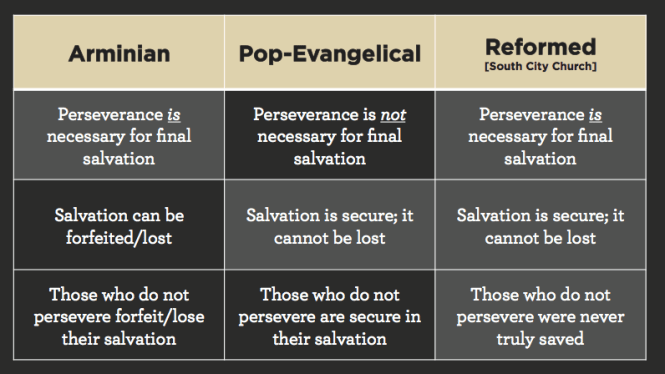
Preservation & Perseverance: Views Charted

“We believe that election is the eternal purpose of God according to which he effectually regenerates, justifies, sanctifies, and glorifies sinners, not on the basis of anything foreseen in them, but solely based on his free and sovereign grace. We believe that this election comprehends all the means connected with its end such that the salvation of all who trust in Christ is guaranteed, that by God’s unfailing grace all genuine believers will persevere in faith unto full and complete salvation.” – SCC Statement of Faith