The Church as Committed, Communal Life

The church is not an institutional network of services and programs. The church is a people, a community of which to be a member, a family.

The help and support it offers is not like that of a drive-through: come and get your “fix” when you decide you need it. The sort of help and support it offers is one that is found through committed relationships and the regular, consistent, habitual, mundane (yet exciting), ordinary (yet supernatural) means of grace — God’s people prayerfully applying God’s word to one another.

We live in an instant gratification and give-it-to-me-now sort of culture. But we should know better here. Life’s not as simple as that. Our brokenness is more entrenched and complex than that.

Membership in the Universal Church: an Analogy

Some reflections…

Saying you’re a part of the Church (universal) without being a member of a specific local church is like saying you’re in the NFL without actually being on the roster of any of the NFL’s teams.

The NFL is made up of its 32 teams. The Church — the universal body of believers from across space and time — is manifested through the multitude of concrete, local churches.

Some may point to exceptions: “But what about…?” “But if you say this, doesn’t that mean…?” But there’s a reason these are exceptions — they are exceptional; they are not the norm.

The Bible both states and assumes that those who are identified with Christ by trusting in him are also those who are identified with him in baptism and identified with his community of believers — the church — through inclusion/membership among their ranks.

To abstain from regularly assembling with and committing oneself to a church community, placing oneself under its leadership and discipline, is to break away from the Biblical pattern of the Christian life — a life lived out in community, with mutual-accountability and encouragement.

To speak of “regular attenders” as some secondary class of pseudo-members is to blur these lines. We are better off to speak of such folks in truer terms, of what they are — perpetual visitors.

Understanding the Lord’s Supper as a Means of Grace

This past week, at our church plant’s Thursday night gathering, we took some time to talk about the importance of the Lord’s Supper in the life of the believer and the church.

We looked at our philosophy of ministry, which says,

The ordained rites of Baptism and the Lord’s Supper are faith-nourishing signs that tangibly portray Gospel realities to believers. As such, they are not to be neglected, devalued, or misused, but, rather, are to be guarded, administered conscientiously, and cherished as gracious gifts from Christ.

Mt 26:26-28; Mk 14:22-24; Lk 22:19-20; Acts 22:16; Rom 6:3-4; 1 Cor 10:16; 11:23-27; Gal 3:27; Col 2:12; Tit 3:5; 1 Pet 3:21.

I want to follow up on that discussion here in this post.

Often times, in the more baptistic, non-denominational, believers’-church-tradition circle in which I find myself, the Lord’s Supper is seen as nothing more than a cognitive aid for rehearsing the sacrificial death of Jesus. We call this the memorial view of the Supper: the Supper is a means of remembering (hence “memorial”) the death of Christ.

Now, I don’t want to downplay the importance of simply remembering Christ’s work on our behalf. But I do want to ask, What is that “remembering” suppose to look like and involve? What does the New Testament have in mind when it talks of this “remembering.” Is it merely a recall, a cognitive exercise like running scenes from the Passion of the Christ in your head? Or is it something more like what we refer to today as “preaching the truths of the Gospel to yourself”?

Continue reading

Goodreads Review of Biblical Foundations for Baptist Churches: A Contemporary Ecclesiology by John Hammett

Biblical Foundations for Baptist Churches: A Contemporary EcclesiologyBiblical Foundations for Baptist Churches: A Contemporary Ecclesiology by John S. Hammett

My rating: 4 of 5 stars

Excellent book.

Well-written. Well-researched. Thoughtful. Generally fair to alternative positions.

One of its best strengths — thoroughly Biblical. He engages in critical exegetical and synthetical (or: systematizing) examination of scripture.

Main complaint (and I say this as one who adheres to Baptist distinctives) — I think he overestimates the clarity of scripture’s testimony to what we call “congregationalism” today, especially in his engagement with what is called “elder rule” polity. Furthermore, I think his actual case for congregationalism is weak. A better case can and should be made than the one he offers.

But, to avoid ending on a negative note — a solid book I will definitely recommend to others in the future.

View all my reviews

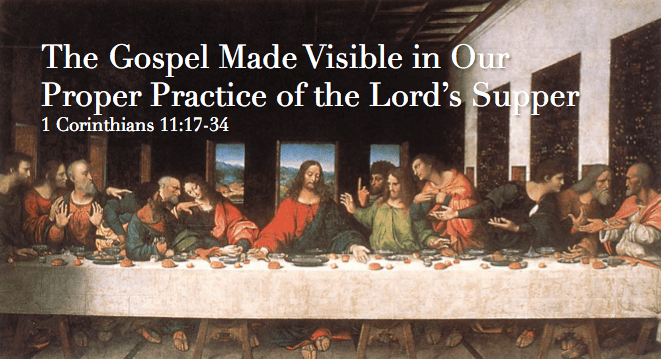
The Gospel Made Visible in Our Proper Practice of the Lord’s Supper (1 Corinthians 11:17-34)

The following was a sermon I delivered on November 22, 2015 as a guest preacher at Living Water Community Church in Vancouver, WA. Below you will find a link to the sermon audio as well as my sermon notes.


Podcast link.


Introductory illustration:

We’re aware of the fact that the clothing we wear needs to fit the occasion, event, or activity to which we wear them.

For example, when I was in high school, I worked at a restaurant. And I had to wear a uniform—this ugly purple polo shirt that felt like burlap. Or, when I refereed soccer, I didn’t just wear whatever I wanted; I wore a referee outfit.

Similarly, many of you probably have either a work uniform, a certain dress code that you have to follow, or, if you’re in school, maybe you have a school uniform.

We even have special gowns for graduating (although I’m slightly convinced that whoever invented these wanted to make graduates feel stupid—“Hey, you’re graduating. Congratulations! How ‘bout you wear this black-garbage-bag-looking thing and silly square hat. Oh! And while you’re at it, why don’t you walk across a stage while we take pictures of you? How does that sound?”).

We have these unwritten rules for what we wear and where we wear them: You don’t wear a tuxedo if you’re fixing your plumbing. And you probably don’t want to dress like Richard Simons if you’re going to a formal wedding… Or ever for that matter. And when you go shopping, you don’t wear your pajamas… well, unless, apparently, you’re shopping at Wal-Mart.

You see, there’s this recognized principle (at least among most of us) that what we wear needs to fit the occasion of the thing we’re wearing it to.

Now when it came to the Lord’s Supper for the Corinthian church, they found themselves wearing “the wrong clothes.” Of course, I don’t mean that they were literally wearing the wrong clothes. But think of this idea of clothing as an illustration—the way they practiced the Lord’s Supper did not match the meaning of the Lord’s Supper. Their practice was inappropriate for what the Lord’s Supper means. And so they found themselves “wearing the wrong clothes.”

But we too can easily find ourselves “wearing the wrong clothes” in how we practice the Lord’s Supper. We too can lose sight of the full, true, Biblical meaning of the Supper, and, consequently, practice it inappropriately.

Continue reading