A Review of Gustaf Aulén’s Christus Victor

The following is the manuscript-outline notes of a presentation I delivered on September 8th for Dr. David Luy’s ST 8000 The Atonement at Trinity Evangelical Divinity School.

The full title of this presentation was Synthetic Re-Description of and Critical Engagement with Christus Victor: An Historical Study of the Three Main Types of the Idea of Atonement by Gustaf Aulén.

I share this in case anyone might find this edifying or for the chance someone studying Aulén’s work might stumble upon this and find it helpful.

And I dedicate this to my grandfather, who, while I was in the process of writing this, told me to “add some jokes.” I hope I have accomplished that, although I admit the jokes may only be humorous to a very narrow audience.


I. Building Consensus

Gustaf AulenGustaf Aulén (1879–1997) was the Bishop of Strängnäs in the Church of Sweden (a Lutheran denomination), was a leading figure in the Lundensian Theology movement, and is probably best known for this work, Christus Victor.

Origin of Christus Victor – The book Christus Victor originated from a series of lectures delivered at the University of Uppsala in Sweden in 1930 (xxi).

Goal – Aulén claims that the aim of this book is to produce an objective historical account without any clandestine apologetic aims (158; cf. xxi). Having read the book, I imagine many of us can’t help but chuckle at such a claim. I myself wonder if he is somewhat disingenuous.[1] But I suppose we’ll have to take Aulén at his word. With that said, if I were to imagine myself in a world where such objective accounts could actually exist, I would argue that Aulén has failed to produce one. His bias is oozing through the text.

Thesis – The thesis that Aulén seeks to prove through this historical account is that the “classic view” of the atonement, in contrast to what he refers to as the “Latin” and “Humanist” views, is the view of the atonement which is “most genuinely Christian” (xxi, 158), evangelical, and catholic (xxvi). It is the truly Christian view because, as his historical count seeks to demonstrate, it is the view found in the New Testament, articulated by the early church fathers, and recovered by the thoroughly evangelical Luther.

Three views [Aulen’s depiction, not mine]: Continue reading
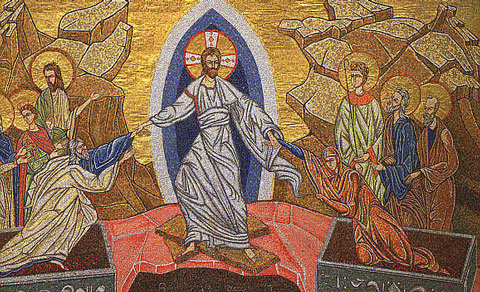
The Significance of Christ’s Resurrection: Scriptural Mediations for Resurrection Sunday

The following is the section on Christ’s resurrection from my personal statement of faith.

If you’d like, use the following, with its footnotes of scriptural references, to work your way  through relevant texts and mediate on the meaning and significance of Christ’s resurrection.

Christ’s bodily resurrection serves as the decisive validation of his ministry and claims.[1] God’s resurrection of Jesus[2] demonstrates that Christ’s sin-vanquishing (and thereby death-defeating) death was indeed effective[3] and vindicates him as God’s appointed Messiah.[4] In fact, it is regarded as his Messianic enthronement.[5] His appointment as judge is confirmed by his resurrection.[6] Because he lives indestructibly, he is permanently able to make intersession for those for whom he died.[7] Through his resurrection he triumphed over demonic forces.[8] Christ embodies the hope of resurrection.[9] In his resurrection, he annihilated death and obtained incorruptibility.[10] As such, in him the eschatological order of resurrection,[11] new creation,[12] new humanity,[13] and Spirit-empowered[14] existence has dawned. His personal resurrection inaugurates the general resurrection.[15] It functions representatively for all those united to him.[16] In him believers are already raised spiritually[17] and will eventually be raised bodily[18]—one holistic resurrection occurring in two installments.

See also my past series presenting a Biblical theology of resurrection.

Continue reading

Outline of Biblical Testimony to the Deity of Christ (Murray Harris)

I’m currently working on an ordination-type personal statement of faith; and I ran across this great resource in the back of one of my books.

An Outline of the New Testament Testimony to the Deity of Christ” by Murray J. Harris in Jesus as God: The New Testament Use of Theos in Reference to Jesus (Grand Rapids, MI: Baker Book House, 1992), 315-317.

A. Implicit Christology

1. Divine functions performed by Jesus

a. In relation to the universe

(1) Creator (John 1:3; Col. 1:16; Heb. 1:2)

(2) Sustainer (1 Cor. 8:6; Col. 1:17; Heb. 1:3)

(3) Author of life (John 1:4; Acts 3:15)

(4) Ruler (Matt. 28:18; Rom. 14:9; Rev. 1:6)

Continue reading

7 Implications of Jesus’ Ascension (Steve Walton)

Steve Walton

Steve Walton states that Jesus’ ascension “expresses the Christian conviction that Jesus now reigns over the universe” (59) and “The ascension of Jesus … provides the apostles with a visual demonstration of the truth of Jesus’ exalted status” (60).

In addition to these summary-type statements, he provides 7 significant theological implications of the ascension.

(1) The ascension implies that Jesus now reigns alongside God in heaven, and thus it is appropriate to call him *“Lord” as well as “Messiah” (Acts 2:36). The (singular) cloud (Acts 1:9) echoes the one in Luke 21:27 on which the *Son of Man comes to God (cf. Dan 7:13), clearly placing Jesus alongside Israel’s God. Thus Jesus, still human, is to be *worshiped (Lk 24:52) alongside Yahweh, and the portrait of Israel’s God expands (Johnson). Psalm 110 (esp. Ps 110:1, 4) was a key biblical passage that was interpreted (following Jesus’ own lead [Mk 12:35–37]) concerning Jesus, who is thus to be understood as having been enthroned at God’s right hand as coruler (e.g., Rom 8:34; Heb 10:12–13).

(2) The ascension presages Jesus’ return to earth from heaven (Acts 1:11; cf. Heb 9:28). That return will be the time of cosmic renewal and restoration promised in Scripture (Acts 3:20–21) and of *judgment (Acts 17:31). The cloud—a key marker of Jesus’ departure (Acts 1:9)—became an emblem of Jesus’ return in early Christian writing (e.g., 1 Thess 4:17; Rev 1:7; 14:14–16). Paul picks up Psalm 110:1 as testimony that the time will come when God will place Jesus’ enemies under his feet (1 Cor 15:25–26). The ascension is “the advance notice of the end” (Robinson, cited in Zwiep, 196).

Continue reading