As interpreters, teachers, and preachers of God’s word we desire to be faithful to the Biblical text. We know that this entails interpreting Scripture according to the Biblical authors’ original intent, historical context, and literary context, among other things. We don’t want to be guilty of eisegesis–reading our own thoughts and ideas into the text rather than getting our conclusions from out of the text (exegesis).
But at the same time, we know that Christ said the entirety of Scripture speaks of Him (Luke 24:25-27; cf. 1 Pet 1:10-12; Rom 1:2). And so as Paul, we would love to say that even in our expositional preaching “I decided to know nothing among you except Jesus Christ and him crucified” (1 Cor 2:2).
But what about the majority of texts where Christ is not mentioned? How do we preach Christ then? Do we preach the authorial intent and then sort of arbitrarily jump to Christ at the end, tack on an altar call or two with some repeated “Just as I am” choruses?
We want to avoid moralism; so we want to preach Christ. We don’t simply want to draw conclusions like, “don’t be like Saul,” “don’t be like the Israelites,” or “be more like David,” as if this alternative is somehow more honest to the authorial intent. But how do we preach Christ-centered in passages that have seemingly little to do with Christ at all?
I think you get my drift.
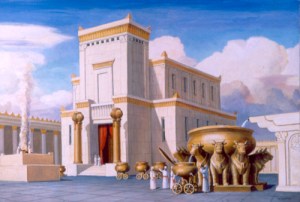 In verses 1 Corinthians 3:16-17, 6:19, and 2 Corinthians 6:16 Paul uses the Old Testament temple as a metaphor for believers. What this metaphor conveys is the comparison of our New Testament worship to that of the Old Testament. The Levitical law required sacrifices. However, now our worship demands a living sacrifice (Romans 12:1), a sacrifice of our lives. The Old Testament worship was centered on locality and the temple building. However, now worship is in spirit and in truth and no longer based on such externals such as location and buildings (John 4:20-24). And finally, just as the Shekinah glory dwelt within the temple, now the same presence of God, the Holy Spirit, dwells within us (1 Corinthians 6:19). And just as the Shekinah glory was the visible presence of God at the temple or tabernacle, so the presence of God should be visible in our lives (i.e., “the fruit of the Spirit,” Gal 5:22-23).
 Kirk E. Miller