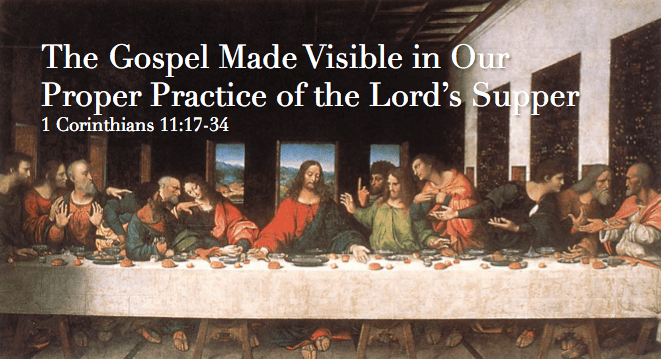
The Gospel Made Visible in Our Proper Practice of the Lord’s Supper (1 Corinthians 11:17-34)

The following was a sermon I delivered on November 22, 2015 as a guest preacher at Living Water Community Church in Vancouver, WA. Below you will find a link to the sermon audio as well as my sermon notes.


Podcast link.


Introductory illustration:

We’re aware of the fact that the clothing we wear needs to fit the occasion, event, or activity to which we wear them.

For example, when I was in high school, I worked at a restaurant. And I had to wear a uniform—this ugly purple polo shirt that felt like burlap. Or, when I refereed soccer, I didn’t just wear whatever I wanted; I wore a referee outfit.

Similarly, many of you probably have either a work uniform, a certain dress code that you have to follow, or, if you’re in school, maybe you have a school uniform.

We even have special gowns for graduating (although I’m slightly convinced that whoever invented these wanted to make graduates feel stupid—“Hey, you’re graduating. Congratulations! How ‘bout you wear this black-garbage-bag-looking thing and silly square hat. Oh! And while you’re at it, why don’t you walk across a stage while we take pictures of you? How does that sound?”).

We have these unwritten rules for what we wear and where we wear them: You don’t wear a tuxedo if you’re fixing your plumbing. And you probably don’t want to dress like Richard Simons if you’re going to a formal wedding… Or ever for that matter. And when you go shopping, you don’t wear your pajamas… well, unless, apparently, you’re shopping at Wal-Mart.

You see, there’s this recognized principle (at least among most of us) that what we wear needs to fit the occasion of the thing we’re wearing it to.

Now when it came to the Lord’s Supper for the Corinthian church, they found themselves wearing “the wrong clothes.” Of course, I don’t mean that they were literally wearing the wrong clothes. But think of this idea of clothing as an illustration—the way they practiced the Lord’s Supper did not match the meaning of the Lord’s Supper. Their practice was inappropriate for what the Lord’s Supper means. And so they found themselves “wearing the wrong clothes.”

But we too can easily find ourselves “wearing the wrong clothes” in how we practice the Lord’s Supper. We too can lose sight of the full, true, Biblical meaning of the Supper, and, consequently, practice it inappropriately.

Continue reading

We Partake of a Better Covenant (Jeremiah 31:31-34)

The following is a sermon delivered at Lake Drive Baptist Church on Sunday morning August 2nd, 2015. You will find both the audio and sermon notes below.

Podcast link.


Sermon Text: Jeremiah 31:31-34 (NASB)

31 “Behold, days are coming,” declares the Lord, “when I will make a new covenant with the house of Israel and with the house of Judah, 32 not like the covenant which I made with their fathers in the day I took them by the hand to bring them out of the land of Egypt, My covenant which they broke, although I was a husband to them,” declares the Lord.

33 “But this is the covenant which I will make with the house of Israel after those days,” declares the Lord,

“I will put My law within them
and on their heart I will write it;
and I will be their God,
and they shall be My people.
34 “They will not teach again, each man his neighbor
and each man his brother, saying,
‘Know the Lord,’
for they will all know Me,
from the least of them to the greatest of them,”
declares the Lord,
“for I will forgive their iniquity,
and their sin I will remember no more.”

Background:

Our salvation comes to us in the form of a covenant. [Pause] This may an be odd notion.

God’s purposes to save and restore his people and his creation are promised, planned, worked out, and achieved in human history beginning in the OT. And the covenants throughout the Bible structure, drive, and advance that salvation plan.

Covenant – a binding agreement involving promises and obligations. 

The Biblical covenants aim at and pursue what God’s original intention was in creation. Think about the Garden of Eden – to have a people, in a land, under God’s rule, and amidst God’s presence.Covenant with Noah – After the flood, God expresses his commitment to creation despite human sin. He will not scratch this creation project, but he will redeem it and restore it to his original design.

Continue reading

What Does a Church Consumed for the Gospel Look Like? (Philippians 4:1-3)

The following is a sermon delivered at Lake Drive Baptist Church on Sunday morning June 14th, 2015. You will find both the audio and sermon notes below.

Podcast link.


Introduction/broader context:

Series theme/theme of Philippians To live a life consumed by the Gospel, i.e., the message of God’s saving activity in the person of Jesus.

  • Theme verse: 1:27 – “Live worthy the Gospel,” i.e., live a life consumed by and in keeping with the nature of the Gospel.
  • 2:1-11 (esp. v.5) – To be so consumed by Christ that we reflect the very humility of Christ.
  • Paul’s motto in 1:21 – “To live is Christ, and to die is gain.”

Corollary theme To be consumed by the Gospel for the Gospel, i.e., for the cause of advancing the Gospel.

  • In 1:12-26, because Paul’s motto is, “to live is Christ” (i.e., his life is consumed with Christ), he views his imprisonment as an opportunity to advance the name of Christ. –Consumed for the Gospel.
  • In his opening prayer (1:3-11), Paul speaks of the Philippians as partners with Paul in advancing the Gospel (1:5-7). –Consumed for the Gospel.
  • And through the book, Paul identifies various ways in which the Philippians are to be consumed for the Gospel. E.g., …
    • 1:27 – “Striving together for the faith of the gospel.” How? “Standing firm [i.e., steadfastness, persistence, perseverance] in one spirit, with one mind [i.e., unity, harmony].”
    • 2:14ff – They are to be “lights in the world” [i.e., a people consumed for the Gospel” by (2:14) “doing all things without grumbling or disputing [i.e., in unity]” and (2:16) “holding fast to” the Gospel [perseverance, steadfastness].

This text (Phil 4:1-3):
Continue reading

“Partaking in a Worthy Manner” (Sermon on 1 Corinthians 11:17-34)

Sunday morning sermonLord's Supper - 1 Cor 11
Lake Drive Baptist Church
Delivered August 31st, 2014
 Text: 1 Corinthians 11:17-34


 17 But in giving this instruction, I do not praise you, because you come together not for the better but for the worse. 18 For, in the first place, when you come together as a church, I hear that divisions exist among you; and in part I believe it. 19 For there must also be factions among you, so that those who are approved may become evident among you. 20 Therefore when you meet together, it is not to eat the Lord’s Supper, 21 for in your eating each one takes his own supper first; and one is hungry and another is drunk. 22 What! Do you not have houses in which to eat and drink? Or do you despise the church of God and shame those who have nothing? What shall I say to you? Shall I praise you? In this I will not praise you.

23 For I received from the Lord that which I also delivered to you, that the Lord Jesus in the night in which He was betrayed took bread; 24 and when He had given thanks, He broke it and said, “This is My body, which is for you; do this in remembrance of Me.” 25 In the same way He took the cup also after supper, saying, “This cup is the new covenant in My blood; do this, as often as you drink it, in remembrance of Me.” 26 For as often as you eat this bread and drink the cup, you proclaim the Lord’s death until He comes.

27 Therefore whoever eats the bread or drinks the cup of the Lord in an unworthy manner, shall be guilty of the body and the blood of the Lord. 28 But a man must examine himself, and in so doing he is to eat of the bread and drink of the cup. 29 For he who eats and drinks, eats and drinks judgment to himself if he does not judge the body rightly. 30 For this reason many among you are weak and sick, and a number sleep. 31 But if we judged ourselves rightly, we would not be judged. 32 But when we are judged, we are disciplined by the Lord so that we will not be condemned along with the world.

33 So then, my brethren, when you come together to eat, wait for one another. 34 If anyone is hungry, let him eat at home, so that you will not come together for judgment. The remaining matters I will arrange when I come. (NASB)


Introduction:

Without necessarily consciously thinking about it, we are aware of the idea that the clothing we wear needs to fit the occasion, event, or activity to which we wear them. For example, when I was in high school, I worked at a restaurant. And I had to wear a uniform—this ugly purple polo shirt that felt like burlap. Or, when I refereed soccer, I didn’t just wear anything; I wore a referee outfit. Similarly, many of you probably have either a work uniform, school uniform, or a certain dress code. We even have special gowns for those who are graduating (although I’m slightly convinced that whoever invented these wanted to make graduates feel humiliated—“Hey, you’re graduating. So… wear this black garbage bag and silly hat while we make you walk on a stage”). We have unwritten rules: You don’t wear a tuxedo to go swimming at the beach. When you go to a funeral, you’re not going to dress like Richard Simons. And when you go shopping, you don’t wear your pajamas… unless, apparently, you’re shopping at Wal-Mart.

Continue reading

Christian Living in a Post-Christendom America

The following is a modified manuscript/outline from a sermon I preached on 1 Peter 2:11-25 at Lake Drive Baptist Church in December 2013.
____________________

I’ve entitled my sermon, “Christian Living in a Post-Christendom America.” What do I mean by “christendom”? “Christendom” refers to the “Christian Empire,” where Christianity is associated with the state, promoted by the state, or the dominant religion within the state.

In a sense, one could have previously referred to America as a form of this Christendom. But now days, it’s quite clear that we live in a post-Christendom America. –Not only non-Christian, but even increasingly anti-Christian.

A mere casual awareness of the news makes one aware of the rapid pace of secularization in our country. For example, only 17 years after President Clinton signed DOMA into law, President Obama successfully pushed for its repeal. And keep in mind, he entered office opposed to gay marriage. And the rapidness of this shift only mirrors trends in the general population. Or again, it only takes a brief glance at recent headlines to demonstrate this:

  • “Starbucks Enters Same-Sex Marriage Boycott Wars.”
  • “Supreme Court Will Consider Hobby Lobby Contraception Mandate Case.”
  • Referring to Chick-Fil-A: “‘Eat More Ignorance’ Is More Like It.”
  • “Southern Baptists Convention Fighting ‘Don’t Ask, Don’t Tell’ Repeal.”“Should the Boy Scouts of America Lift Its Ban on Gay Members?”
  • “New Mexico Supreme Court Unanimously Rules Against Discriminating Anti-Gay Photographer.”
  • “Judge Orders Colorado Bakery to Cater for Same-Sex Weddings.”
  • “‘Duck Dynasty’ Star Suspended for Anti-Gay Remarks.”

And without necessarily endorsing any of the parties in these conflicts– And no matter what you think about these controversies on a political level, they nonetheless indicate an increasing hostility and threat to Christian thought and values. … We live in an ever-increasingly secular culture.

So, how are we as Christians to respond? What does Christian living look like in a post-Christendom America? 1 Peter has much to say about how Christians should live within a non-Christian and even anti-Christian society.

Continue reading