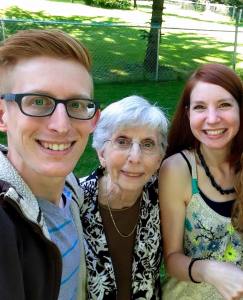
Last night after dinner my grandmother passed away.
We were close. But I think more than anything I’m sad for my grandpa, because he lost his life partner and best friend. He loved her so much. (They were that adorable old couple that’s more in love now than the day they were married.)
 Death is an incredible reminder that things are not right in this world. Death is universally typical; but, as a Christian, it is my firm conviction that death is not “normal.” It is an intrusion into God’s good creation, a testimony to and result of humanity’s horrific plunge into deep-seated rebellion against a good God (what we as Christians call sin). And, apart from Christ’s return, it is something we will all face.
As the Biblical book of Ecclesiastes tells us, death seems to stamp the entirety of our lives up until that moment as “pointless.” Whatever was achieved, whatever good was done, whatever meaning was found, whatever joy was had, death puts a (seemingly) permanent end to it all.
But our hope — our only hope from death, the only hope my grandmother has in overcoming death — is the good news about this guy named Jesus, who, as the Bible tells us, is God become a human being for the very purpose that he might take upon himself this human predicament (death), face it square in the face, wrestle it down, and, through his own death on our behalf, deal death itself a deathblow, achieving resurrection-life through his own resurrection.
This is the gospel. This is our anthem as Christians: deliverance from sin and all of its nasty effects (including death) for all who lean wholly on Jesus for their rescue.
1 Cor 15; 1 Thes 4:13-18; 2 Tim 1:10; Heb 2:14; Rev 21:4.
 The Biggest Story: How the Snake Crusher Brings Us Back to the Garden by Kevin DeYoung


