Is Confrontation Always What’s Needed? A Potential Pitfall of Nouthetic Counseling

Nouthetic counseling emphasizes the need to help people primarily by confronting their sin and offering what is perceived as Biblical correction. As the Logos Factbook defines it, Nouthetic counseling is “[a] form of Christian counseling emphasizing biblical teaching and confrontation of sin to address personal problems.”

Now, I’m not trying to broad brush all practices of Biblical—or Nouthetic counseling—as necessarily being guilty of this error. But I do worry that this emphasis on confronting sin as the remedy leads many to too quickly see confronting sin as the needed medicine in almost every pastoral encounter.

When the only tool one has is a hammer—when this is all one’s may trained in or attuned to look for—everything can look like a nail. One goes on the hunt for nails—or worse, creates them when one can’t easily find one.

Furthermore, when one perceives their primary job as sin-confronting, this can encourage one to be quick to make assessments (assumptions) in order to swiftly identify that sin that needs confronting. When one thinks their primary job is to confront, they’re more apt to become slow to listen and quick to speak (cf. James 1:19), since, of course, confronting requires speaking. And if it’s actually loving to confront (as indeed it sometimes is), we can give ourselves license to ungentle, blunt speech.

But contrast this one-size-fits-all approach to pastoral care with Paul’s wise words in 1 Thess 5:14: “[W]e urge you, brothers, admonish the idle, encourage the fainthearted, help the weak, be patient with them all.” Paul instructs different approaches to different people facing and experiencing different situations. Notably, consider his words about the fainthearted and imagine the effect that assuming confrontation is the one-size-fits-all, blunt-confrontation solution might have on this person.

And when we disciple others in this approach, we unwittingly train them to respond to others like Job’s friends (“There must be some sin at root here that’s to blame”)—whom God rebuked, we should remember.

The Harmful Simplicity of Reductionistic Theology

I take no issue with making the gospel central in all things (the church, preaching, the Christian life, etc.)

But one of the results of a malformed gospel-centeredness is a reductionistic theology that treats nearly every issue someone faces as a matter of sin to be dealt with. Sin is always seen, diagnosed, and treated as a root cause. Why? Because if the gospel is the solution to everything, and that gospel is primarily, if not exclusively, understood in terms of addressing sin, then sin is always the issue, and addressing sin with the gospel is always the solution.

I theorize we’re also susceptible due to a simplistic conception of total depravity. We give our doctrine of total depravity what we might call “maximalist” interpretive power. Yes, we are pervasively sinful (Isa 1:6). Total depravity is true. But, along with our simplistic gospel-centeredness, we misconstrue the doctrine of total depravity into a fixation on looking for sin everywhere. We misapply the doctrine of total depravity by searching for sin “behind every bush” and over-spiritualizing situations. But not everything is sin or is to explained by sin—at the very least, not exclusively so.

Added to this, training in pastoral counseling often focuses on teaching pastors how to address sin. So pastors are hardwired to approach situations in terms of sin and sanctification. Those are their default operating categories. The danger is, when you’re a hammer, you start to see everything as a nail.

I call all of this “reductionistic” because it takes true things (e.g., sin and a gospel that addresses it), but embraces these true things at the exclusion of other true things. For instance, someone comes to a pastor in suffering. But, instead of seeing their signs of trauma and affliction for what they are, the pastor diagnoses them as displaying a sinful refusal trust in God, rest in Christ, and obey the call to contentment. Instead of caring for the person and acknowledging their plight, they add insult to injury: they take someone who is suffering, and now further inflict them with wrongful condemnation. Often the suffering is ignored as not the “real” issue. Moreover, the sufferer may be treated as contentious or unrepentant when they (rightly) push back at the bad counsel.

The reality, though, is that humans are both sinners and sufferers. We are not only perpetrators of evil, but also victims to it. We not only sin; we are also sinned against. And the gospel meets not merely our sin but also our suffering. The good news (gospel) is not only that our sin is forgiven, but that Christ will undue the curse in all its effects—including evil and suffering.

This means, for example, that:

  • Although the Bible tells us to cast our cares on God (1 Peter 5:7), it also leads us in lament (complaint) to God (see the Psalter). Apparently the two are not mutually exclusive!
  • Or again, God is sovereign, but humans are also responsible. God’s sovereignty is not an excuse for inaction and resigning ourselves to evil and injustice. Sovereignty isn’t the same as fatalism; God uses means.
  • Yes, we are to forgive those who sinned against us (Eph 4:32). Yes, God will ultimately judge when Christ comes again (Acts 17:31). But God also establishes means for provisional justice in this life too (e.g., Rom 13:1–7). These are not mutually exclusive.
  • God works all things for good for those who love him (Rom 8:28). Yet among the things he works for good are things that are evil (see vv.35–39). Just because he works something for good does not mean it itself is good—and we don’t need to pretend that it is! These, too, are not mutually exclusively.

We could go on…

Why this matters? Bad theology makes for bad counsel. More pointedly, bad pastoral theology makes for pastoral malpractice—even spiritual abuse.
How God Hates Divorce: His Merciful Allowance in a Fallen World

God hates divorce.

But that does not mean he opposes all divorce.

No, divorce was never God’s original intention for marriage. Divorce was not part of the equation when he created marriage: “from the beginning it was not so,” as Jesus said quoting Gen 2:24 (Matt 19:9).

Nonetheless, on this side of the fall, we find in scripture that, in his mercy, God gives certain allowances for divorce.

My experience as a pastor, counseling people with abusive spouses, helped me better understand God’s hatred of divorce. I’m not saying experience determines our theology or should be used to overrule scripture. But sometimes experience can expand our understanding.

God always hates divorce. But sometimes he hates it because it’s unwarranted, it’s wrong to pursue, he doesn’t allow it (like in Malachi 2:16). In other instances though, God hates divorce because, although he warrants it, he nonetheless hates the sin that made it warranted.

In other words, all divorce involves sin. But not all divorce is sinful.

I’ve seen first hand the negative impact when pastors fail to grasp this. Very practically, they see divorce as a greater evil than the abuse the spouse is enduring. Divorce is never seen as God’s mercy to the abused spouse.

Divorce is never the outcome we want for any marriage. But sometimes it’s God’s mercy in a fallen world—”because of your hardness of heart,” as Jesus says (Matt 19.8).

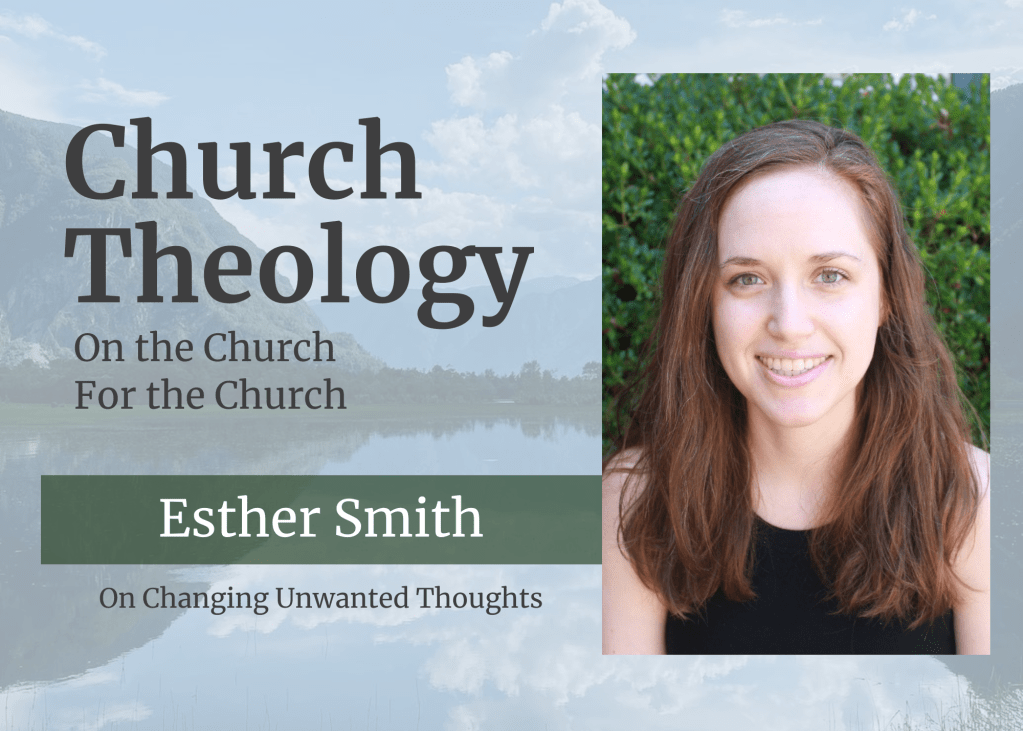
Changing Unwanted Thoughts (with Esther Smith)

Are you burdened by anxious thoughts? Does your mind race uncontrollably? Are you prone to ruminate? Maybe you are wearied with thoughts of hopelessness, self-deprecation, unpleasant mental images, or a range other unwanted thoughts. At some point or another, all of us experience some form of mental anguish or distress. In this episode, Esther Smith, seasoned counselor and author of A Still and Quiet Mind: Twelve Strategies for Changing Unwanted Thoughts, provides us a multi-faceted, Biblically-integrated approach for dealing with the battles in our minds.

Access the episode here. (Available on Apple Podcasts, Spotify, Google Podcasts, and more.)

Divorce & Remarriage — A Church Policy Paper

I produced the following for use as an official policy/position paper at South City Church (Milwaukee). It is largely inspired by and makes modifications from John Piper and Bethlehem Baptist’s A Statement on Divorce & Remarriage in the Life of Bethlehem Baptist Church.


As those who believe that “the Bible is God’s very word, … supremely authoritative for what is true and right,” and, as such, “is to be … obeyed in all that it commands” (I. Scripture under Membership Affirmations in the Constitution), we must look to scripture to determine how we should view, handle, and approach the matter of divorce and the potential remarriages that would follow.

However, the subject of divorce and remarriage is one over which many faithful Christians disagree. All agree that remarriage is intended to be a life-long union, with remarriage being permissible after the death of one’s spouse. But, with regards to remarriage after a divorce, whereas some believe that such remarriages are always wrong, others believe that remarriage after divorce may be permissible in certain select cases. Good, respectable arguments exist on both sides. And faithful, Bible-believing Christians disagree.

As members of this church, we are called to hold one another accountable and to intervene in each other’s lives (church discipline) when we stray from following Christ. And we have covenanted to do just that (see the Church Covenant in our Constitution). This discipline and mutual-accountability encompasses all areas of life, no less our marriages, divorces, and potential remarriages.

The question thus emerges, how shall we as a church engage in this sort of mutual-accountability and discipline in the midst of potential disagreements over what is right or permissible with respect to divorce and remarriage? To this end we accept the below principles, which we believe express minimum strictures expected of Bible-adhering Christians, as our boundaries for accountability and discipline.

Continue reading