In this episode of Logos Live, I sat down with Joel Beeke to talk about the Protestant Reformation—what it was, and why it still matters today.
Church History
40 Quotes from The Pastoral Rule by Gregory the Great
Gregory the Great wrote The Pastoral Rule to provide guidance for “spiritual directors” (clergy) on the responsibilities and tasks of pastoring. It is widely considered one of the best works of pastoral theology.
He breaks his work into four parts.
- He addresses the qualifications of those who would obtain pastoral authority.
- He provides directions on the proper life and work of the pastor.
- He offers specific guidance and insight on how to pastor particular types of people given their unique temperaments, struggles, characteristics, and circumstances.
- He closes with an exhortation to humility in pastoral ministry.
He sets out to write his book, among other reasons, “to express my opinion of the severity of their weight [i.e., the burdens of pastoral care] so that he who is free of these burdens might not recklessly pursue them and he who has already attained them might tremble for having done so.”1 At the close of his book, he says, “I have tried to show what the qualities of a spiritual director ought to be.”2
The following are some of my favorite quotes from the work, organized loosely by subject matter.3
1. The dangers of the pastoral authority
“No one does more harm in the Church than he who has the title or rank of holiness and acts perversely. … [B]ecause such a sinner is honored by the dignity of his rank, his offenses spread considerably by way of example. And yet everyone who is unworthy would flee from such a great burden of guilt if, with the attentive ear of the heart, he pondered the saying of the Truth: ‘He that scandalizes one of these little ones who believes in me, it would be better for him that a millstone was hung around his neck and that he was cast into the depth of the sea.’ … Whoever, therefore, gives off the appearance of sanctity but destroys another by his words or example, it would be better for him that his earthly acts, demonstrated by worldly habits, would bind him to death than for his sacred office to be a source for the imitation of vice in another. Indeed, his punishment in hell would be less terrible if he fell alone.” (32)
“[Jesus] chose instead the penalty of a shameful death so that his [followers] might also learn to flee the applause of the world, to fear not its terrors, to value adversity for the sake of truth, and to decline prosperity fearfully. This final concern [i.e. prosperity] often corrupts the heart through pride, while adversities purge it through suffering. In the one, the soul becomes conceited; while in the other (even if the soul is occasionally conceited), it humbles itself. In the one, the man forgets who he is; while in the other, he is recalled, even unwillingly, to know what he is. … For commonly in the school of adversity, the heart is subdued by discipline; but if one rises to a position of spiritual authority, the heart is immediately altered by a state of elation that accompanies the experience of glory.” (33)
Continue readingBaptist Ecclesiology as Continued Reform, an Extension of the Reformation

Hercules Collins’ An Orthodox Catechism is a Baptist adaptation of the Reformed Heidelberg Catechism. In his, preface, Collins compares the theological development by these early Baptists to the reforms under Joshua, Hezekiah, and Ezra and Nehemiah, as they went back to scripture to recover “true worship” as prescribed by God. Collins specifically mentions that these Particular Baptists agree with the other “orthodox divines” in the “fundamental principles.” They simply differ on some things about “church-constitution” (ecclesiology). In other words, Collins sees the Baptists as providing further reformation (like Joshua, Hezekiah, Ezra, Nehemiah) specifically in the realm of ecclesiology (“church-constitution,” “the true form of God’s house”). In other words, early Baptists saw themselves as simply continuing in the spirit of the Protestant Reformation, extending Reformation principles to ecclesiology.
I will quote the entirety of his explanation:
“In what I have written you will see I concenter with the most orthodox divines in the fundamental principles and articles of the Christian faith, and also have industriously expressed them in the same words, which have on the like occasion been spoken, only differing in some things about church-constitution, wherein I have taken a little pains to show you the true form of God’s house, with the coming in thereof, and the going out thereof. But I hope my zeal in this will not be misinterpreted by any that truly fear God. That God whom we serve is very jealous of his worship; and forasmuch as by His providence the law of His house has been preserved and continued to us, we look upon it as out duty in our generation to be searching out the mind of God in His holy oracle, as Ezra and Nehemiah did the Feast of Tabernacles, and to reform what is amiss, as Hezekiah, who took a great deal of pains to cleanse the house of God, and set all things in order, that were out of order, particularly caused the people to keep the Passover according to the institution. For it had not, says the text, been of a long time kept in such sort as it was written., And albeit the pure institutions of Christ were not for some hundred of years practiced according to the due order, or very little through the innovations of antichrist; and as circumcision for about forty years was unpracticed in the wilderness, yet as Joshua puts this duty in practice as God signified His mind in that particular, so we having our judgments informed about the true way of worship, do not dare to stifle the light God has given us.
Now albeit there are some differences between many godly divines and us in church constitution, yet inasmuch as those things are not the essence of Christianity, but that we do agree in the fundamental doctrine thereof, there is sufficient ground to lay aside all bitterness and prejudice, and labor to maintain a spirit of love each to other, knowing we shall never see all alike here. We find in the primitive times that the baptism of Christ was not universally known. Witness the ignorance of Apollos that eminent disciple and minister, which knew only the baptism of John. And if God shall enlighten any into any truth, which they shall stifle for base and unwarrantable ends, know that it is God who must judge, and not man. And wherein we cannot concur, let us leave that to the coming of Christ Jesus, as they did their difficult cases in the Church of old until there did arise a priest with Urim and Thummin, that might certainly inform them of the mind of God thereabout.”1
Likewise, earlier in the preface, in explaining his reason for constructing this catechism, he remarks,
“Now that … you may be the better established, strengthened, and settled on that sure rock and foundation of salvation, Christ’s merits, in opposition to the poor imperfect works of an impotent creature; also settled on the foundation of church-constitution, on which you are already built, through the grace of God which stirred you up to search the divine oracle, and rule of Divine service, as Ezra and Nehemiah searched into the particular parts of God’s worship, by which means they came to the practice of that almost lost ordinance of God, the Feast of Tabernacles, which for many years was not practiced after the due order, though a general notion was retained about it.”2
The early Particular Baptists saw themselves as part of a larger family along with the Reformed Presbyterians and Congregationalists (see The Savoy Declaration, which is based on The Westminster Confession of Faith). This is evidenced by the fact that these Particular Baptists seem to deliberately repurpose The Westminster Confession of Faith (as The Second London Baptist Confession), The Westminster Catechism (as Benjamin Keach’s The Baptist Catechism), and The Heidleberg Catchesim (Hercules Collins’ An Orthodox Catechism). They did this, among other reasons, presumably to show their general alignment with these Reformed brethren and the broader Reformed tradition. In fact, we see this motivation explicitly stated by Keach in his preface to The Baptist Catechism:
“Having a desire to show our near Agreement with many other Christians, of whom we have great esteem; we some years since put forth a Confession of our Faith, almost in all points the same with that of the Assembly and Savoy, which was subscribed by the Elders and Messengers of many Churches, baptised on profession of their faith: and do now put forth a short account of Christian principles, for the instruction of our families, in most things agreeing with the shorter Catechism of the Assembly. And this we were the rather induced to, because we have commonly made use of that Catechism in our families, and the difference being not much, it will be more easily committed to memory.”3
So the preface to earlier confession, The First London Baptist Confession opens with the following, clarifying that these Baptists considered themselves among the Reformed and thus were “unjustly” labeled Anabaptist by their detractors:
“A confession of faith of seven congregations or churches of Christ in London, which are commonly, but unjustly called Anabaptists; published for the vindication of the truth and information of the ignorant; likewise for the taking off those aspersions which are frequently, both in pulpit and print, unjustly cast upon them.”
Likewise see the assessment of Reformed scholar, Richard Muller, on the 18th century Particular Baptist John Gill:
“The eminent Particular Baptist preacher, theologian, and exegete, John Gill (1697-1771), stands as proof, if any were needed, that the thought of English nonconformity and, within that category, English Baptist theology, is in large part an intellectual and spiritual descendant of the thought of those Reformers, Protestant orthodox writers, and Puritans who belonged to the Reformed confessional tradition. This must be acknowledged despite the pointed disagreement between Baptists and the Reformed confessional tradition over the doctrine of infant baptism; this one doctrine aside, their theology is primarily Reformed and what disagreements remain are disagreements with and often within the Reformed tradition rather than indications of reliance on another theological or confessional model.”4
Or hear from Reformed theologian, Herman Bavinck: “From the outset Reformed theology in North America displayed a variety of very diverse forms.” Among whom he mentions Baptists who “gained a firm foothold on Rhode Island under Roger Williams in 1639.” He concludes:
“Almost all of these churches and currents in these churches [Baptists and the others he mentions] were of Calvinistic origin. Of all religious movements in America, Calvinism has been the most vigorous. It is not limited to one church or other but—in a variety of modifications—constitutes the animating element in Congregational, Baptist, Presbyterian, Dutch Reformed, and German Reformed churches, and so forth.”5
Tom Hicks explains at greater length:
“In England during the post-Reformation period, there were great debates over the nature of the church, even though the heirs of the Reformed faith agreed on the gospel and most other doctrines. The Reformed Anglicans wanted an English state-church with an Episcopalian form of government. The English Presbyterians also sought cooperation between church and state, but with a Presbyterian form of government. Independents agreed with the Anglicans and Presbyterians that infants should be baptized, but they did not agree with any kind of formal church-state synthesis. … Independents also believed in a congregational form of church government….
The first ‘Reformed Baptists’ … founded ‘baptistic congregationalist’ churches because, while they agreed with the Independents on almost all other doctrines, they disagreed on infant baptism. It is important to understand that the first Reformed Baptists didn’t see themselves as a certain kind of ‘Baptist.’ Rather, they viewed themselves as congregationalists with baptistic convictions when it came to the subject of baptism.
It is common for teachers of Baptist history to identify Arminian ‘General Baptists’ (Smyth and Helwys), who held to a general atonement, as part of the same group as the Calvinist ‘Particular Baptists’ (Spilsbery, Kiffin, Knollys), who held to a particular atonement. Most Baptist scholars today would say that the term ‘Baptist’ merely identifies the genus of churches that baptist believers. Therefore, they think Baptist churches come in two different species: General Baptists (Arminians) and Particular Baptists (Calvinists). …
[But] the General and Particular Baptists did not consider themselves two different kinds of Baptists. They would never have joined in formal association with one another, and, in fact, the Particular Baptists regarded the General Baptists as dangerously heterodox. … The General Baptists had been heavily influenced by the continental Anabaptists and their theological errors. …
Reformed Baptists, therefore, are not a species of the genus ‘Baptist.’ Rather, they are a species of the genus ‘Reformed.’ Reformed Baptists are not a branch of a Baptist tree; rather they are a branch of the Reformed tree. … Reformed Baptist identity is catholic first, then confessionally Reformed, and finally Baptist.”6
Matthew Bingham agrees, writing,
“[T]hese men and women [mid-seventeenth-century ‘Baptists,’ and, more specifically, those commonly known as ‘Particular Baptists’] are most helpfully understood, not by any of these labels, but rather as congregationalists who, as it happened, reached novel conclusions regarding the legitimacy of infant baptism. This repudiation of paedobaptism did not instantaneously alter either their basic theological orientation or their relational networks; nor did it automatically confer upon them a new ‘Baptist’ identity, a supposition strongly supported by their basic inability to settle upon a consistent term of self-identification.
A coherent, overarching pan-‘Baptist’ identity may well have developed over subsequent decades, but it is problematic to project this back on to the English Revolution and Interregnum. Moreover, even the rejection of paedobaptism was itself made possible and plausible by a more basic congregational ecclesiological paradigm, a conclusion substantiated by the intense conceptual pull which believer’s baptism would exert throughout congregational circles on both sides of the Atlantic. Thus, I have suggested that the mid-seventeenth-century dissenters ubiquitously referred to as ‘Particular Baptists’ would be better described as ‘baptistic congregationalists,’ a label which more accurately describes their mid-seventeenth-century self identity, and does not insert them retroactively into an imagined pan-‘Baptist’ denomination which, at that time, clearly did not exist. This leaves open, of course, the question of what term might best describe the so-called General Baptists. I am inclined toward something like ‘baptistic separatists,’ a term that highlights their distinctive sacramentology without also implying that they exhibited relational and theological continuities with mainstream congregationalists. To properly locate them, however, will require sensitivity to the unique relational and theological matrix out of which they emerged, a task only possible when one jettisons unhelpful and anachronistic denominational categories.”7
Some have argued that Baptist ecclesiology, e.g., believers-only baptism, was so novel it excludes Particular Baptists from the Reformed tradition. Regarding credobaptism specifically, Hick’s responds that the Particular Baptists were simply attempting to recover the original practice of the church catholic. “The early Particular Baptists understand that prior to Augustine, the baptism of believers alone was widespread.”8 Furthermore, he notes,
“It’s important to remember that there is a sense in which all of the church polities of the post-Reformation period were somewhat novel when compared to the time just before the Reformation. … Baptist polity was no more of less novel than the other ecclesiastical polities of the post-Reformation period. Rather, Baptists were simply trying to apply the biblical doctrines of sola Scriptura (Scripture alone) and justification sola fide (faith alone) to the church.”9
In other words, these earliest Particular Baptists sought to take the principles of the Reformation and simply apply them further, more consistently and exhaustively, to the life of the church.10
Notes
- Collins, Hercules. An Orthodox Catechism. Edited by Michael A. G. Haykin and G. Stephen Weaver, Jr. Palmdale, CA: RBAP, 2014. Pages 3–4. ↩︎
- Collins, An Orthodox Catechism, page 2. ↩︎
- Benjamin Keach, The Baptist Catechism, Commonly Called Keach’s Catechism: Or, a Brief Instruction in the Principles of the Christian Religion (Philadelphia: American Baptist Publication Society, 1851), 2. ↩︎
- Richard Muller, “John Gill and the Reformed Tradition: A Study in the Reception of Protestant Orthodoxy in the Eighteenth Century,” in The Life and Thought of John Gill: A Tercentennial Appreciation, ed. Michael A. G. Haykin (Leiden: Brill, 1997), 51. ↩︎
- Herman Bavinck, John Bolt, and John Vriend, Reformed Dogmatics: Prolegomena, vol. 1 (Grand Rapids, MI: Baker Academic, 2003), 200–201. ↩︎
- Tom Hicks, What Is a Reformed Baptist? (Pensacola, FL: Founders Press, 2022), 17–18, 20. ↩︎
- Matthew C. Bingham, Orthodox Radicals: Baptist Identity in the English Revolution (Oxford: Oxford University Press, 2019), 152–53. ↩︎
- Hicks, Reformed Baptist, 19. ↩︎
- Hicks, Reformed Baptist, 20–21. ↩︎
- As David W. Bebbington argues in Baptists Through the Centuries: A History of a Global People (Waco, TX: Baylor University Press, 2010). ↩︎
The Athanasian Creed (with Brandon Smith)
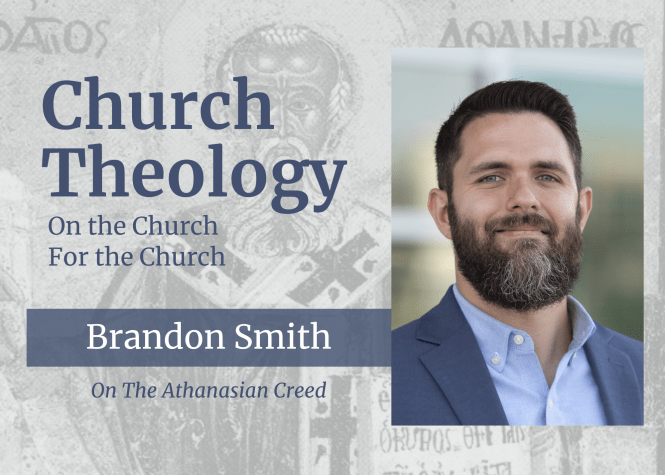
The Athanasian Creed famously confesses, “We worship one God in Trinity, and Trinity in Unity; Neither confounding the Persons nor dividing the substance.” But what exactly does this mean that God is one and yet three persons? And why is The Athanasian Creed so concerned about the doctrine of the Trinity as it relates to our salvation? In this episodes Kirk is joined by Brandon Smith to discuss these questions and more!
(We apologize for the poor quality audio on Kirk’s end. His computer was experiencing a technical problem during the recording which affected the audio.)
Access the episode here. (Available on Apple Podcasts, Spotify, Google Podcasts, Stitcher, and more.)
See all other episodes in this series.
The Chalcedonian Definition (with Stephen Wellum)

Delegates from throughout the ecumenical (universal or “catholic”) church met in Chalcedon in 451 AD to address the emergence of certain heresies surrounding the person and nature of Christ. Some were teaching that Jesus merely took on the material aspects of a human body (Apollinarianism). Others so distinguished Jesus’ humanity and divinity that they conceived of each as involving a distinct person (Nestorianism). Finally, some so emphasized Christ’s unity that they spoke of his divinity blending with his humanity to form a new mixed nature (Eutychianism or Monophysitism). The Council of Chalcedon thus responded to these errors, producing a confession of orthodoxy known as The Chalcedonian Definition (or the Symbol of Chalcedon). It affirmed that the incarnate Christ is one person with both a human and divine nature.
But why does this statement matter, and are its distinctions all that important? What, if anything, can we learn from it today? Dr. Stephen Wellum joins Kirk in this episode to discuss the meaning and significance of this important historical document.
Access the episode here. (Available on Apple Podcasts, Spotify, Google Podcasts, Stitcher, and more.)
See all other episodes in this series.
 Kirk E. Miller