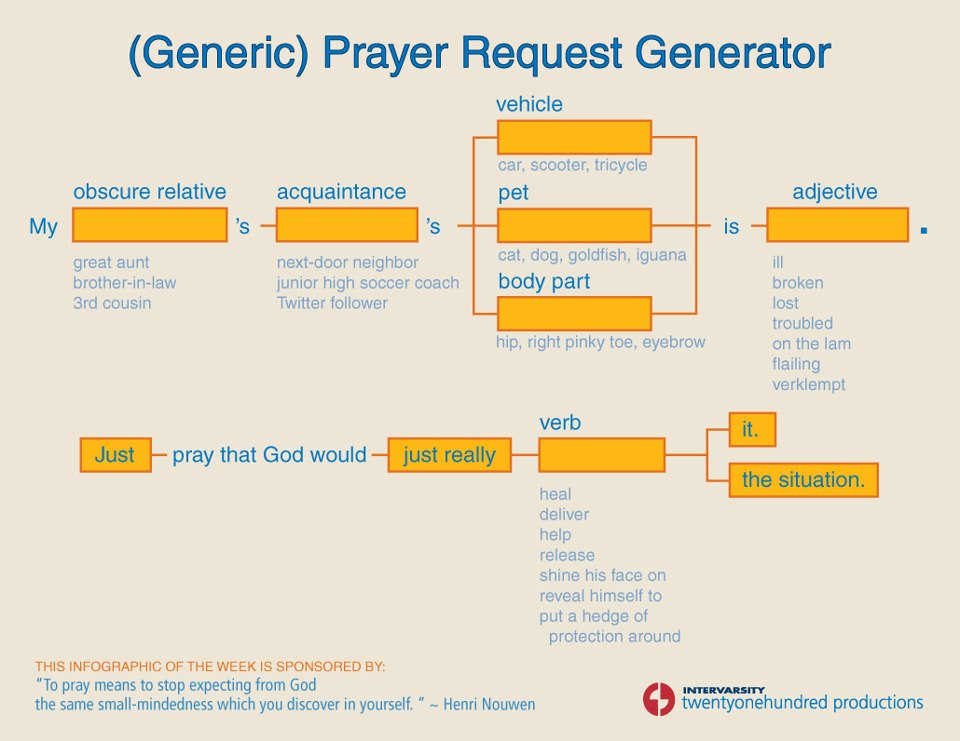
[Click on image for full size.]
I found this pretty funny. And I could probably just share this picture and leave the post “as is.” But I imagine the maker of this “prayer request generator” probably wanted to get us to think. So… let’s think.
[Click on image for full size.]
I found this pretty funny. And I could probably just share this picture and leave the post “as is.” But I imagine the maker of this “prayer request generator” probably wanted to get us to think. So… let’s think.
The following is a modified manuscript/outline from a sermon I preached on 1 Peter 2:11-25 at Lake Drive Baptist Church in December 2013.
____________________
 I’ve entitled my sermon, “Christian Living in a Post-Christendom America.” What do I mean by “christendom”? “Christendom” refers to the “Christian Empire,” where Christianity is associated with the state, promoted by the state, or the dominant religion within the state.
In a sense, one could have previously referred to America as a form of this Christendom. But now days, it’s quite clear that we live in a post-Christendom America. –Not only non-Christian, but even increasingly anti-Christian.
A mere casual awareness of the news makes one aware of the rapid pace of secularization in our country. For example, only 17 years after President Clinton signed DOMA into law, President Obama successfully pushed for its repeal. And keep in mind, he entered office opposed to gay marriage. And the rapidness of this shift only mirrors trends in the general population. Or again, it only takes a brief glance at recent headlines to demonstrate this:
And without necessarily endorsing any of the parties in these conflicts– And no matter what you think about these controversies on a political level, they nonetheless indicate an increasing hostility and threat to Christian thought and values. … We live in an ever-increasingly secular culture.
So, how are we as Christians to respond? What does Christian living look like in a post-Christendom America? 1 Peter has much to say about how Christians should live within a non-Christian and even anti-Christian society.

Within the baptist tradition, there seems to be a certain repulsion towards written prayers. For whatever reason (probably because of its association with certain other traditions or its abuse), it has a stigma. For example, the great Baptist Charles Spurgeon once said,
Be assured that free [i.e., unprepared] prayer is the most scriptural, and should be the most excellent form of public supplication. … a manner which is warranted by the word of God, and accepted of the Lord. The expression, “reading prayers,” to which we are now so accustomed, is not to be found in Holy Scripture … The phrase is not there because the thing itself had no existence. Where in the writings of the apostles meet we with the bare idea of a liturgy? Prayer in the assemblies of the early Christians was unrestricted to any form of words.[1]
I want to respond, “Eh, Spurgeon, don’t be so dogmatic here. Don’t be so harsh now.”
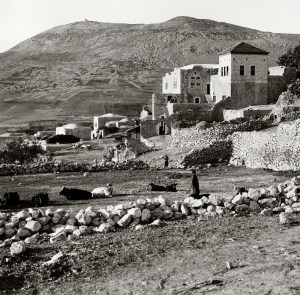
As I read and meditated on this passage, something with which I was initially struck that I hadn’t paid much attention to before was the significance of this well in the story. In v.5, John goes out of his way to point out this well’s significance. It was Jacob’s well, the great forefather of Israel. Moreover, after Jesus mentions His “living water,” the woman asks in v.12, Are you greater than our father Jacob who gave us this well and drank out of it himself? In other words, do you think that your water is somehow better than Jacob’s, our great forefather? And of course, likely alluding to the OT imagery of the Holy Spirit as water, Jesus argues that His “water” is superior. Jesus is greater than Jacob. And, if D.A. Carson’s understanding of “truth” (i.e., the reality, the antitype) in v.24 is correct, this insight correlates to Jesus’ statement about worshipping in “truth.” Jesus is that “true” everything that the OT anticipated according to John. Specifically here, He is superior to Jacob; His well, i.e., Himself, is the “true” well.

As I meditated on this passage, my thoughts seemed to center around what I think is this psalm’s central thrust, its thesis if you will. That thesis is well summarized in v.8a: “Ascribe to the LORD the glory due His name.” Ascribe (not “give”)—the idea of attributing some quality to God that is already His. This attribution is the central concept of worship in this psalm. In other words, to put this thesis in my own words, we are to give God the worship that He is due. We are to worship God who is worthy of our worship; and the measure, scope, and intensity of our worship is to correspond to the worthiness of the God to whom that worship is given. And, of course, the psalm goes on to make unavoidably clear that the worship due God is immeasurable great. Therefore, our worship of God must not be limited; it cannot be too great.
 Kirk E. Miller