What does Hosea mean by the expression “arise from the land” in Hosea 2:2 (English 1:11)?

The following was a short exegetical essay for Dr. Eric Tully’s Advanced Hebrew Exegesis of Hosea course at Trinity Evangelical Divinity School.

Please note: I use the Hebrew Bible’s chapter and verse references below, which can at times be different than what one will find in our English translations.


After naming his third child “Not My People,” Hosea introduces an oracle of eschatological hope. The patriarchal promise of numerous descendants will be fulfilled and the kingdom united under one ruler. However, one particularly difficult aspect of this oracle is the phrase וְעָל֣וּ מִן־הָאָ֑רֶץ. Determining the meaning of this phrase is not only important for understanding the meaning of this oracle, but also for developing a full view of the book’s entire prophetic hope.

Lexically, עָלָה has a wide semantic range (cf. CHALOT and BDB). Yet, as McComiskey notes, the common denominator among all of its potential connotations and nuances is the concept of ascending (30). Stuart suggests that ועלו מן־הארץ likely carries a dual connotation—return from exile and resurrection. He argues that the future situation of Israel appeals to this interpretation—in exile, not God’s people, and in desperate need of absolute rejuvenation (39). Thus, according to Stuart, אֶרֶץ has a dual referent—the land of exile and the land of their grave (39). However, Garrett argues that for Hosea to refer to foreign land as אֶרֶץ would be unprecedented in the OT and therefore unlikely. Rather, Garrett (73) and McComiskey (30) suggest that here עָלָה carries the idea of vegetation springing up (עָלָה) from the ground (מן־הארץ). McComiskey notes several other texts that seem to demonstrate a similar use of עָלָה (e.g., Gen 41:5, 22; Deut 19:22 [23]; Isa 55:13). Particularly noteworthy is another use of עָלָה in Hosea—Hos 10:8—which refers to thorns and thistles growing up. This interpretation of ועלו מן־הארץ in 2:2 is linked to and supported by the literal meaning of Jezreel, “God sows” (cf. a similar meaning in 2:24-25). Therefore, in this interpretation, Jezreel is not geographical here, but figurative, and connotes the repopulation anticipated earlier in this verse (McComiskey, 30; Garrett, 73), thus fitting the context quite nicely. Nonetheless, Garrett (73) still believes ועלו מן־הארץ may also carry resurrection connotations (cf. Ezek 37). Finally, Wolff, although not rejecting the vegetation motif, argues that ועלו מן־הארץ primarily means “take possession of the land,” specifically the promised land. He argues this based on a similar understanding of עלה מן־הארץ in Ex 1:10 (but this translation seems unlikely; cf. English translations) and the context of 2:2 which refers to a united kingdom, presumably within the land (28).

In conclusion, given the various meanings, עָלָה could have (note its wide semantic range), context must serve as the deciding factor. Therefore, a proper interpretation of this clause must take seriously its relationship to the following כִּי clause and provide a satisfactory explanation. The vegetation metaphor interpretation seems to do this best, i.e., because great is the day of “God sows,” God will sprout up his vegetation [implied: which He has sowed] in the land. Resurrection motifs do not satisfy this relationship to the כִּי clause. Garrett’s observation that אֶרֶץ nowhere else refers to foreign land seems to eliminate the return from exile view. The vegetation metaphor interpretation is therefore preferred.
Brief Meditative Reflections on John 4:1-26 – Jacob’s Well & Worshiping God in “Truth”

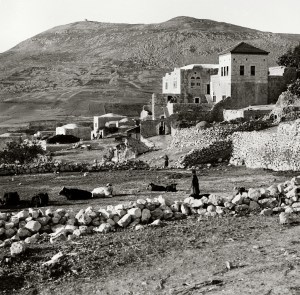
As I read and meditated on this passage, something with which I was initially struck that I hadn’t paid much attention to before was the significance of this well in the story. In v.5, John goes out of his way to point out this well’s significance. It was Jacob’s well, the great forefather of Israel. Moreover, after Jesus mentions His “living water,” the woman asks in v.12, Are you greater than our father Jacob who gave us this well and drank out of it himself? In other words, do you think that your water is somehow better than Jacob’s, our great forefather? And of course, likely alluding to the OT imagery of the Holy Spirit as water, Jesus argues that His “water” is superior. Jesus is greater than Jacob. And, if D.A. Carson’s understanding of “truth” (i.e., the reality, the antitype) in v.24 is correct, this insight correlates to Jesus’ statement about worshipping in “truth.” Jesus is that “true” everything that the OT anticipated according to John. Specifically here, He is superior to Jacob; His well, i.e., Himself, is the “true” well.

Continue reading

Brief Meditative Reflections on Psalm 96

As I meditated on this passage, my thoughts seemed to center around what I think is this psalm’s central thrust, its thesis if you will. That thesis is well summarized in v.8a: “Ascribe to the LORD the glory due His name.” Ascribe (not “give”)—the idea of attributing some quality to God that is already His. This attribution is the central concept of worship in this psalm. In other words, to put this thesis in my own words, we are to give God the worship that He is due. We are to worship God who is worthy of our worship; and the measure, scope, and intensity of our worship is to correspond to the worthiness of the God to whom that worship is given. And, of course, the psalm goes on to make unavoidably clear that the worship due God is immeasurable great. Therefore, our worship of God must not be limited; it cannot be too great.

Continue reading

Does Hosea 6:7 Refer to a Pre-Fall, Adamic Covenant?

The past several hours, I’ve been studying this question and working through the exegetical issues involved. Since this exegetical question is of significant interest to me given my areas of theological interest (i.e., redemptive history and systems of theology that attempt to provide theological organization to it), I’ve taken the time to compose a more detailed outline of my exegetical notes. For those of you with similar interests (and for those of you who requested these notes), I thought I’d share my notes. After reading through these notes, feel free to comment with your own thoughts and/or tentative conclusions.

Theological implications: This verse could refer merely to what is likely the Mosaic Covenant or additionally refer to a pre-fall covenant (e.g., Covenant of Works, Adamic Covenant, Covenant with Creation, etc.) If the latter is true, this verse would validate seeing the concept of covenant as a fundamental framework for God’s relationship with mankind and thus God’s work of redemption (as Covenant Theology argues).

Continue reading

Theological issues involved in Nehemiah’s request for God to observe his prayer (Nehemiah 1:6; cf. v.11)

The following was a short exegetical essay for Dr. Richard E. Averbeck’s Pentateuch and Historical Books course at Trinity Evangelical Divinity School.


In Nehemiah 1:6, Nehemiah begins his prayer with an introductory petition to God. He begins, “let your ear be attentive and your eyes be open to hear the prayer of your servant.” Although the casual reader will likely brush over this line without much notice or a second glance, this language prompts many exegetical and theological questions for the thoughtful interpreter. Some of these questions may be trivial or easily resolved, e.g., does God have ears, eyes, or a physical sort of body? But others are quite serious—what does this request imply about the nature of God, His impassibility, his omniscience, omnipresence, omnipotence, immutability, aseity, etc.?—and may even begin to touch on debates revolving around what has been called “process theology.” The careful exegete and interpreter, therefore, do well to investigate this matter in greater detail.

According to Fensham, this language denotes Nehemiah’s request for God to pay attention to His prayer (155). But does an omniscient, omnipresent God need to be reminded or requested to pay attention? On a complementary note, Breneman clarifies the issue by arguing that this language serves the rhetorical purpose of communicating a request to action. The Biblical testimony never exhibits doubt that God hears, observes, and notices the prayers of His people. In other words, “Nehemiah knew that God would hear.” That wasn’t the issue. “He was asking God to take action” (172). Williamson provides some evidential grounds for this kind of conclusion. He claims that Nehemiah’s manner of appeal, namely, an appeal to the activity of God’s sensing organs, was quite normal and would not have struck the original readers as so bizarre or necessarily theologically troublesome. Of exegetical significance, Williamson points out the obvious metaphorical nature of this language—“The superficially curious juxtaposition of ‘eyes’ and ‘hearing’ provides a fully intelligible metaphor. . . .” (173). Similar language is also used at the dedication of the temple in 1 Kings 8:29, 52 and 2 Chron 6:40, in which the meaning is clearly metaphorical, figurative, and poetic. On the other hand, Clines and Allen believe that this language is based on the ritualistic habits commonly involved in praying. Stating, “Prayer is not simply a verbal matter, but is also expressed by ritual actions and postures,” Clines claims that Nehemiah began his petition by requesting that God take notice of his physical acts of prayer, “his evident signs of grief” (138-139; cf. Allen, 92).

In conclusion, I find the metaphorical-figurative explanation the most compelling. Clearly, Nehemiah is appealing to God that God hears his prayer. But this does not imply that God otherwise might not be aware of Nehemiah’s cry. God is spirit, and therefore he does not have literal, physical, bodily eyes and ears. To use such language is to employ anthropomorphic language to express in human terms, in more understandable language, what might otherwise come across more abstractly. This conclusion is best supported by the following observations: (1) Williamson’s observation that the mismatched juxtaposition between God’s supposed eyes and hearing ability makes little sense if taken literally and (2) the parallels with 1 Kings 8 and 2 Chron 6 argue for an anthropomorphic use. Clines and Allen’s argument that Nehemiah was requesting that God take notice of Nehemiah’s prayer rituals is extremely stretched and unnecessary. Therefore, in sum, Nehemiah is appealing to God’s attentiveness, that is, that God might “hear” his prayer in the sense that God might respond positively to Nehemiah’s request. Rather than indicating a deficiency in God, Nehemiah demonstrates an utter dependence on God that displays the omnipotence of God.