Learning to Sing God’s Songs of Trust (Psalm 4)
Series: Learning to Sing God’s Songs (Psalms)
Lake Drive Baptist Church
Sunday Morning Sermon
2.14.2016
Biblical Studies
A Compassionate God and an Uncompassionate Prophet (Jonah)

A Compassionate God and an Uncompassionate Prophet (Pt. 1 – Jonah 1)
Lake Drive Baptist Church
Sunday Morning Sermon
2/28/2016
The Gospel According to Jonah (Jonah 1:17-2:10)
Lake Drive Baptist Church
Sunday Morning Sermon
3/6/2016
A Compassionate God and an Uncompassionate Prophet (Pt. 2 – Jonah 3-4)
Lake Drive Baptist Church
Sunday Morning Sermon
3/13/2016
What Does a Miserable Christian Sing? (Lament Psalms)
What Does a Miserable Christian Sing? (Lament Psalms; Psalm 13)
Series: Learning to Sing God’s Songs (Psalms)
Lake Drive Baptist Church
Sunday Morning Sermon
4.3.2016
“It is the the doers of the law who will be justified” (Rom 2:13): G.K. Beale on Justification according to Works
In A New Testament Biblical Theology: The Unfolding of the Old Testament in the New, G.K. Beale asks, “How can believers be said to be judged by works and yet be justified by faith?” (e.g., Rom 2:13; Js 2:14-26; cf. Rom 3:28)
In the process of answering his question concerning what Beale tactfully calls this “consummate, manifestive stage of justification” (i.e., the justification according to works of which scripture speaks), Beale gives the following helpful illustration to help us understand this “twofold justification.”
A mundane illustration may help to clarify. In the United States, some large discount food stores require people to pay an annual fee to have the privilege of buying food at their store. Once this fee is paid, the member must present a card as evidence of having paid the fee. The card gets the members into the store, but it is not the ultimate reason that the person is granted access. The paid fee is the ultimate reason, the card being the evidence that the fee has been paid. We may refer to the paid fee as the “necessary causal condition” of store entrance and to the evidential card more simply as a “necessary condition.” The card is the external manifestation or proof that the price has been paid, so that both the money paid and the card issued are necessary for admittance, but they do not have the same conditional force for gaining entrance. We may call the paid fee a “first order” or “ultimate” condition and the card a “second order” condition.
He concludes,
Likewise, Christ’s justifying penal death is the price paid “once for all” (Heb. 9:12; cf. 9:26–28), and the good works done within the context of Christian faith become the inevitable evidence of such faith at the final judicial evaluation. Christ’s work is the “necessary causal condition” for justification, and the believer’s works are a “necessary condition” for it. Jonathan Edwards helpfully referred to Christ’s work as “causal justification” and the believer’s obedience at the end of the age as “manifestive justification.” This manifestive evidence not only is part of a judicial process but also becomes evidence that overturns the wrong verdict of the world on believers’ faith and works done in obedience to Christ.
G. K. Beale, A New Testament Biblical Theology: The Unfolding of the Old Testament in the New (Grand Rapids, MI: Baker Academic, 2011), 506–507.
The Gospel Made Visible in Our Proper Practice of the Lord’s Supper (1 Corinthians 11:17-34)
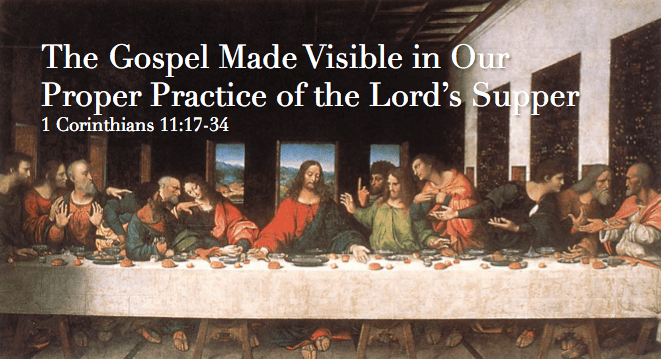
The following was a sermon I delivered on November 22, 2015 as a guest preacher at Living Water Community Church in Vancouver, WA. Below you will find a link to the sermon audio as well as my sermon notes.
Introductory illustration:
We’re aware of the fact that the clothing we wear needs to fit the occasion, event, or activity to which we wear them.
For example, when I was in high school, I worked at a restaurant. And I had to wear a uniform—this ugly purple polo shirt that felt like burlap. Or, when I refereed soccer, I didn’t just wear whatever I wanted; I wore a referee outfit.
Similarly, many of you probably have either a work uniform, a certain dress code that you have to follow, or, if you’re in school, maybe you have a school uniform.
We even have special gowns for graduating (although I’m slightly convinced that whoever invented these wanted to make graduates feel stupid—“Hey, you’re graduating. Congratulations! How ‘bout you wear this black-garbage-bag-looking thing and silly square hat. Oh! And while you’re at it, why don’t you walk across a stage while we take pictures of you? How does that sound?”).
We have these unwritten rules for what we wear and where we wear them: You don’t wear a tuxedo if you’re fixing your plumbing. And you probably don’t want to dress like Richard Simons if you’re going to a formal wedding… Or ever for that matter. And when you go shopping, you don’t wear your pajamas… well, unless, apparently, you’re shopping at Wal-Mart.
You see, there’s this recognized principle (at least among most of us) that what we wear needs to fit the occasion of the thing we’re wearing it to.
Now when it came to the Lord’s Supper for the Corinthian church, they found themselves wearing “the wrong clothes.” Of course, I don’t mean that they were literally wearing the wrong clothes. But think of this idea of clothing as an illustration—the way they practiced the Lord’s Supper did not match the meaning of the Lord’s Supper. Their practice was inappropriate for what the Lord’s Supper means. And so they found themselves “wearing the wrong clothes.”
But we too can easily find ourselves “wearing the wrong clothes” in how we practice the Lord’s Supper. We too can lose sight of the full, true, Biblical meaning of the Supper, and, consequently, practice it inappropriately.
 Kirk E. Miller