John Calvin on Hebrews 6:4-6, 10:26, and 12:17

John Calvin provides some helpful comments on passages like Hebrews 6:4-6, 10:26, and 12:7.

These passages in Hebrews say,

For it is impossible, in the case of those who have once been enlightened, who have tasted the heavenly gift, and have shared in the Holy Spirit, and have tasted the goodness of the word of God and the powers of the age to come, and then have fallen away, to restore them again to repentance, since they are crucifying once again the Son of God to their own harm and holding him up to contempt. – Heb 6:4-6

For if we go on sinning deliberately after receiving the knowledge of the truth, there no longer remains a sacrifice for sins. – Heb 10:26

For you know that afterward, when he desired to inherit the blessing, he was rejected, for he found no chance to repent, though he sought it with tears. – Heb 12:17

Calvin, is this saying that God will refuse forgiveness to someone who repents?

Continue reading

Key Bible and Theological Reference Tools: Biblia Hebraica Stuttgartensia (BHS)

This post is a re-blog of my post at Rolfing Unshelved.


This post is part of a series entitled Key Bible and Theological Reference Tools. This series seeks to provide one with an introduction to some key Biblical and theological reference tools. In this series one will find basic explanations, significant examples, and other information about these reference tools.


Basic Description of BHS

Biblia Hebraica Stuttgartensia (BHS) (BS 715 1990) is an edition of the Masoretic Hebrew Old Testament text. It is based on the Lenigrad Codex B19A (the oldest known manuscript of the complete Hebrew Bible), includes a textual apparatus (provides information relevant for textual criticism), and is the most widely used scholarly text of the Hebrew Old Testament.

Psychology & Christianity: Five Views – Goodreads Review

Psychology & Christianity: Five ViewsPsychology & Christianity: Five Views by Eric L. Johnson

My rating: 5 of 5 stars

Great book.

At times it felt less like reading a multiple view book and more like reading a collection of complementary essays from very similarly positions. Philosophically, it seems like the latter 4 views are more complementary than contradictory, although the Biblical Counseling view seems like it would differ a bit in terms of practice. Even the authors of these views recognized the complementary reality of their positions. Their main differences seemed to be that of emphasis.

In contrast, I found the levels of explanation author rather frustrating. He seemed very naive concerning the philosophical and epistemological discussion being had by the other authors and often didn’t seem like he was really understanding what the other authors were saying. I had a hard time respecting him.

In sum, a very helpful and insightful book. Definitely a “thick” read.

View all my reviews

The Hermeneutical Element of Godly Character

Athanasius

At the very end of his book, On the Incarnation, Athanasius makes a very interesting comment that has always stuck out to me.

But for the searching and right understanding of the Scriptures there is need of a good life and a pure soul, and for Christian virtue to guide the mind to grasp, so far as human nature can, the truth concerning God the Word. One cannot possibly understand the teaching of the saints unless one has a pure mind and is trying to imitate their life. Anyone who wants to look at sunlight naturally wipes his eye clear first, in order to make, at any rate, some approximation to the purity of that on which he looks; and a person wishing to see a city or country goes to the place in order to do so. Similarly, anyone who wishes to understand the mind of the sacred writers must first cleanse his own life, and approach the saints by copying their deeds. Thus united to them in the fellowship of life, he will both understand the things revealed to them by God….

~ Athanasius, On the Incarnation, chapter 9, section 57.

Illustration

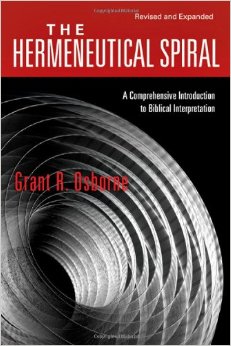
Grant Osborne has popularized an idea known as the ‘hermeneutical spiral’ according to which various elements like exegesis of the text, biblical theology, systematic theology, historic theology, etc. create a ‘hermeneutical spiral’ something like the following admittedly simplistic explanation: